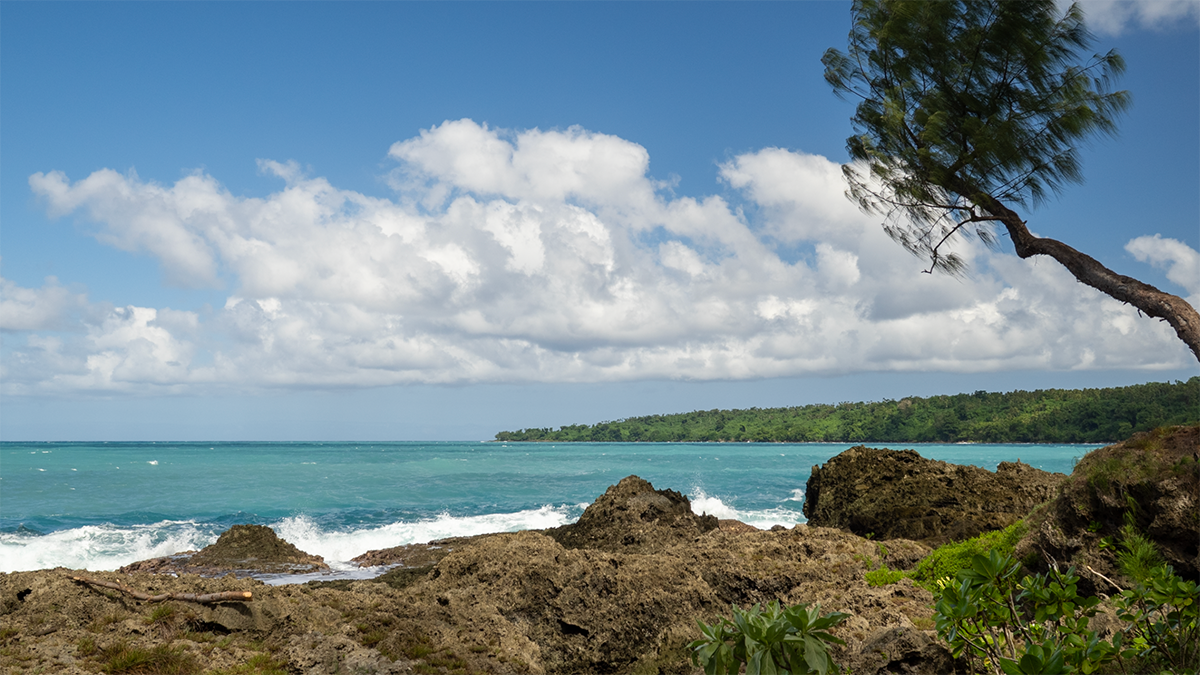
Uplifted coral terraces along the coast of Espiritu Santo preserve a record of past sea level, reef growth, and tectonic motion in the southwest Pacific. Credit: Kaustubh Thirumalai Editors’ Vox is a blog from AGU’s Publications Department. AGU’s Paleoceanography and Paleoclimatology is opening its pages to a new kind of article. Beginning this year, the journal welcomes Research Letters: concise, high-impact contributions that communicate a timely result. Capped at 12 publication units—note that one unit is approximately 500 words or one figure or table—this format is designed to accommodate compact, consequential scientific advances in our field. This year marks four decades since the first volume of Paleoceanography appeared in 1986, under the founding editor, James Kennett. In the years since, the field has grown from a focus primarily on marine sediments into the integrative Earth system science we know today. In 1992, the “Paleoceanographic Currents” format was introduced under the editorship of Kenneth Miller, recognizing that some contributions “generate a great deal of interest” precisely by being concise and current. In today’s voluminous age of publishing, the need for brief, focused submissions has only increased. What kind of articles are suited to a short-format Research Letter? We envision that this format can briefly communicate a broad array of research within the scope of Paleoceanography and Paleoclimatology. These may include proxy advances, drilling approaches or sampling strategies that enable more detailed and robust reconstructions. Scientific ocean drilling has always sat at the heart of this journal, and Research Letters offer an outlet for extracting exciting results from expeditions and fresh perspectives on legacy cores and data. This format is also well-suited for critical discoveries in chronology, stratigraphic correlation, or numerical analysis of syntheses that may be effectively communicated in a shorter format. Research Letters can also introduce a compact mechanistic or statistical model, or results from climate simulations and proxy comparisons that help test a hypothesis or establish a useful benchmark for the field. Research Letters may also be an ideal vehicle to communicate timely paleo perspectives on unfolding climate events. For instance, major El Niño events, marine and terrestrial heatwaves, unusual monsoon seasons, ice calving and coral bleaching events, droughts, or circulation extremes can create a window in which insights from past climates become especially relevant. Alternatively, these events may provide opportunities to address the sensitivity and fidelity of proxy calibrations under extreme scenarios. Short-format articles connecting recent events to a well-constrained paleoclimate analog, proxy archive, or model experiment can help place present-day extremes within a longer Earth-system context. Paleoceanography and Paleoclimatology will now join other AGU journals (including Geophysical Research Letters, Geochemistry, Geophysics, Geosystems, and Earth and Space Science) that welcome Research Letters. The Research Letters format is ideal for significant results that are immediately useful to the community. Authors can also benefit from AGU’s manuscript transfer process, making it easier to find the right journal home for concise contributions. Research Letter submissions will undergo the same rigorous peer review as all articles published in the journal. The shorter format can help methodological and interpretive advances stand out and be adopted more readily across the myriad subfields of paleoceanography and paleoclimatology. We welcome submissions of Research Letters that present a clear, self-contained result within the scope of our journal. —Kaustubh Thirumalai ([email protected], 0000-0002-7875-4182), Department of Geosciences, University of Arizona, Tucson, AZ, United States, Ursula Röhl (0000-0001-9469-7053), MARUM – Center for Marine Environmental Sciences, University of Bremen, Bremen, Germany, and Sarah J. Feakins (0000-0003-3434-2423), Department of Earth Sciences, University of Southern California, Los Angeles, CA, United States Citation: Thirumalai, K., U. Röhl, and S. J. Feakins (2026), Introducing Research Letters in Paleoceanography and Paleoclimatology, Eos, 107, https://doi.org/10.1029/2026EO265030. Published on 12 August 2026. This article does not represent the opinion of AGU, Eos, or any of its affiliates. It is solely the opinion of the author(s). Text © 2026. The authors. CC BY-NC-ND 3.0Except where otherwise noted, images are subject to copyright. Any reuse without express permission from the copyright owner is prohibited.
Introducing Research Letters in Paleoceanography and Paleoclimatology
Full Article
Original Source
Read the full article at Eos →KhanList aggregates and links to publicly available news content. We do not host full articles from third-party sources. Always verify important information with original sources.