
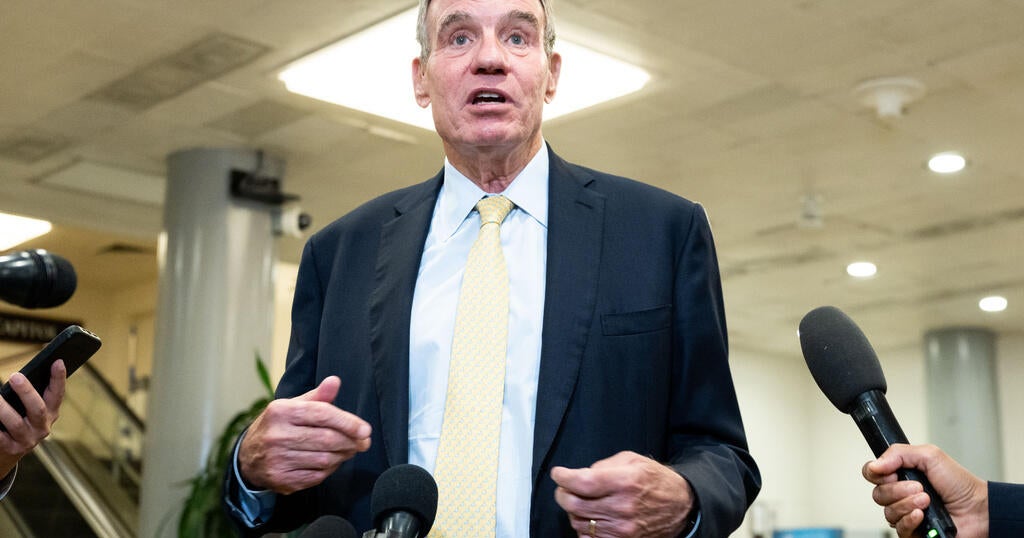
By Olivia Gazis covers intelligence and international security matters for CBS News. Twice Emmy-nominated, she has traveled worldwide with the secretary of state and contributes reporting on intelligence, foreign policy and other security topics across CBS News broadcast, radio, online and streaming platforms. Read Full Bio October 23, 2026 / 5:26 PM EDT / CBS News Add CBS News on Google The top Democrats on the House and Senate intelligence committees say they are preparing for the possibility that President Trump makes claims of foreign interference to challenge next month's midterm elections.The lawmakers said recent intelligence assessments show no indication of foreign efforts to manipulate voting machinery or vote counts. But Mr. Trump and his allies have an established history of raising claims about voter fraud and election interference.Sen. Mark Warner of Virginia and Rep. Jim Himes of Connecticut said this week they have asked CIA Director John Ratcliffe and Director of National Intelligence Jay Clayton to be reachable by phone on Election Day, seeking direct access to the senior intelligence officials who could help verify, in real time, any claims of foreign interference made by the president or his administration."What we can demand is, what is the basis of this intelligence? What is the source of this intelligence?" Warner said."We're making the assumption that the president is not going to accept the results of what looks to be a very challenging election for him and his party," Himes told reporters on Wednesday. "There's a wide array of scenarios that we have war-gamed and trained for."The lawmakers, who could become chairmen of their respective committees if Democrats win control of both chambers in November, said they are concerned Mr. Trump could cite fabricated or selectively presented intelligence to cast doubt on election results or justify extraordinary federal intervention, potentially including attempts to seize ballots or voting equipment.Himes added, however, that recent meetings with career intelligence officials had given him confidence that analysts would resist pressure to manufacture evidence of foreign interference. In a July prime-time address, Mr. Trump cited declassified intelligence about China's acquisition of American voter data to raise concerns about election security. The material he released did not show that Beijing had altered votes or election results, and it is not clear how much of the voter data acquired by China was publicly available, though the White House has said it included nonpublic data.A spokesperson for the Office of the Director of National Intelligence told CBS News that Clayton, since his confirmation in July, "has made it clear to the leadership of the House Intelligence Committee and Senate Select Committee on Intelligence that he is available to them 24/7 on any issue."A CIA spokesperson said: "Director Ratcliffe is responsive to CIA's Oversight Committees and will continue to be available as appropriate."CBS News has reached out to the White House for comment. The lawmakers' preparations come as the intelligence community continues to track foreign influence operations aimed at American voters, but to date has identified no evidence of plans to interfere with the mechanics of the election, Warner and Himes said.The intelligence community distinguishes between foreign influence, which is aimed at swaying voters or undermining confidence in elections, and interference, which involves targeting the technical aspects of voting, including voting machines and registration systems."Nothing out there suggests that there is either the capability or the intent to do interference," Himes said, contrasting that assessment with a "pretty robust influence environment."He said recent intelligence assessments had observed influence efforts underway by Russia, Iran and China, with a "grab bag" of other actors, including North Korea, weighing potential action.Warner said Russia was pursuing operations this cycle "similar to prior occasions," including efforts targeting Democrats. Himes added that Russian campaigns "are also particularly focused in a bipartisan way on people and things that have been aggressive on Ukraine."Iranian actors are "looking at disruption in Europe," Warner said, while Chinese operations have been more selective and aimed at local races.Ahead of the 2024 election, U.S. intelligence officials assessed that Moscow favored Mr. Trump's candidacy, while Tehran favored his Democratic opponent, Kamala Harris. Iranian operatives were also accused of targeting presidential campaigns through cyber operations, including the compromise of Mr. Trump's campaign. The U.S. intelligence community also found that Russia tried to influence the 2020 election to support the Trump campaign, while Iran sought to denigrate the Trump campaign. Intelligence agencies found "no indications that any foreign actor attempted to alter any technical aspect of the voting process," including voter registration or vote-counting.Warner and Himes said Congress has yet to receive several election-related intelligence assessments required by law, including reports due 120, 60 and 30 days before Election Day. The committees received a classified update this week, and the House panel expects another bipartisan briefing next week.They blamed the overdue updates on the tenures of Clayton's predecessors at ODNI — Tulsi Gabbard and Bill Pulte, who held the role in an acting capacity."The previous two DNIs had zero interest in complying with the law here," Warner said, while acknowledging that Clayton had made an effort to address some of the deficiencies.The lawmakers also expressed concern about what they described as a weakening of the federal government's capacity to detect and counter election threats, with reductions to the Foreign Malign Influence Center at ODNI, as well as a significant staffing reduction at the Cybersecurity and Infrastructure Security Agency, which helps state and local officials protect election infrastructure.Himes warned that the loss of technical expertise could undermine the government's ability to detect foreign threats, even if career intelligence analysts remain committed to producing objective assessments."You can do a lot of work with loyal analysts at ODNI or at CIA," Himes said. "If you don't have the technical talent to identify technical — either collection or exploitation — you have a huge problem." White House doubles down on Trump's baseless election interference claims 02:48 White House doubles down on Trump's baseless election interference claims (02:48)
Intel Democrats on how they'll react if Trump alleges election meddling
Full Article
Original Source
Read the full article at Cbsnews →KhanList aggregates and links to publicly available news content. We do not host full articles from third-party sources. Always verify important information with original sources.