
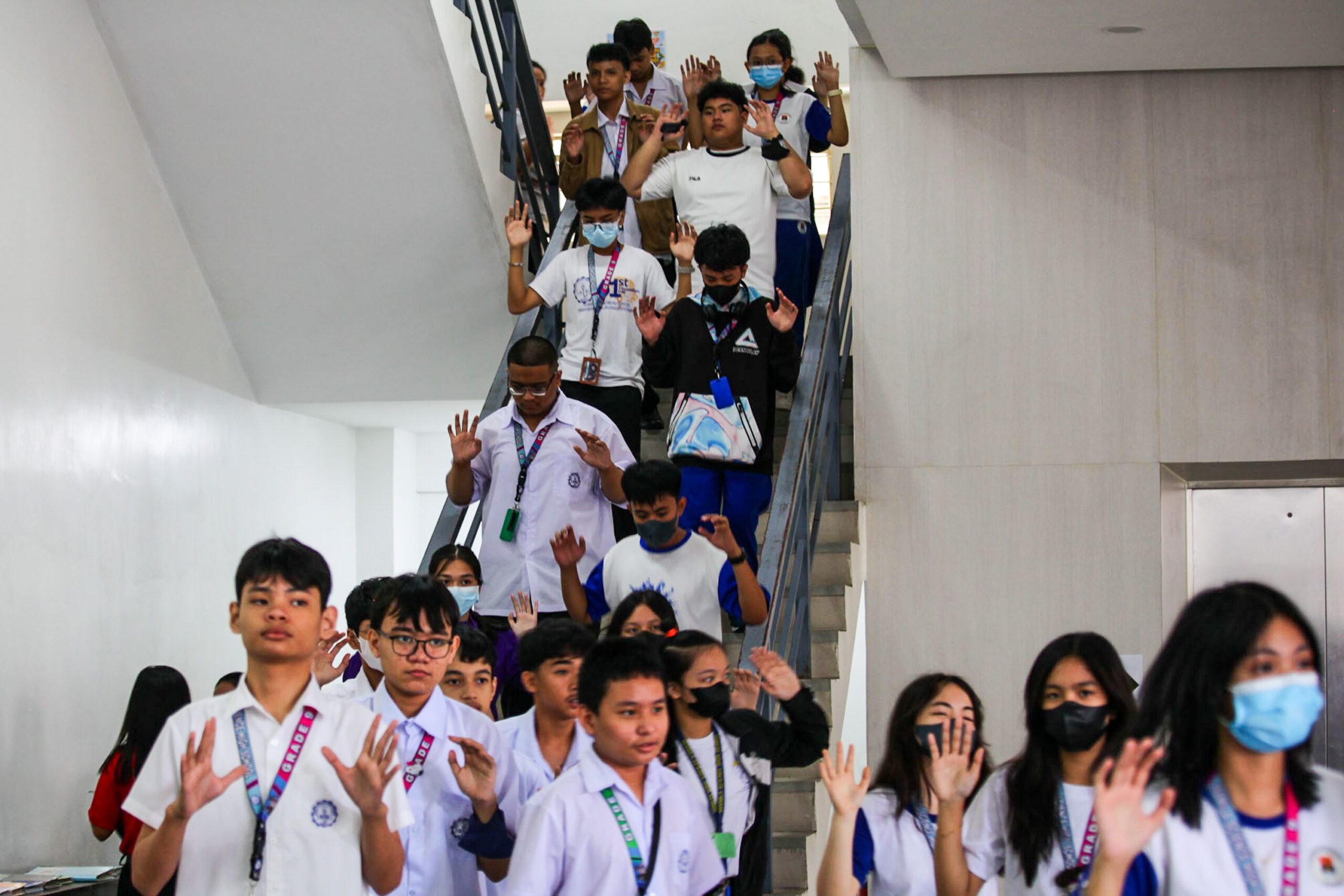
The Department of Education postponed a nationwide active shooter drill in schools following concerns from medical groups. Experts recommended that schools conduct needs assessments and adopt discussion-based activities instead of simulations that could frighten children. This is AI-generated. Read the article for full context. Report any errors. MANILA, Philippines – The Department of Education (DepEd) heeded the calls of some medical groups to postpone the nationwide active shooter drill initially set in public and private schools for Tuesday, August 25. The Philippine Psychiatric Association (PPA), the Philippine Society for Child and Adolescent Psychiatry (PSCAP), and the Philippine Pediatric Society (PPS) warned that there is currently no evidence showing that simulations prevent attacks from happening. For them, the planned nationwide exercise could only expose students to “hyperrealistic scenarios of violence” and cause lasting psychological harm, especially since it would be held just a week after the August 18 tragedy at Ateneo de Zamboanga University’s junior high school campus. Here’s what the medical experts recommend instead: Assess schools first For the PPA and the PSCAP, schools should conduct their own needs assessment to ensure that the “unique characteristics” of their communities are taken into account when planning safety exercises. The PPS said schools must conduct an inventory of their own structural and operational safety measures, including access controls, doors and locks, alarm and communication systems, evacuation and shelter areas, family-reunification procedures, trained response teams, and available medical and psychological support. General findings, except details that could compromise security, and corrective plans must be reported to families and personnel. Back in July, the DepEd conducted a school safety audit and found that many public schools in the country still lack security guards and CCTV cameras. Consider discussion-based activities The PPA and the PSCAP said schools can adopt tabletop exercises, where teachers, staff, and parents discuss “what if” scenarios to “build coordination and preparedness without frightening children.” Discussions must include who will lock doors when there’s an intruder, who will call the parents in such situations, and where students should go. “Participation should be inclusive, with accommodations for learners who have disabilities, sensory-processing needs, or prior trauma,” the groups said in a joint statement. The PPS also said discussion-based activities may be the safer option for communities that were recently affected by school violence or other serious incidents, as experts must conduct mental health assessments first. No surprise, simulated gunfire in drills Experts also urged the DepEd to hold safety drills using “trauma-informed approaches.” For the PPS, this means that schools should announce when a drill is going to be held. Parents and guardians should be given advance notice about the activity, and there must be a clear option to request modified participation or exemption for their children. The group said children should receive age-appropriate explanations and be allowed to pause or stop participating in drills. “Drills must not use deception, surprise, simulated gunfire, realistic weapons or injuries, or aggressive attacker role-play,” it said in a statement. “Children should not be instructed or expected to confront or stop an attacker as part of a drill. Any discussion of physical resistance should be approached cautiously and tailored to the learner’s age, developmental capacity, physical ability, and circumstances.” There must be a calm debriefing after the drill, with school authorities monitoring students for any distress and providing appropriate support. National guidance on drills The PPS stressed that drills must be supported by the full and consistent implementation of the DepEd’s child protection policy, including prompt connection of children at risk to appropriate services for mental health, social welfare, and law enforcement, among others. “Prevention also requires trusted adults, responsible media and online practices, and the safe storage of firearms and other weapons,” the group said, noting that there must be a comprehensive prevention strategy. It also pushed the DepEd to convene a multidisciplinary and multisectoral technical working group, involving various experts and representatives of parents and the youth, to craft guidance on drills based on international evidence and the country’s context. For the PPA and the PSCAP, a mental health task group can be formed by the DepEd, Department of Health, and medical groups to generate Philippine-specific outcome data before scaling the drills nationwide. What happened before The DepEd memorandum that directed the now-postponed August 25 activity had listed the needed preparations for schools, telling them to coordinate with authorities and invite one external evaluator. The agency also gave schools various educational materials related to the drill. It was supposed to be the first time for the activity to be conducted nationwide. The DepEd mounted its first active shooter drill at Manila Science High School in July. The school went through the drill twice, days before it was overseen by Education Secretary Sonny Angara and other DepEd officials on July 15. During the drill, an individual pretended to be an intruder, carried a toy gun, and went to classrooms and other facilities. He was dressed in black, with an “active shooter” label on his body. Some students told Rappler they felt fear when the drill was conducted for the first time. “Unusual” and “shocking” were also some of the words they used to describe their experience. – Rappler.com
Instead of active shooter drills, here’s what experts recommend for schools
Full Article
Original Source
Read the full article at Rappler →KhanList aggregates and links to publicly available news content. We do not host full articles from third-party sources. Always verify important information with original sources.