
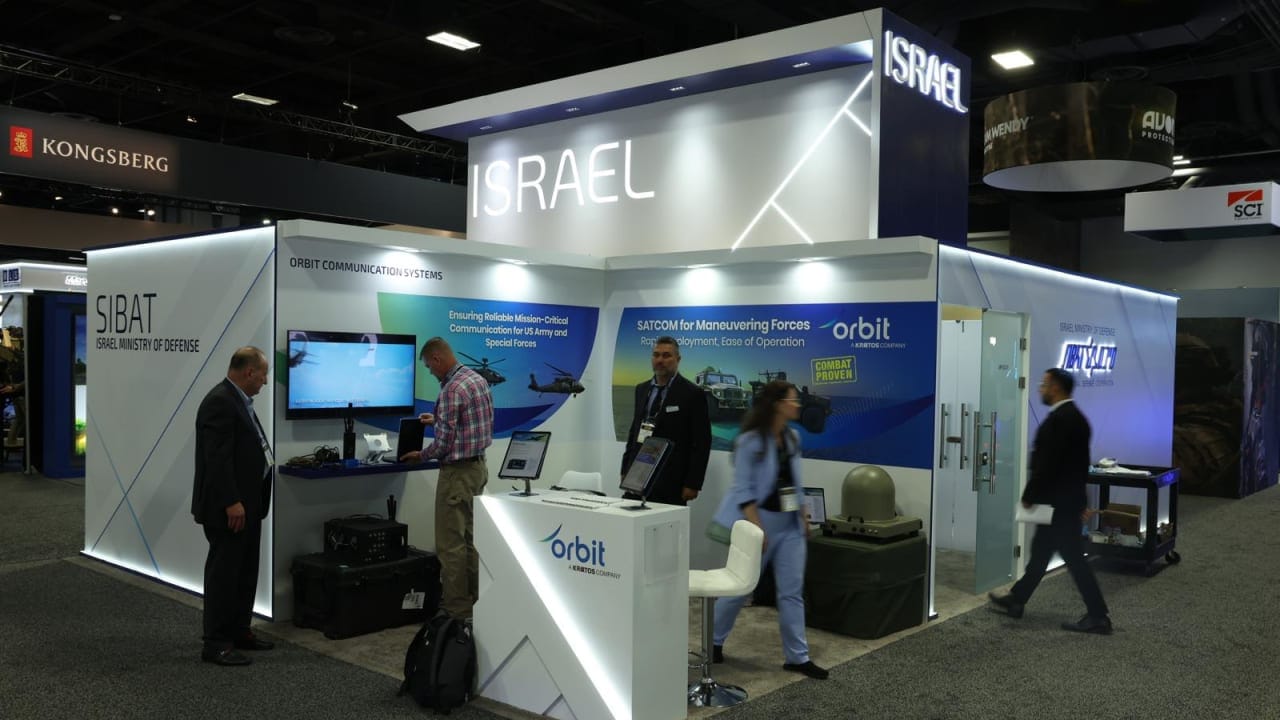
OCTOBER 19, 2026 16:39Updated: OCTOBER 19, 2026 17:18WASHINGTON — The US defense industrial base is a world of its own. Major contractors, military acquisition offices, government agencies, investors, and established networks of decision-makers can make it difficult for even the most promising start-up with battle-proven solutions to know where to begin.Breaking into the US defense industrial base is not only a matter of showing up with battlefield-proven technology. It is a maze of prime contractors, acquisition offices, government agencies, and entrenched networks that can shut out even the most established Israeli start-ups. CET Sandbox arrived at AUSA determined to change that.More than 60 Israeli founders spent the week in Washington in a program built to give them what most lack: access. Instead of wandering the vast exhibition halls hoping for chance encounters, CET Sandbox moved them directly into private receptions, curated introductions, and closed-door conversations with the people who actually shape US defense procurement.The premise is simple. Israeli companies often bring technology validated under real operational conditions, but translating that into American contracts requires a different playbook, one built on relationships, timing, and an understanding of how the US system makes decisions. CET Sandbox is trying to give Israeli founders that playbook.One of the side events held by CET Ventures at AUSA in Washington in October 2026 (credit: ANNA AHRONHEIM)“We're extremely happy with how AUSA went,” David Yahid, co-founder and chief operating officer of CET, told Defense & Tech by The Jerusalem Post. “Seeing the founders connect with the US ecosystem was exactly what we hoped for, and the level of engagement from the US side made it clear that we're only just beginning to build this bridge with Israel.”The week placed Israeli entrepreneurs in front of major defense contractors – Anduril, Lockheed Martin, Northrop Grumman, BAE Systems – alongside investors, government representatives, and industry specialists. The goal was to help Israeli founders become better equipped to do business in the United States and understand who matters, how decisions are made, and what it takes to move from a promising demo to an actual program of record.From Israeli innovation to American adoptionAvner Bendheim, co-founder and CEO of Tenna Systems, brings a particularly relevant perspective to that challenge.Bendheim served in an elite unit operating advanced signals intelligence systems (SIGINT). He also helped establish the Israel Air Force’s space program and served as the program director, operational requirements department. He now leads Tenna, whose battlefield-tested software is designed to safeguard wireless-dependent systems across defense, aerospace, and mobility sectors, domains where connectivity has become both indispensable and dangerously vulnerable.“The whole Israeli defense tech ecosystem is figuring out its go-to-market,” Bendheim told D&T. He explained that with all the various programs and individuals, “CET helps to understand who to engage, how to engage, and when to speak with them.”According to him, “CET is doing a great job for the companies here and the Israeli ecosystem. It’s a whole different ballgame here in the United States than in Israel. They have been able to put all stakeholders in the same room and you get to know them all.”“The US Department of War is a multiheaded beast, and even if the technology is operationally deployed, there is a lot of work,” he said. “The DoW is going through its own tectonic shifts in how it acquires and deploys technology.”Israel’s defense-tech ecosystem has developed around close connections between military users, entrepreneurs, established defense companies, and investors. Meanwhile, the US market is much larger, more fragmented, and more difficult for an outsider to navigate.Echoing Bendheim, Elad Amar, the CEO of Pyrrhus Aeronautics said that CET has helped him and his company understand the American ecosystem."The ecosystem here is a beast that can be hard to penetrate and maneuver within. CET helps us with a strong balance of operators, investors and venture capitalists."Pyrrhus was conceived by Amar when he was behind enemy lines in the Gaza Strip and saw troops dropping their weapons when trying to operate drones. The technology, Laser Aiming & Drone Remote System (LADRS), can be mounted on a rifle and allow troops to operate drones without removing their hands from their gun.While it has already been used in special Israeli army units as well as by the US Special Operations Command, in the US Army and the Marines, Amar told D&T that CET has "been extremely useful for startups like us."Elad Amar, Co-Founder & CEO of Pyrrhus Aeronautics (credit: ANNA AHRONHEIM)The right connections can change the equationThe combination of operational experts, investors, and venture capitalists can be particularly useful for founders trying to identify the right next steps for their businesses.Naama Zamir of Sealartec told D&T that CET understands the value of bringing together people who can help start-ups comprehend what they need to do to raise capital, reach customers, and grow. “CET helps us make the right connections and helps us realize what questions we need to ask,” she said on the sidelines of AUSA.Sealartec is an Israeli company founded in 2018 and based in Haifa that specializes in Autonomous Launch and Recovery Systems (ALRS) designed for both manned and unmanned surface vessels using a patented bow-capture system. The autonomous solution uses local positioning, onboard sensors, and smart algorithms to locate, identify, and physically connect with returning USVs in even challenging sea conditions.The company has collaborated with major industry players such as BAE Systems, Elbit Systems, and Israel Aerospace Industries.But it’s not always about connecting with the primes. Daniel Ferber of RFix highlighted to D&T the importance of connecting smaller companies with investors and local businesses that can help them establish themselves in the American market.“CET brings inside information to the ecosystem and helps us make the right connections,” he said. The early-stage start-up already has customers, but Ferber said that events like the ones held by CET “bring in the right people to connect with the right investors, local companies, and more.”RFix, an Israeli telecommunications and defense technology company, develops a terrain-aware RF (radio frequency) signal simulation platform. Co-founded in 2025 by Ferber and Bar Harel, the Tel Aviv-based company provides software infrastructure used by wireless engineering, aerospace, and defense teams.For these start-ups, such relationships can provide a route into an ecosystem that might otherwise appear inaccessible. They can also help founders understand the expectations of American customers and partners before committing time and resources to expansion.The objective is to help companies make informed decisions about how to enter the market, rather than expecting them to learn every lesson through trial and error.Building an American presenceOmer Sharar, CEO of InfiniDome, offered a perspective on the practical work involved in establishing a foothold in the United States.InfiniDome has been working with CET Sandbox for around two years, developing relationships and learning how to navigate the American ecosystem. But, Sharar told D&T, “we are just starting to scratch the surface of the American market.” Sharar added that CET has built a “very unique ecosystem. Up until now, no one has had a recipe for breaking into the US defense ecosystem. CET is giving us the knowledge of how best to break down the barriers.”For Israeli start-ups, this can be an important part of preparing for US customers and partners. But it requires founders to think beyond their technology and consider the structure, relationships, and resources needed to operate in a new market.US Defence Secretary Pete Hegseth participates in a panel on Project Agincourt, an initiative about autonomous warfare (credit: REUTERS)Relationships that outlast AUSAThe program’s significance extends beyond a week of meetings in Washington.Yahid told D&T that “events like this, where we work with our partners to create private receptions and networking events that let the conversation go beyond the quick intros on the floor and actually start to build real relationships, showed the primes exactly what the potential is. We came away with significant demand from US primes for more and deeper engagement with the Israeli ecosystem, and a clear signal of willingness from the US side to explore what comes next.”AUSA brings together a vast cross-section of the American defense establishment, but attending the exhibition does not automatically provide access to the people who matter most. For a start-up without established US relationships, identifying the right contacts and securing meaningful conversations can be a substantial undertaking.CET Sandbox seeks to change that equation by preparing founders before the event and organizing opportunities to meet relevant stakeholders during and after the exhibition.Its program included preparatory work in Israel, private receptions during AUSA week, and a closed forum with leaders from the defense industrial base. The emphasis was on giving founders a clearer strategy for entering the market, not simply maximizing the number of meetings they attend.The real measure of success will be what happens next: whether introductions lead to investment, commercial partnerships, testing opportunities, and eventually contracts.For Israeli start-ups, that process can determine whether a technology remains a promising capability or becomes the foundation of a scalable international business.The American defense market is enormous, but its complexity can be daunting for companies entering it for the first time. By connecting Israeli founders with experienced people across that ecosystem, CET Sandbox is trying to make the market more accessible and help Israeli innovation find a path from the battlefield to the broader US defense industrial base.Follow us on Google
Inside the US defense giant: CET Sandbox helps Israeli founders find their way in America
Full Article
Original Source
Read the full article at Jpost →KhanList aggregates and links to publicly available news content. We do not host full articles from third-party sources. Always verify important information with original sources.