
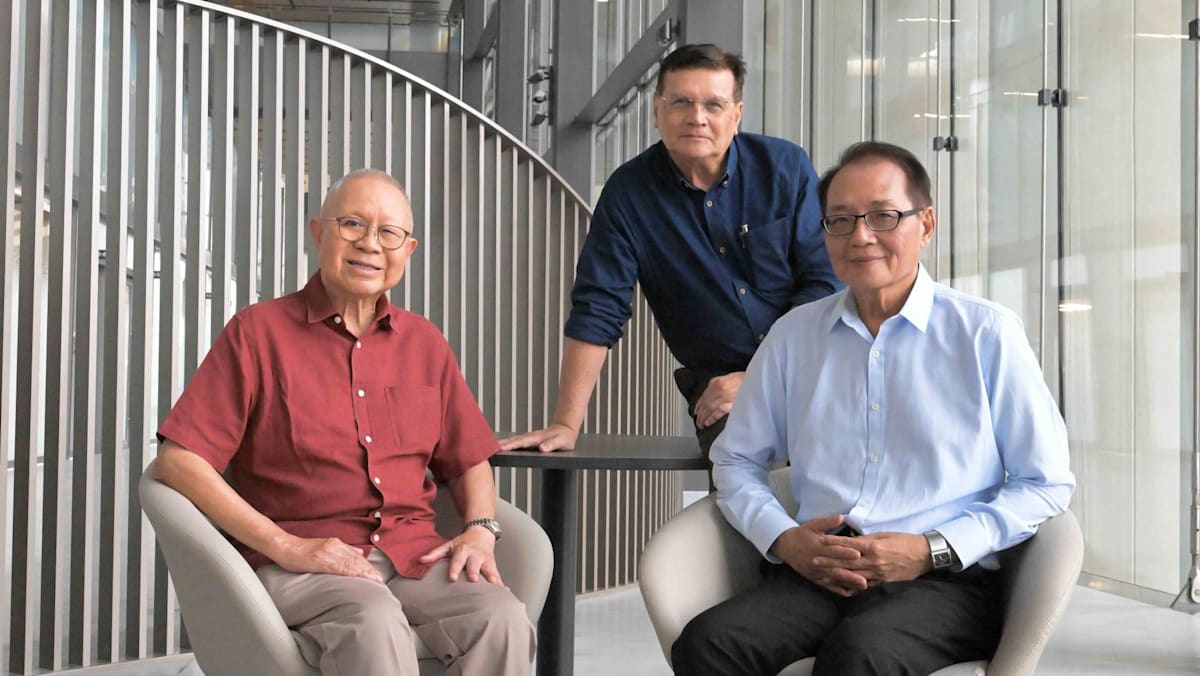
SINGAPORE: Most military officers wear their medals on their chests.But as a government official once told Mr Kevin Santa Maria, officers from the Security and Intelligence Division (SID) wear their medals inside their jackets – hidden from view, much like the work they do.A former SID chief of staff, Mr Santa Maria spent over two decades at the top-secret agency under the Ministry of Defence. He said its officers took pride in doing important work in the shadows to keep Singapore safe.They were satisfied knowing they were part of a team working towards something bigger than themselves. President Tharman Shanmugaratnam with Mr Eddie Teo at the latter's swearing-in and reappointment as Chairman of the Council of Presidential Advisers on Sep 29, 2023. (Photo: Facebook/Tharman Shanmugaratnam) Last month, former SID director Eddie Teo was conferred Singapore’s highest civilian honour, the Order of Temasek (With Distinction), Darjah Utama Temasek, at the National Day Awards. He was recognised for his 56 years of public service, including 24 years at SID. He joined the agency in 1970 and went on to become its longest-serving director from 1979 to 1994.During his tenure, officers were not handed their awards at such public events – something he regrets to this day."For a very long time, that was one mistake I made. I did not allow them to get National Day Awards because I thought there was a security risk," said Mr Teo, now 79."But wiser directors who came after me changed that policy, and I'm glad that now the good officers in SID can be given National Day Awards." (From left) SID’s former senior director of counterterrorism Ng Kah Meng, former chief of staff Kevin Santa Maria and former director Eddie Teo on Aug 13, 2026. (Photo: CNA/Lim Li Ting) Established in 1966, SID started out as a small team providing geopolitical analysis before growing into an intelligence agency.Besides providing intelligence to the government, it supports discussions on key strategic issues and analyses global developments that could affect the country’s security and national interest.Like the US' Central Intelligence Agency and the UK's Secret Intelligence Service, more commonly known as MI6, SID falls "within that same genre" in terms of collecting information, said Mr Santa Maria. Since its inception, the agency has operated in the shadows, shrouded in secrecy, to keep Singapore safe from external threats. Little information is published online about the agency.But in 2021, it took a rare step into the public eye, launching a website to recruit more mid-career professionals. The agency marks its 60th anniversary this year. Mr Teo, Mr Santa Maria and former senior director for counterterrorism Ng Kah Meng spoke with reporters for the first time about the work they did behind the scenes. SID celebrates 60th anniversary SID marked its 60th anniversary with a closed-door event on Friday (Sep 4) to honour the contributions of both present and past officers. Prime Minister Lawrence Wong attended the event and was joined by Senior Minister K Shanmugam, Defence Minister Chan Chun Sing and Senior Advisor in the Prime Minister’s Office Teo Chee Hean.Speaking during the event, Mr Wong highlighted the value SID has provided to Singapore's leadership and the agency's unique contributions to the nation's security and success over the years."Over the past 60 years, SID has played important roles at critical junctures in Singapore’s history. There are many others which may never enter the public record, and will not be discussed, even in a closed-door setting like this," Mr Wong said during a speech."But through all of them, SID has helped successive generations of Singapore leaders see the world more clearly – identify threats early, understand the intentions of others, and make difficult decisions with greater confidence."He also expressed appreciation to past and present SID officers, including pioneer leaders such as former SID directors Mr Tay Seow Huah, Mr S R Nathan and Mr Eddie Teo.Looking ahead, he said the agency's work would become more demanding and more important in a changing external environment, with more things to watch for such as shifting relationships, new restrictions and future vulnerabilities.The boundaries between security, economics and technology are also becoming less distinct, he said, adding that trade, investment, supply chains and access to technology are "increasingly being used as instruments of statecraft".Mr Wong encouraged the agency to continue sharpening its edge to keep Singapore safe and ahead. "We need to understand not just what countries are saying and doing politically, but also how they may use all sorts of different levers, economic and technological levers, to advance their interests."SID must therefore help us understand these shifts early, assess what they mean for Singapore, and give us the foresight to prepare and respond," said the prime minister.He also said the agency must continue to attract and retain people with sharp minds, sound judgment, deep expertise and a strong sense of mission for the country."SID has truly come a long way over these past six decades. From a small group of pioneers working quietly after hours, you have grown into a professional and capable intelligence service," Mr Wong added."For a small country like Singapore, that ability to anticipate, understand and act early is a vital source of strategic advantage. And you help contribute to this strategic advantage." Collapse Expand THE JOBFirst off, they are not spies, said Mr Santa Maria. Television shows and movies may have shaped how people view intelligence work, especially given SID's low profile."But actually, it's far from that. It is not as dramatic as what comes out; it's good for a movie and a TV show, but what we really do is actually quite different," he said.The word “spy” has negative connotations, he added.“We are an intelligence agency that provides information … The word 'spy' is too overdramatised, which I would not want to define (the) agency as,” said Mr Santa Maria. SID’s former chief of staff Kevin Santa Maria on Aug 13, 2026. (Photo: CNA/Lim Li Ting) Over the past 60 years, the threats the agency faces have evolved.When Mr Teo joined the agency in 1970, one of the first issues he dealt with was the Communist Party of Malaya, which wanted to overthrow the government through violent revolution and establish a communist state in Malaya.Riots in Kuala Lumpur were a pressing issue. "That seized us because racial politics became very important, and we were worried about spillover into Singapore," said Mr Teo.He also anticipated that terrorism would grow and he formed a small group within SID to study the issue.Eventually other agencies joined, including from the Ministry of Foreign Affairs and the Internal Security Department. Leading this larger group was Mr Ng.After terrorists hijacked four commercial passenger planes on Sep 11, 2001, crashing two into the World Trade Center towers in New York, senior leaders in the Singapore government realised terrorism was "no longer a policeman's problem", said Mr Ng."It is a problem of strategic proportions. So in SID, we took it upon ourselves to issue a series of assessments, explaining to the Cabinet what this was about. Where did it come from? Why did it happen in this way?"That was a start (to) ramping up furiously our counterterrorism coverage," said Mr Ng, adding that the coverage was a shared responsibility between several senior leaders in the agency.The same year, Singapore had one of its closest shaves with transnational terrorism, when the Jemaah Islamiyah (JI) terrorist group targeted Singapore.Authorities launched an operation that crippled the Singapore JI network, thwarting multiple terror plots against the country."When we were dealing with the JI threat, that came home to us in a very big way, because the threat was imminent," said Mr Santa Maria."We were facing something that could hit us anytime, anywhere. You can imagine that happening in Singapore – the implications (would be) catastrophic – and that really kept us awake."SID's job was to assess where the threats were coming from externally and it worked closely with ISD, said the 66-year-old."I will always remember that because … it wasn't like two weeks; it was years of hard work to finally find them and bring them back, and a lot of professional coordination." Since the early 2000s, the terrorism landscape has evolved with lone-wolf actors emerging as a growing threat alongside coordinated group terror plots. Self-radicalised individuals have become a big concern, including for Singapore.In late July, ISD said it detained three self-radicalised teens, with two of them planning attacks on schools in Singapore. One came within weeks of carrying out his killings."Our vigilance towards these threats can never completely go away, even though prioritisation of resources and so on and attention may change over time in response to the changing conditions," he said."But so long as the world has zones of conflict and these zones of conflict become magnets to attract people to want to go and become trained, and then they become emboldened because they are now empowered with the ability to do things when they come back to the region. So that is something that we really have to keep being vigilant about." SID’s former senior director of counterterrorism Ng Kah Meng on Aug 13, 2026. (Photo: CNA/Lim Li Ting) All three men agreed that the fundamental mission of SID remained unchanged - to keep policymakers well-informed on threats to Singapore and provide intelligence assessments that are objective and accurate.Mr Teo said: "Our intelligence assessments were based on facts as we knew them. We were very conscious that we must never twist or change our assessments to fit policy."SID is not a department that formulates policy. It feeds our policymakers objective intelligence assessments, and we will never allow intelligence to be politicised." Listen: In 2021, when SID launched its website and stepped further into the public eye, the agency received a 50 per cent increase in applications from young graduates and mid-career professionals, said Mr Santa Maria.After 2021, more mid-careerists started coming in, he added."It kind of shifted the DNA of SID,” he said, with people bringing different views from diverse fields such as law, media and communications."That gave us a very rich perspective of what's going on outside there, and I think that's where SID has basically enriched itself in its talent of being able to do better work."Those who join the agency must truly be interested in the intelligence business, he added. "We go through a lot of stress. It's intense. It gets you down. It's tiring," he said.Officers sometimes have 12- to 15-hour working days. Despite the demands, it is their sense of mission and purpose in serving Singapore at a "very special organisation" that keeps them going, Mr Santa Maria added. The Security and Intelligence Division's website was launched in 2021. WORKING WITH MR LEE KUAN YEWWhen Mr Teo became SID director in 1979, Mr Lee Kuan Yew was prime minister. Mr Lee worked directly with the agency and would call Mr Teo."I can tell you very few public servants have that privilege … The experience of working under these legends is something that is difficult for me to explain to you, but you have to be there," he added.Mr Lee's attention to detail stood out to Mr Ng, who recalled that the founding prime minister would start by asking them a few questions before drilling down on minute details."Part of that is yes, he wants to know the answers, but part of it is to satisfy himself that you are not winging it, that you are not bluffing him, then he can take you seriously," said Mr Ng."It was actually a joy to discuss with him because you know his perspectives are both very broad, but he immediately zooms down, then he zooms up again, and then he switches into decision-making mode based on the facts and the assessments that we give him."Mr Teo also recalled receiving phone calls from Mr Lee at midnight or being told to launch operations on a Friday or Saturday.“Your weekend is gone," the former SID director joked. "Despite all that, it was worth spending all my time in the public service."It was so interesting, inspiring, and the people I worked with showed me that Singapore was in a good place because they were doing all these things – not for the money, not for the power, but to enhance Singapore's well-being and to serve the people of Singapore."Because your bosses behave like that, you also behave like that."Mr Teo took over as director from Mr S R Nathan, who went on to be elected Singapore’s president.He had big shoes to fill when he took over, he said, adding that there were several officers more senior than him.One quality he admired about Mr Nathan was his ability to make friends and sustain those friendships over the years."He's written cards every year to people that he's met 30, 40 years ago, and his ability to persuade and win over people – that's something that I really respect about him."I owe S R a lot, and I will always remember him for what he did for me," said Mr Teo, who later served as chairman of the Council of Presidential Advisers."I hope that the way I ran SID was worthy of his perception of how SID should go," he added. Mr Eddie Teo (left) and Mr S R Nathan during an official trip to Milford Sound, New Zealand, 1972. (Photo: Eddie Teo) SACRIFICES AND RETIREMENT Given the high-stakes situations they were in, how did they find time to rest?They said they got used to the job and eventually learnt to compartmentalise and separate work from everything else."You can't let it affect your life, where half the time, you're looking at behind you, who's watching you, or worrying about the world – that's not a way to live," said Mr Santa Maria.Keeping work from spilling into their personal lives was not always easy. Mr Ng remembered walking out of wedding dinners on at least three occasions after receiving calls about potential threats."It wasn't, say, ‘I had to pull out of a dinner'. It was really, actually wanting to go and do something about it," he said.Even when a call turns out to be a false alarm, any information about threats has to be taken seriously, he added.For Mr Teo, the decades he spent as an officer and later a director came with sacrifices at home - something he is now trying to make up for in retirement."In a way, it's good to feel the sense of responsibility has been lifted from my shoulders. After 56 years, I am now free," he said.His son marked his retirement with a tribute on Facebook, describing it as a new chapter."I was very touched by that, because I know I neglected him when he was young. I never spent the time I should have spent with him. But that's life. You choose what you do, and you can't go back and change things," he said."So I try to make up for it now by spending more time with family." SID’s former director Eddie Teo on Aug 13, 2026. (Photo: CNA/Lim Li Ting) For Mr Ng and Mr Santa Maria, retirement has opened the door to various pursuits.Mr Ng, who retired 10 years ago, now spends his time pursuing his passion for art. While he occasionally painted during his years in service, he now has more time to devote himself to the craft and stocked up on art materials soon after his retirement."It was really very fulfilling because somehow, lucky accidents happened in my art journey," he said. His paintings have been displayed at gala dinners to raise charity for seniors.He has also taken up tai chi.Mr Santa Maria retired last November and has been providing leadership training, publishing a book on the subject. He also caught up on reading and ventured into uncharted territory - LinkedIn.Unsurprisingly, his profile remains deliberately discreet, but he enjoys being on the platform."It's an incredible world on LinkedIn. I didn't know, obviously, but just interacting with people of the same interests and things like that," he said.Looking back, he said: "Do I miss SID? Yes and no. Yes, because nothing gives you that kind of adrenaline. But there must be a time that you need to stop."I kind of miss the work, and yet I don't, because now I am a lot freer to do the things I want to do and pursue things I want to do in the next phase of my life."
Inside Singapore’s secret intelligence agency: Three former SID leaders on threats, sacrifice and service
Full Article
Original Source
Read the full article at Channelnewsasia →KhanList aggregates and links to publicly available news content. We do not host full articles from third-party sources. Always verify important information with original sources.