
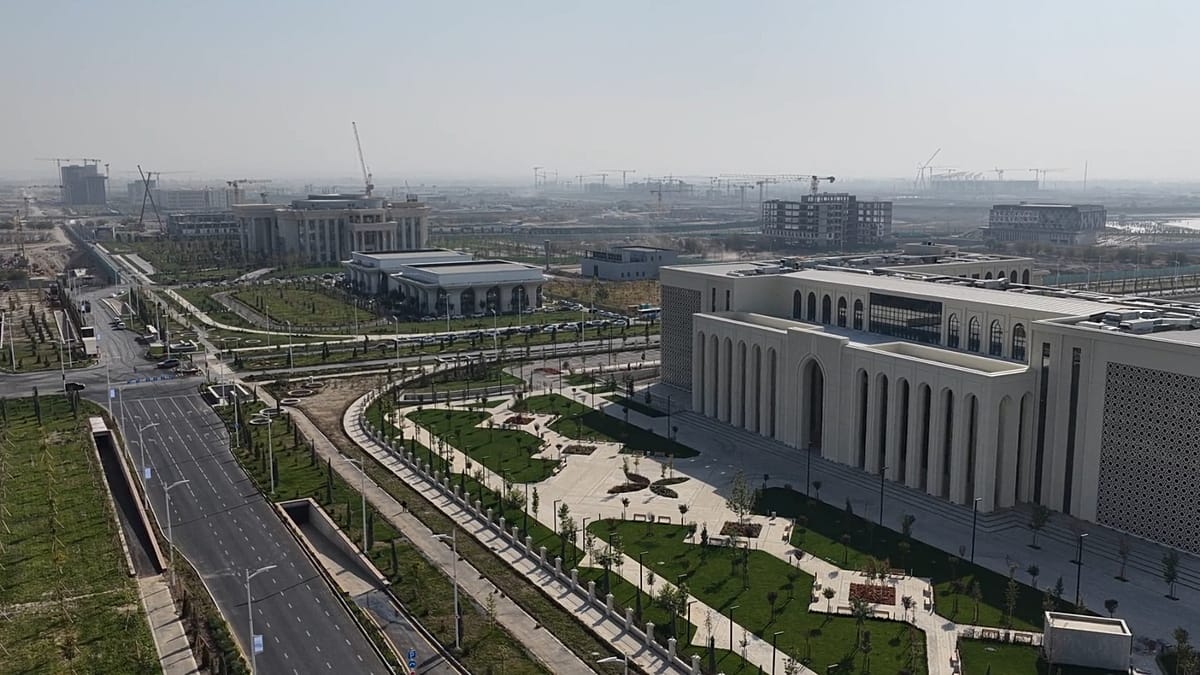
On the eastern outskirts of Tashkent, the capital of Uzbekistan, a new city is being built for up to two million residents. Launched in 2023, New Tashkent is planned as a major economic and administrative centre covering 20,000 hectares. ADVERTISEMENT ADVERTISEMENT The first phase covers 6,000 hectares and is designed for 600,000 residents, with projects worth $50bn (€44.8bn) planned. Authorities say developments worth $2bn (€1.8bn) have been completed, while construction has started on ten more projects valued at $2.5bn (€2.2bn). Drawing international investment "New Tashkent is not just a place for building new housing," President Shavkat Mirziyoyev said in October, describing plans for an independent economic centre bringing together business, education, healthcare, tourism and services. Fifty plots have been earmarked for foreign investors, with proposals set to be shared through Uzbekistan's diplomatic missions. Shohruh Ochilov, an investment specialist at the New Tashkent Directorate, told Euronews the directorate had received delegations from France and Kazakhstan and engaged with companies from China, the United Arab Emirates, Saudi Arabia and other countries. At an October meeting, President Mirziyoyev urged officials to accelerate construction by introducing simpler approval procedures, reducing administrative obstacles and improving investment proposals. New Tashkent's government hub A relocation programme aims to move 150 state bodies and state-linked organisations to New Tashkent, with facilities planned for more than 60 government agencies. The Ministries of Construction, Transport and Energy already operate there. Nine more buildings are under construction to around 2,600 employees. President Mirziyoyev has also instructed officials to begin relocating other ministries and public organisations. "I consider it a great privilege to come to work every day in a city that is still under construction," said Umida Boyzoqova, an adviser to the Minister of Construction. The reorganisation is also intended to make public services more accessible. Elyor Komilov, a deputy department head at the ministry, said its future headquarters would bring departments and related organisations under one roof. "When citizens come to us, whether to submit a request or deal with some official business, they will be able to complete everything they need in one place," he explained. Homes designed for families Nearly 7,000 apartments are complete in Sharq Bahori's first phase, alongside landscaped courtyards and playgrounds. The 95-hectare development is planned to contain almost 15,000 homes. Nazokat Makhmudova, head of marketing at the New Tashkent Directorate, guided Euronews through two show flats: a 63-square-metre apartment with a separate kitchen and a 54-square-metre home with open-plan living space. Both feature panoramic windows and adjustable heating and cooling systems. The flats are delivered fully finished, buyers would not need to undertake major renovations. The developer also says it uses A+ energy-efficient construction materials. Makhmudova also reported interest from elsewhere in Uzbekistan and neighbouring countries. "The main customers for our apartments are people who are purchasing them as an investment in their children's future," she said. Authorities expect 20,000 apartments across New Tashkent to be ready by the end of 2026, with capacity for at least 70,000 people. Universities, culture and sport New Uzbekistan University has opened facilities for 7,000 students, with research buildings and an innovation park planned for its wider campus. Nizami Pedagogical University has opened an academic building for 12,000 students and a laboratory complex; its campus is planned to accommodate 20,000. The new National Library can accommodate 1,500 readers and provides access to digital resources. A $100mn (€90mn), 55,000-seat stadium is being built to FIFA standards for major international football competitions. It is expected to host matches at the 2027 FIFA Under-20 World Cup, co-hosted by Uzbekistan and Azerbaijan, with wider sporting and community use envisaged beyond the tournament. Yasin Uyghur, chief operating officer of contractor KOC Construction, said sourcing heavy machinery had been challenging, while simpler customs procedures had helped with imports. "We are working in two shifts, day and night. We have reached 1,600 workers, alongside more than 50 engineers and architects. International supervisors are working with us as well," he told Euronews. The contractor has set an ambitious 16-month construction target. Transport links to and within New Tashkent Connecting the new city with the capital is central to its transport strategy. Eighteen kilometres of roads are already complete. A proposed 21-kilometre metro line, with nine stations, would connect with Tashkent's existing network and is projected to carry up to 230,000 passengers daily. A new bus service already connects government employees with their workplaces in New Tashkent. Construction has also begun on a bridge across the Chirchik River, while further plans include a ten-kilometre road connection, electric buses, cycling and pedestrian routes, and underground parking. Within the city, the 15-minute city model aims to place schools, shops, parks and basic services within a short walk or cycle of homes, reducing reliance on cars.
Inside New Tashkent, Uzbekistan's planned city for two million people
Full Article
Original Source
Read the full article at Euronews →KhanList aggregates and links to publicly available news content. We do not host full articles from third-party sources. Always verify important information with original sources.