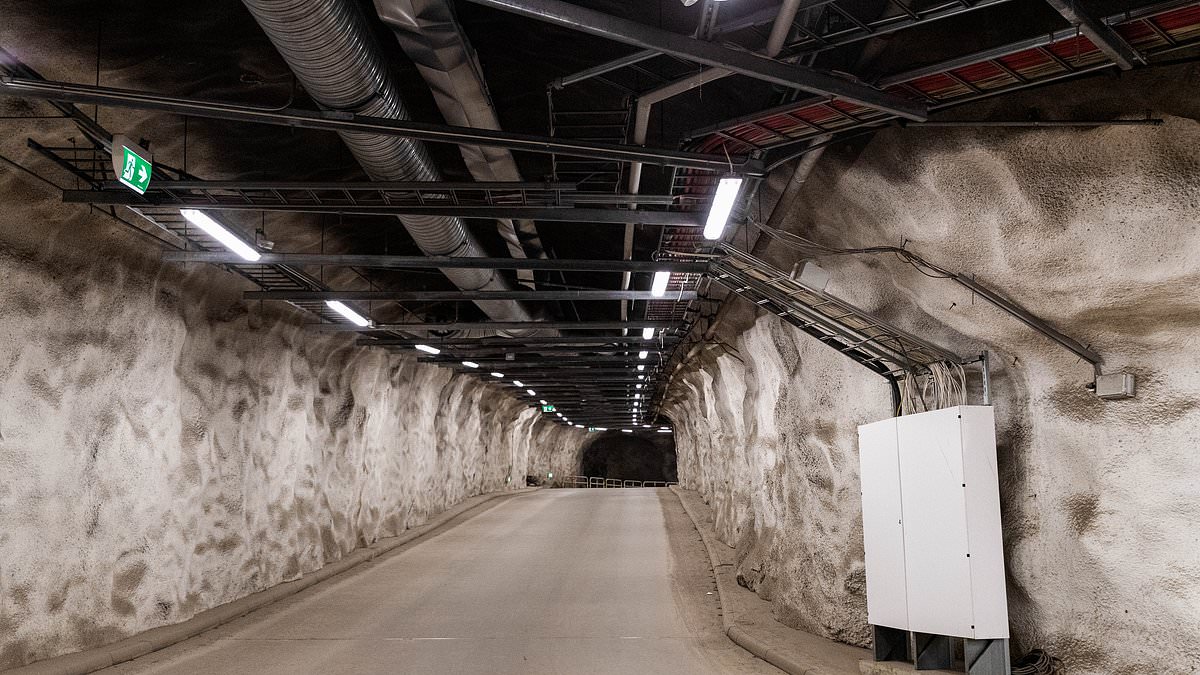
Beneath the countless saunas and coffee shops that populate the streets of Helsinki lies a secret second city, that will lie dormant until disaster strikes. Underneath the Finnish capital, more than 5,500 shelters have been carved into the bedrock, with enough space to hold nearly a million people – a huge number, especially given that the city's population is only 675,000. The country has been continuously building safety bunkers since 1939, when Russia invaded during the Second World War during a protracted conflict known as the Winter War. But since 1954, Finland's government has legislated that a bomb shelter is mandatory underneath buildings exceeding 1,200 square metres (12,900 square feet). Among the biggest of these shelters is Merihaka. At 71,000 cubic metres, the shelter is roughly the volume of a seven-storey office building. It was built in 2003 and has sports pitches, a gym and a children's playground 25m (80ft) underground that are in use daily to allow locals to get used to the idea of staying in it. Should it be needed in an emergency, it can be converted with stores of bunk beds, water tanks and portable toilets within 72 hours.The main entrance consists of two sets of enormous blue blast doors. The first is designed to stop blast waves, while the second protects those inside from chemical, biological and nuclear weapons.The bunker has space for around 6,000 people. A court used for floorball - a kind of indoor hockey - located at the Merihaka shelter in Helsinki An access road at the Merihaka shelter, which measures 71,000 cubic metres or roughly the volume of a seven-storey office building Locals at the Itakeskus Swimming Hall, which is carved into solid bedrock and can be drained and converted into a bomb shelter for 3,800 people A stairway at the shelter, which was built in 2003 and has sports pitches, a gym and a children's playground 25m (80ft) underground that are in use dailyBut Jukka-Pekka Schroderus, from the City Rescue Department, told The Times that because of how long it takes to close these enormous doors, officials may have to make a decision to close the doors early and how many people end up inside. He said: 'If the situation is challenging we may have to close doors and leave people outside.' Merihaka is one of 48 big shelters in Helsinki, which also has 5,500 smaller ones. Some 50,500 have been constructed around the country – a legacy of the attempted Soviet invasion during the Second World War. Other shelters like it contain amenities including Olympic-size swimming pools with water slides, saunas, Go-Kart tracks, skate parks, churches and archery centres. They are so prevalent across the city that some are even used as 'rehearsal areas for heavy metal bands', according to Schroderus. Though they are big, they have been created so that only a third of the 6,000 people it is designed to house will sleep at a time. Schroderus said: 'The idea is we are like a submarine where at any one time a third of people are resting, a third doing activities and a third on duty, cleaning.''When we close the shelter there will be no water from outside, air or sewerage. There’s a lot of practical challenges. Imagine you have 6,000 people all producing between 0.5 to 2kg of human waste every day so we need a lot of hands to carry that away.'Though each person will be given 50 litres of water, food will not be provided. Every Finn is meant to keep a grab bag with a 72-hour survival kit that includes food, medicine and powerbanks, which they are meant to bring in with them. Merihaka is one of 48 big shelters in Helsinki, which also has 5,500 smaller ones The main entrance at Merihaka consists of two sets of blue blast doors. The first is designed to stop blast waves, while the second protects those inside from chemical, biological and nuclear weapons Should Merihaka be needed in an emergency, it can be converted with stores of bunk beds, water tanks and portable toilets within 72 hours Finland's reputation as a country of preppers has caught the attention of the world. Politicians, administrators and businesses from overseas, such as oil giant Saudi Aramco, have all sought information or visits to see how the bunkers are made and maintained. Resilience Center Finland, an exports body established in March, said Finland's security and defence exports stood at tens of billions of euros, with shelter sales amounting to some dozen million euros, with significant growth potential.'Within two years we won't need to compete fiercely with our peers over getting a gig. Rather, it will very soon be a question of capacity running out,' Ilkka Kivisaari, CEO of Finnish-Swiss-owned Verona Shelters Group, said, citing high demand in countries such as Poland and Germany and high interest from the Middle East. At the entrance of another shelter in the city, which can house 3,800 people, Juha Simola, the CEO of Finnish Temet Group arrived straight from the Czech Republic after an export promotion trip led by Finland's president Alexander Stubb.He was showing shelter technology to visitors from Saudi Aramco, the world's top oil exporter, and said he had also had interest from elsewhere in the Gulf during the war in Iran.'There was a quite big hit in Abu Dhabi and I got a phone call from there that please come quickly,' Simola told Reuters, without giving further details.He said his company was building a factory in the United Arab Emirates, which he said was planning to construct hundreds of shelters.Temet, which has been in the business for 70 years, hopes to book 80 per cent of its sales from exports over the coming years, Simola said. Finland's reputation as a country of preppers has caught the attention of the world A sports court at Merihaka. Other shelters like it contain amenities including Olympic-size swimming pools with water slides, saunas, Go-Kart tracks, skate parks, churches and archery centres A large parking area at the Merihaka underground civil defence shelterWhile Temet and Verona are Finland's biggest firms operating in shelter solutions, there are several smaller companies specialising in specific areas such as blast doors and communications.Ukrainian president Volodymyr Zelensky, his Polish counterpart Karol Nawrocki and EU Commission president Ursula von der Leyen have all visited Merihaka in the past years.'We came to gain the experience that's available here, and we have a very big dream of building a sports complex like this,' Tetiana Grunska, deputy head of the Balakliia City Military Administration in Ukraine, said during the visit of the Mayors' Club Ukraine, an organisation uniting more than 600 current and former city mayors and territorial community heads. Poland is also looking to overhaul its shelters.This year and last, Poland has allocated 5.8billion zlotys ($1.59billion) to the reconstruction of its collective defence facilities, its interior ministry said.'We're building from scratch. The situation in this respect was really dire in Poland – the last shelter was built in the mid‑1990s, so for 30 years nothing was done,' Robert Klonowski, deputy director in the Polish interior ministry, said.Ukraine and Poland have already introduced new legislation to make shelters mandatory in certain new buildings but Mayors' Club board member Yuliya Chufistova said doing so had led to private investors cancelling projects in Ukraine.'The price is higher when rules are more strict, so we need to find the balance,' she said.
Inside Helsinki's bunker city with enough space for a MILLION people if Putin launches a nuke
Full Article
📰 Original Source
Read full article at Dailymail →KhanList aggregates and links to publicly available news content. We do not host full articles from third-party sources. Always verify important information with original sources.