
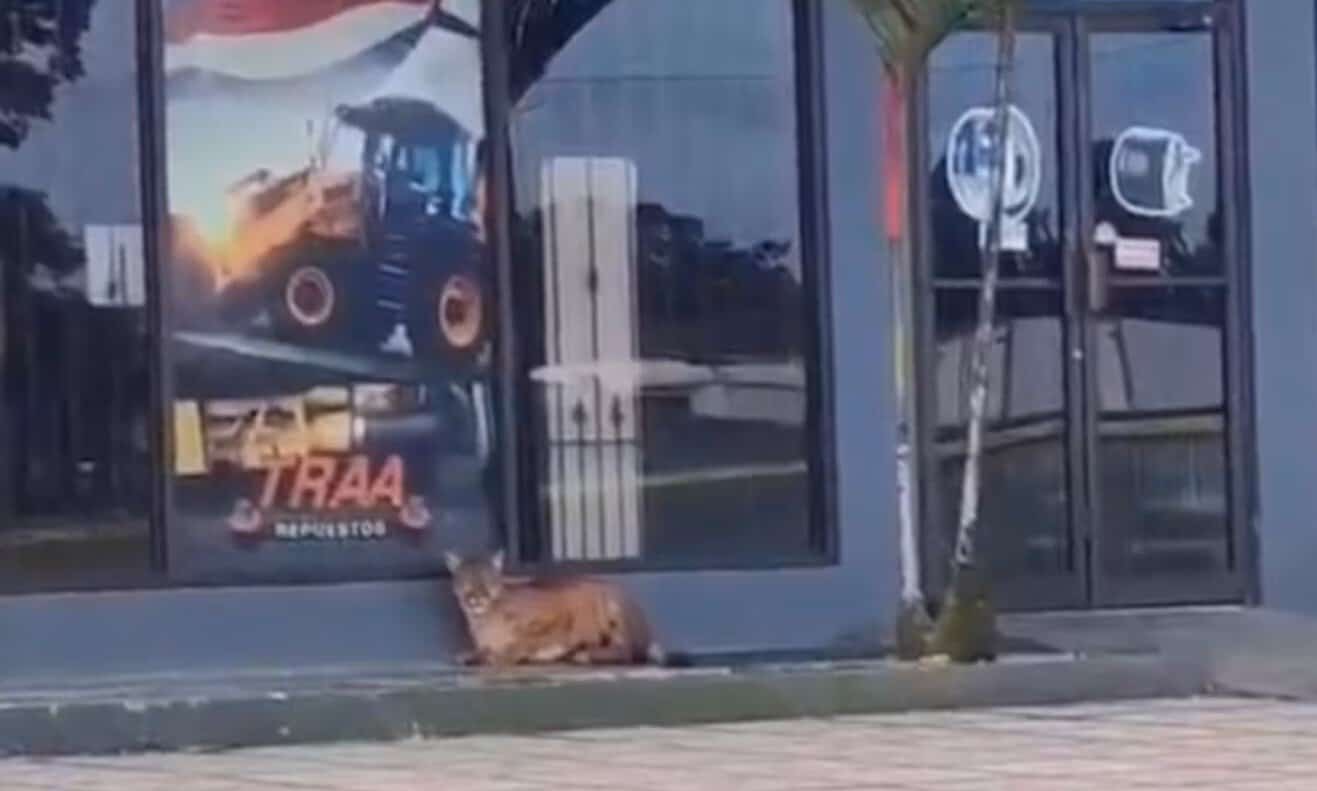
An adult puma in Costa Rica with broken legs was rescued Wednesday morning in Guápiles after it was apparently struck by a vehicle on Route 32, the main highway linking San José with the Caribbean port of Limón. Firefighters received the call at 6:25 a.m. They found the cat lying in front of a store window along the highway, about 150 meters (490 feet) west of the Pequeño Mundo store, keeping its distance from the people nearby. Police cordoned off the area while a veterinarian from the National System of Conservation Areas (SINAC) traveled to the scene. Officers kept onlookers back because the animal, although calm, could attack if frightened. Staff from SINAC’s Tortuguero Conservation Area assessed the puma and sedated it in a controlled way so it could be handled safely. Rescuers then wrapped the sedated animal in a white cloth and placed it in a box for transport. The puma was taken to Toucan Rescue Ranch for veterinary evaluation. An initial examination found fractures in its legs, and the animal was expected to be moved to the National University’s Small Animal and Wildlife Hospital in Heredia. Its current condition has not been reported. No driver or vehicle has been identified. Elena Vargas, director of the Tortuguero Conservation Area, urged drivers to keep a prudent speed and stay alert to road conditions because wild animals can appear without warning. Driving at an appropriate speed gives motorists time to react, she said, and the loss of wildlife on the country’s roads is something that can be prevented. Wild cats are among the most exposed. The Las Pumas Rescue Center and Sanctuary in Cañas counted 76 wild cats hit on Costa Rica’s roads in 2025: 54 ocelots, 12 jaguarundis, five pumas, four margays and one jaguar. Eighty-eight percent died at the scene. Across all species, researchers estimate that about four wild animals are killed on Costa Rican roads every hour. Route 32 has long been one of the deadliest stretches. It crosses nine protected zones, including seven biological corridors and Braulio Carrillo National Park. Studies from about a decade ago estimated that more than 1,200 wild animals died along the highway each year. The highway’s widening was supposed to come with protection for wildlife. Its environmental permit calls for 31 underpasses and 20 canopy bridges. In a report to the Constitutional Court last November, the National Roads Council (Conavi) said 29 of the underpasses had been built but only two of the 20 canopy bridges. Six more bridges were under construction and 12 were still pending. The court’s deadline for the work expired in 2024, and in May 2025 it rejected Conavi’s request for another extension. Conavi said it expected to finish the remaining bridges during 2026. Even where crossings exist, they may not work for an animal like a puma. A study by Panthera Costa Rica, supported by the Inter-American Development Bank, monitored underpasses and canopy bridges on Routes 1 and 160 for six months. Pumas, collared peccaries, margays, jaguarundis and nine-banded armadillos were never recorded using the structures, even though they lived in the surrounding forest. The same study documented at least 14 collisions with large animals such as tapirs, pumas and deer. Some of them sent people to the hospital and destroyed vehicles. The researchers concluded that crossings reduce roadkill only as part of a complete system. That system includes exclusion fencing to steer animals toward the crossings, regular maintenance and continuous monitoring. A new law aims to make that the standard. The Law to Guarantee Wildlife Crossings in Infrastructure was published in the official gazette La Gaceta on Sept. 7. It requires wildlife crossings and other safe-passage measures wherever roads cut ecological connectivity. The law applies to new projects and to the rehabilitation, widening, improvement and maintenance of existing roads. It requires the Public Works and Transport Ministry, municipalities and SINAC to coordinate. Anyone who comes across an injured wild animal on the road should not approach it or try to move it. Keep a safe distance and call the Environment Ministry at 1192 or the 911 emergency line so trained personnel can respond.
Injured Puma Rescued on Route 32, Where Only 2 of 20 Promised Wildlife Bridges Had Been Built
Full Article
Original Source
Read the full article at Ticotimes →KhanList aggregates and links to publicly available news content. We do not host full articles from third-party sources. Always verify important information with original sources.