
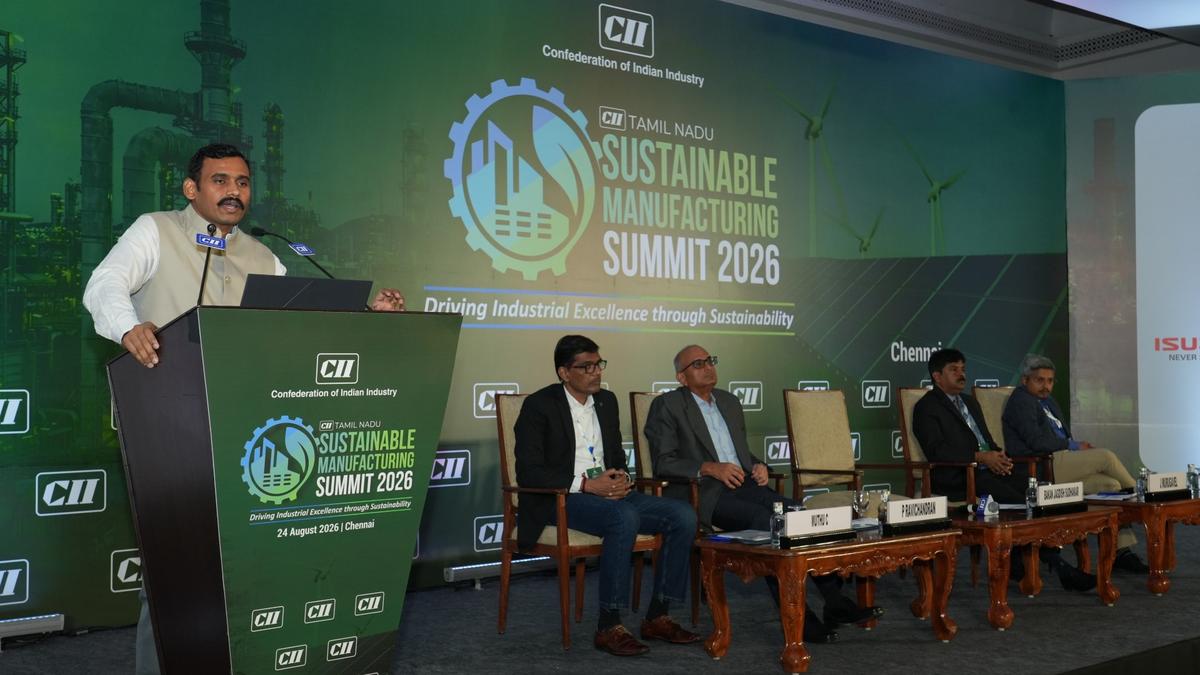
:Sustainability is being viewed as a direct lever for reducing costs, improving efficiency and strengthening competitive advantage, industry leaders said at the CII TN Sustainability Manufacturing Summit 2026.During a panel discussion titled “Making Sustainability Profitable: Cutting Costs, Creating Value,” executives from Festo, Amara Raja Group, TAFE and sustainability consultancy LGS Assurance highlighted how identifying waste, improving resource efficiency and embedding sustainability into product and manufacturing decisions can deliver measurable business value.Tapan Upadhyay, who heads application engineering and technical support at Festo, said companies should first identify where energy is being wasted before investing in new sustainability projects. “The greenest energy is the energy that you do not use, do not waste,” he said.Citing audits conducted by Festo, he said improperly installed pneumatic tubing can cause compressed-air leakage of between 100 and 300 litres a minute, with around 150 litres a minute being a rough average. “A single incorrectly cut joint could cost a company around ₹1 lakh annually, he said, while faulty installation could result in a similar cost.He also highlighted the cost of over-sizing components, a practice adopted as a safety precaution. Selecting a cylinder one size larger than required can increase air consumption by as much as 50%, while a 20% optimisation in payloads could deliver an additional 15–20% saving. In the example he cited, combining such measures could reduce running costs by around 70–80%.Highlighting that push towards circularity as having commercial benefit, Prasant Tiwari, Chief Sustainability Officer, at Amara Raja Group, said around 85% of the lead used in the company’s battery manufacturing comes from recycled sources. The company has also established what he described as India’s largest lead-recycling smelter.“My EBITDA (earninge before interests, taxes, depreciation and amortisation) margins are highly dependent on what is the cost of lead in energy. So this is also hedging to the business,” he said.He also highlighted the company’s water-management initiatives, saying Amara Raja had become “12x water positive” and was able to secure good-quality water for direct use in its plants.The company is also seeking to optimise the use of treated water that was previously used for gardening, including through drip irrigation.Tiwari urged manufacturers to view requirements such as zero liquid discharge, renewable energy adoption and carbon taxation as regulatory requirements; he said “everything which we are talking about today is going to be a legal requirement for you tomorrow.” he said, arguing that companies that act early could gain a competitive advantage.Ashok Muthuswamy, Vice President for Business Excellence, TQM and Sustainability, TAFE said the company uses augmented reality, virtual reality and other immersive technologies to develop digital prototypes and identify design and manufacturing problems before physical production starts.The company has also extended digital quality checks to its suppliers. Components can be digitally measured, with the resulting data transferred to the cloud, allowing TAFE to assess quality and process capability while parts are still on suppliers’ CNC machines.“The key is how do you produce more with less,” Muthuswamy said.He said product-use efficiency is particularly important for farm-equipment manufacturers because Scope 3 emissions account for the overwhelming majority of emissions associated with many auto companies. According to his estimate, Scope 1 and Scope 2 together account for about 2% of overall emissions, while Scope 3 represents roughly 98%. Of the latter, around 95 percentage points are linked to the use of the product itself, with the remainder coming from other Scope 3 sources such as employee travel.This makes improving the efficiency of products in use a critical sustainability priority. For farm equipment, Muthuswamy pointed to improving the efficiency of existing diesel-powered vehicles while also exploring technologies such as electric power and hydrogen.He also highlighted precision farming, where satellite imagery, drones and ground-level sensors can be used to determine the precise amounts of fertiliser, crop protection products and water required at specific GPS coordinates, instead of applying inputs uniformly across an entire field.Such efficiency improvements can also have direct livelihood implications. Muthuswamy noted that contract tractor operators in India may earn between ₹1,000 and ₹2,000 a day depending on location. Keeping equipment operational, therefore, is not only a productivity issue but can directly affect household incomes.Keerti D’Souza, founder of LGS Assurance, framed the business case for sustainability around the three Ps — people, planet and profits. While acknowledging that profitability remains the fundamental objective of business, she said companies must consider the social and environmental dimensions alongside financial returns.She cited occupational health and safety, including workplace ergonomics, as an area where even a 5% improvement or saving can generate a tangible return.When asked what single argument could persuade a sceptical CEO that sustainability is profitable, the panelists offered different perspectives. D’Souza pointed to research and development as a key source of value creation. Muthuswamy suggested framing sustainability initiatives in terms of both “opportunity and threat.” Tiwari emphasised the need for a clear business case based on profits, growth and a sustainable business model.Upadhyay identified quantification as a common obstacle. Companies may recognise that a sustainability initiative will deliver benefits, he said, but often struggle to translate those benefits into monetary terms. Understanding the cost of resources such as compressed air can make it easier to demonstrate the potential return on investment to senior management.The wider challenge for manufacturers was also highlighted during the summit’s inaugural session. Ravichandran Purushothaman, Chairman of CII Southern Region, cited the carbon footprint of smartphones as an example. A standard smartphone can carry a footprint of around 50–60 kg of CO₂ equivalent, while a larger iPhone model can reach 100–120 kg. With Chennai emerging as a major manufacturing hub for iPhones, the cumulative impact is “significant”.With India entering into several free-trade agreements in recent years, Purushothaman argued that decarbonisation across the supply chain is rapidly becoming a requirement for export competitiveness rather than a voluntary sustainability initiative.Delivering the chief guest address, Bakan Jagdish Sudhakar, IFS, Chief Executive Officer of the Tamil Nadu Green Climate Company, said the state has established a greenhouse-gas emissions baseline using 2019 as the reference year, in line with IPCC guidelines. He also expressed confidence that Tamil Nadu could achieve carbon neutrality ahead of India’s national target of 2070.
Industry leaders: Sustainability should drive savings, not just compliance
Full Article
Original Source
Read the full article at Thehindu →KhanList aggregates and links to publicly available news content. We do not host full articles from third-party sources. Always verify important information with original sources.