
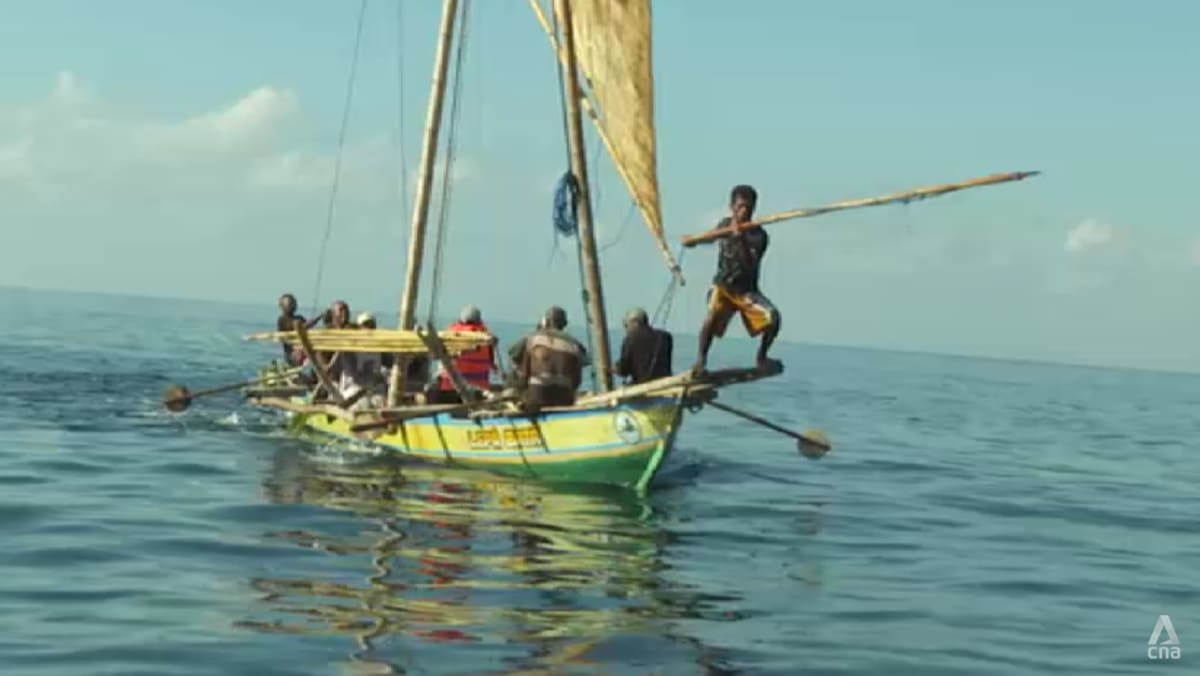
LAMALERA, Indonesia: Standing on the bow of a traditional wooden boat, the lamafa, or chief harpooner, waits.When a whale is spotted, he launches himself into the sea, using the force of his dive to drive a bamboo-shafted harpoon into the whale.No modern harpoon guns or sonar technology are ever used.Here on the southern coast of Lembata Island in Indonesia’s East Nusa Tenggara province, life in the remote village of Lamalera has long been shaped by the sea. The village of about 1,600 people is known for its centuries-old tradition of subsistence whale hunting.The practice is recognised by the Indonesian government as part of the country's cultural heritage, carried out for survival and tradition rather than commercial profit.But as this way of life faces an uncertain future, local officials hope the tradition can eventually gain UNESCO intangible cultural heritage status, although Indonesia has yet to submit an application. BEFORE THE HUNTIn Lamalera, the hunt begins long before the first boat sets sail.The annual whaling season starts on May 1, but preparations begin days earlier with a series of rituals seeking reconciliation, blessings and protection at sea.One of the most important is Tobu Neme Fate, a sacred ceremony of reconciliation, unity and purification, which happens on Apr 29."Tobu Neme Fate is a tradition that, according to our customary laws, must be observed every year,” customary leader Vincentius Geleka Bataona told CNA.“It is a time for the community to come together to discuss and prepare ourselves before going out to sea.”The following day, members of the Langowujon clan, the traditional custodians of Lamalera's customary rituals, perform the Ie Gerek ritual.The ancestral ceremony is believed to summon the spirits of the whales before the hunt begins.Later that same day, the villagers gather on Lamalera beach to honour and pray for fishermen who died or were lost at sea.On May 1, the mood shifts from remembrance to anticipation.The community gathers for Misa Leva, a Catholic Mass during which the village’s traditional whaling boats – also known as peledang – and harpoons are blessed before the hunting season begins.“It reflects one of Lamalera's greatest strengths: bringing together the Catholic faith and a cultural tradition that has endured for centuries,” said Lamalera pastor Fransiskus Xavenius Heaven.The ceremony is also an example of how Catholicism has become intertwined with Lamalera’s indigenous traditions.Catholic missionaries arrived on Lembata Island in 1886, centuries after whale hunting was already practised in Lamalera.Rather than replace local customs, the Church adapted to them, incorporating elements of the community’s traditions into its religious life.Beyond the rituals, preparations for the whaling season also include making sure every tool is ready for the hunt. A select group of master blacksmiths are entrusted with making the harpoon heads. (Image: CNA) Harpoon heads are still forged by hand using techniques passed down through generations.Only a select group of master blacksmiths are entrusted with making them, as a poorly made harpoon can fail at a critical moment, endangering the entire crew.One of them, 87-year-old Ignasius Blajatake Beding, has been forging harpoons for more than 60 years.“We teach our children because we know we're getting old and won't be around forever. It's better that they carry on this tradition than leave it to others,” said Beding. A DANGEROUS HUNTAt daybreak, crews push their peledang into the sea, rolling the heavy vessels over logs placed beneath their keels.Every crew member plays a vital role.While the lamafa stands at the bow to spot the whale, the lama uri, or helmsman, guides the boat while rowers propel it through the waves, using rhythmic chants to keep their strokes synchronised during the long, exhausting hours at sea.German traveller Marco Grossman was among the few outsiders fortunate enough to witness a successful whale hunt.“Everyone is mega focused on doing the right thing in order to get the whale. It's very intense and boats will get crushed or like capsized and people will fall into the water,” he recounted.“It's chaotic, they still manage to work together, obviously, because they're very experienced, but it's a lot of screaming. It's very intense, and it's very raw." 25-year-old Benjamin Keleka Tapoona, one of Lamalera's chief harpooners, knows the risks all too well."The thing I fear most is getting tangled in the rope. A whale's tail can strike the crew. Some people have been killed, others seriously injured,” he said.“Just the other day, an older man got his foot caught in the rope and lost it. There are many dangers. When you're on the peledang, you have to stay completely focused."Former harpooner and boat builder Ignasius Seran Blikololong lost his youngest son Benjamin during a whale hunt more than a decade ago."As a father, the sadness of losing Benjamin is overwhelming,” he said.“He already had a family of his own, and he had taken over the work I used to do. At night, I often lie awake thinking about him."Despite the risks, landing a sperm whale remains the most anticipated moment of the season.Every catch is shared according to a strict system of distribution, with portions set aside for widows, orphans and the sick.Much of the meat is also dried so it can be preserved for months.Whale meat is also used to barter for food that is difficult to grow in Lamalera’s arid, rocky terrain. Home to one of Indonesia's last remaining traditional barter markets, Wulandoni draws people from across Lembata Island to exchange goods without using cash. (Image: CNA) TRADING WHALE MEAT AT MARKETSOn Saturday mornings, the nearby village of Wulandoni hosts one of Indonesia’s remaining traditional barter markets.Lamalera residents travel there to exchange marine products for agricultural produce from neighbouring farming communities.Every week, Maria Gasparine Kremo walks nearly two hours from Lamalera to the market."If you don't have money, that's not a problem,” she said.“If you have fish, you can simply trade with fish – no one expects you to pay in cash."One slab of fresh whale meat, for instance, can be traded for six bananas, while dried whale meat can be exchanged for 12 sweet potatoes.But in recent years, successful sperm whale hunts have become increasingly rare. FEWER SPERM WHALESIn 2025, the village landed just three sperm whales. As of July this year, it had landed only one."Some days the catch is good, and some days it isn't. In the end, it all comes down to luck,” said Matheus Gilo Bataona, head of Lamalera B village.He says that often, what the village catches is not enough to meet their subsistence needs.“Back in 2018 or 2019, there was a day when we caught seven whales. But in recent years, that hasn't happened."With successful sperm whale hunts becoming increasingly rare, fishermen rely more heavily on other marine species to sustain their livelihoods.Pilot whales and smaller cetaceans – such as dolphins – as well as several shark species, are also caught to supplement the village's food and resource needs.While there is currently no evidence that Lamalera's subsistence whale hunt is ecologically unsustainable, some conservationists argue that precautionary catch limits should be considered."For example, I might be comfortable with a limit of 10 animals a year, while the community might say they need 20. That's the discussion we need to have,” said Putu Liza Mustika, an environmental science lecturer at James Cook University. She is also the co-founder of Cetacean Sirenian Indonesia, a non-governmental organisation dedicated to the conservation of marine mammals. The waters around Lembata are estimated to support a sustainable catch of more than 10,000 tonnes of fish a year. (Image: CNA) At the same time, authorities are also exploring ways for Lamalera's residents to become less reliant on whales and other protected marine species.The waters around Lembata are estimated to support a sustainable catch of more than 10,000 tonnes of fish a year.Officials believe better fishing vessels could help Lamalera's fishermen tap into these resources. But changing livelihoods takes more than simply providing new boats."Even with better fishing boats and equipment, the community still lacks the skills to make full use of its marine resources,” said Hadi Umar, head of the fishery office in Lembata Regency.“That's why changing mindsets in Lamalera – from the older generation to the younger – will take time."Despite its remoteness, Lamalera is not immune to the forces of globalisation. Marianus Yakobus Rubo Bataona is among the young people in Lamalera choosing not to become fishermen or lamafa. (Image: CNA) Today, fewer young people are choosing to become fishermen or lamafa.Marianus Yakobus Rubo Bataona is one Lamalera resident choosing to eschew a life at sea, instead studying for a university degree in guidance and counselling.He said when he was younger, he had dreams of joining a peledang crew or even becoming a lamafa.“But that dream gradually faded because my parents wouldn't let me go to sea. I think that was their way of protecting me.”“After all, we all know the sea is dangerous every time you go out."
Indonesia’s centuries-old whaling tradition faces an uncertain future
Full Article
Original Source
Read the full article at Channelnewsasia →KhanList aggregates and links to publicly available news content. We do not host full articles from third-party sources. Always verify important information with original sources.