
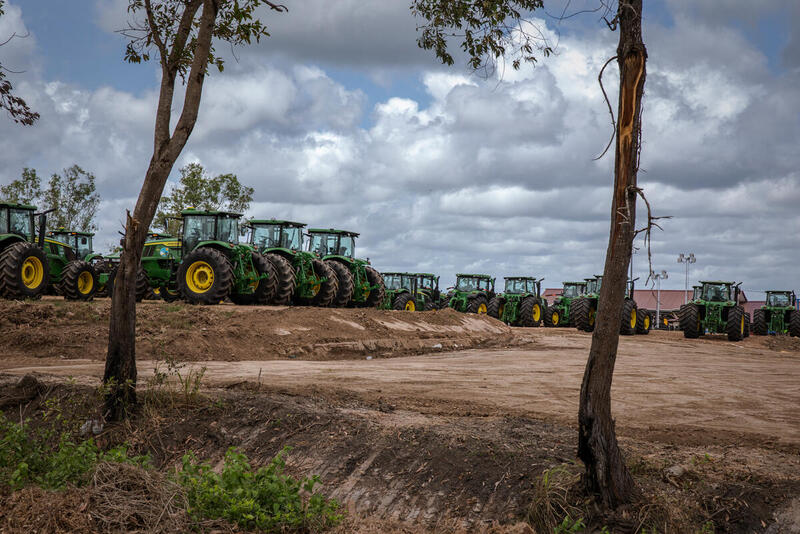
A government official announced that Indonesia had achieved rice self-sufficiency three years ahead of schedule and no longer needed the previously announced 2 million hectares for food production.Instead, future food and biofuel production would be directed toward degraded land.But the government has yet to clarify how the announcement will affect food and energy projects already underway, raising questions about whether policy and implementation will follow its stated shift. JAKARTA — Indonesia says it no longer needs to expand rice cultivation into forest areas, but it has yet to explain what the announcement means for large-scale food and energy projects already underway in Papua and Kalimantan. Presidential Special Envoy for Climate and Energy Hashim Djojohadikusumo said Oct. 6 that Indonesia had achieved rice self-sufficiency three years ahead of schedule and no longer needed the previously announced 2 million hectares (4.9 million acres) for food production. “The government sees no further need for expanding rice cultivation areas in the so-called forest areas and forest zones that were announced a few years ago,” Hashim said in Jakarta. At the same event, President’s Special Envoy for Multilateralism and International Trade Mari Pangestu said future food and biofuel production would instead be directed toward degraded land. The announcement appears to mark a shift from a government push that environmentalists have described as one of the world’s largest deforestation projects, involving vast rice and sugarcane plantations in southern Papua. But less than two weeks before Hashim’s announcement, the Ministry of Forestry designated about 5.67 million hectares (14 million acres) of forest through its 2026 Forest Utilization Direction Map, or PAPH, as areas that could be proposed for forest-utilization permits, including for food security and energy, as well as forest rehabilitation. “This means there is an inconsistency between the statements issued by public officials,” Indonesian Forum for the Environment (Walhi) campaigner for essential ecosystems Musdalifah Jamal told Mongabay by phone. “This contradiction shows us that the government has not yet abandoned a development paradigm that places forest areas as spaces to fulfill food and energy needs.” The forestry ministry has welcomed the direction of Hashim’s announcement but has not said whether it changes existing policies or projects. “A distinction needs to be made between new expansion plans that require the clearing of forest areas, activities that are already under way, and increasing production on agricultural land that is already available,” ministry spokesperson Ristianto Pribadi said, as quoted by The Straits Times. “Therefore, we cannot yet say that all activities in the two regions will automatically stop, nor confirm when they will stop,” he said, referring to South Papua and Central Kalimantan. Environmental groups say the announcement must therefore be followed by changes to policies that have facilitated forest conversion. “At face value, the statements from Pak Hashim and Ibu Mari Pangestu said the Government of Indonesia would no longer pursue deforestation for food or energy crops,” Mighty Earth founder and CEO Glenn Hurowitz told Mongabay. “In order for these positive statements to have impact, they have to be implemented, including by changes in decrees and other policies.” Nadia Hadad, executive director of NGO MADANI Berkelanjutan, said the government also needs to align its food, energy, forestry and fiscal policies with the new commitment. “Climate commitments are ultimately not measured by how many statements are made, but by whether policies and state money move in the same direction,” she said in a press release. Franky Samperante, director of the Pusaka Foundation, which works with Indigenous peoples in Papua, said officials often express commitments to sustainable development and forest protection that have yet to be translated into concrete policies and actions. Corporate heavy machinery is still clearing natural forests in several areas of Papua targeted for food estate programs, including rice fields, sugarcane plantations and oil-palm plantations, he said. Indigenous communities, who are custodians of the land and forests, have also faced alleged harassment and criminalization, prompting United Nations rights officials to raise concerns over alleged human rights abuses and environmental destruction linked to the project. A map that shows the location of the food estate program in Merauke, South Papua. Image courtesy of Greenpeace. Clearing already underway The project began under former President Joko Widodo and expanded rapidly under President Prabowo Subianto, including beyond Merauke into Boven Digoel, Mappi and Asmat districts. The latest monitoring by TheTreeMap, which runs the Nusantara Atlas forest-monitoring platform, indicates that about 11,500 hectares (28,400 acres) of wetlands have been cleared for rice in Wanam and Wogikel villages. TheTreeMap also identified about 40,000 hectares (99,000 acres) cleared for sugarcane, mainly across primary forests and savannas near the border with Papua New Guinea. Some clearing followed construction of a 135-kilometer (84-mile) access road intended to support 1 million hectares (2.5 million acres) of planned rice fields in Merauke. Sentinel-2 animation from May 2024 to August 2026 showing the progressive construction of a new food-estate road extending 135 km in a strikingly straight line. As the road advances across the landscape, an expanding zone of clearance at its western end marks the conversion of Melaleuca swamp forest into land prepared for rice cultivation. Successive monthly images reveal the unfolding footprint of infrastructure and agricultural expansion. Animation created in Nusantara Atlas using Nimbo cloud-free monthly Sentinel-2 composites. An investigation by Tempo found that the Ministry of Defense prepared the road’s environmental impact assessment after construction was already about one-third complete. Indigenous communities challenged the project in court, arguing that clearing began without their consent and environmental approval. The Jayapura State Administrative Court rejected the lawsuit in September. As of February, road construction had resulted in nearly 7,600 hectares (18,800 acres) of deforestation, according to Greenpeace analysis. TheTreeMap founder and landscape ecologist David Gaveau said satellite imagery now shows the entire 135-km road corridor has been opened, though it remains unpaved, while at least one oil palm concession has built feeder roads connecting to it. “Will paving, further feeder-road construction and more infrastructure development continue?” he asked. An excavator clearing land inside the Merauke Food Estate area, recorded at coordinates 140°45’25.62″E, 8°12’37.87″S. Image courtesy of Auriga Nusantara, taken on 5 May 2026. Not just rice Rice is only one component of the government’s broader food and energy plans for South Papua. The current government has expanded the program to include sugarcane, oil palm and livestock. A Greenpeace report found 10 companies had been granted sugarcane concessions covering about 560,000 hectares (1.4 million acres) in Merauke. Greenpeace’s analysis of government maps puts the broader project at about 2.7 million hectares (6.7 million acres). “Will further clearing within these sugarcane concessions stop? What happens to additional sugarcane concessions that have yet to begin clearing?” Gaveau asked. Greenpeace Indonesia senior forest campaigner Refki Saputra said the government is also expanding its biofuel ambitions. A coalition of NGOs estimates that implementing the B50 biodiesel mandate could require an additional 5.36 million hectares (13.2 million acres) of oil palm plantations by 2039, with the potential for 1.5 million hectares (3.7 million acres) of deforestation. The government also plans to increase the bioethanol blend in gasoline to 20% in the next five years. Hashim said at the sustainability forum that biofuels remain necessary to reduce Indonesia’s reliance on imported fuel. “Let’s say the rice-field program is withdrawn, so what will be put there instead? Sugarcane everywhere? Oil palm everywhere? Because the [biofuel and food estate] programs still exist,” Refki told Mongabay by phone. Clearing of a natural ecosystem dominated by relatively small-diameter Melaleuca sp. inside the Merauke Food Estate area, recorded at coordinates 140°35’37.82″E, 8°16’35.09″S. Image courtesy of Auriga Nusantara, taken on 5 May 2026. What counts as ‘forest’? Another question is what Hashim meant by “forest areas.” Hashim said rice had been planted in swamp areas in Papua and Kalimantan. But Refki pointed out that swamps are not necessarily degraded or ecologically unimportant. Merauke’s wetlands and savannas form part of the TransFly, one of New Guinea’s distinctive ecoregions and an important habitat for wildlife and migratory birds. Because much of Merauke’s natural vegetation consists of wetlands, some ecosystems can be categorized as scrubland or savanna rather than forest on official land-cover maps, Greenpeace noted. Gaveau said another distinction is critical: Whether Hashim’s “forest areas” means ecosystems with actual forest cover or the legally designated Forest Estate, known as Kawasan Hutan. In 2025, Forestry Ministerial Decree No. 591 reclassified 486,939 hectares (1.2 million acres) in Merauke, Boven Digoel and Mappi from Forest Estate to land outside it, or APL, to support the national strategic project. According to TheTreeMap’s spatial analysis, the reclassified area contains nearly 300,000 hectares (741,000 acres) of primary closed-canopy forest, as well as Melaleuca stands and other wetlands. “Does ‘forestry areas’ refer to the ecosystem on the ground, or the Kawasan Hutan?” Gaveau asked. “Will this announcement protect them too, or could conversion proceed because they are now classified as APL? Will the decree be reviewed?” Land reclassified as APL is no longer governed as Forest Estate under the Forestry Law, although other environmental and land-use requirements still apply. A natural wetland ecosystem inside the Merauke Food Estate area, recorded at coordinates 140°45’34.41″E, 8°7’1.62″S. Image courtesy of Auriga Nusantara, taken on 6 May 2026. What counts as ‘degraded’? The same ambiguity surrounds the “degraded land” that Mari said would replace forests for future food and biofuel production. Gaveau noted that Merauke contains seasonally inundated grasslands, wooded savannas and Melaleuca swamp forests, natural ecosystems shaped by fire over millennia. “Will these native ecosystems be considered ‘degraded’ because of their low vegetation cover? Or will the government distinguish natural grasslands from land degraded by past deforestation?” he said. Mighty Earth said the announcement could instead provide an opportunity for large-scale conservation and restoration in support of the government’s goal of restoring 12 million hectares (30 million acres) of native ecosystems. “That would be a program of planetary significance that could suck gigatons of carbon out of the atmosphere,” Hurowitz said. But Indigenous and civil society groups say local communities must have a role in deciding what qualifies as degraded land and how it is used. “Local communities should be involved in decisions about the development and use of natural resources in their territories,” Merauke Solidarity said in a statement. Banner image: Tractors and excavators are seen in Senayu village, Sermayam district, Merauke regency, South Papua province on September 18, 2025. Image courtesy of © Ulet Ifansasti / Greenpeace FEEDBACK: Use this form to send a message to the author of this post. If you want to post a public comment, you can do that at the bottom of the page. Credits Topics
Indonesia says it no longer needs forests for rice. What happens to projects underway?
Full Article
Original Source
Read the full article at News →KhanList aggregates and links to publicly available news content. We do not host full articles from third-party sources. Always verify important information with original sources.