
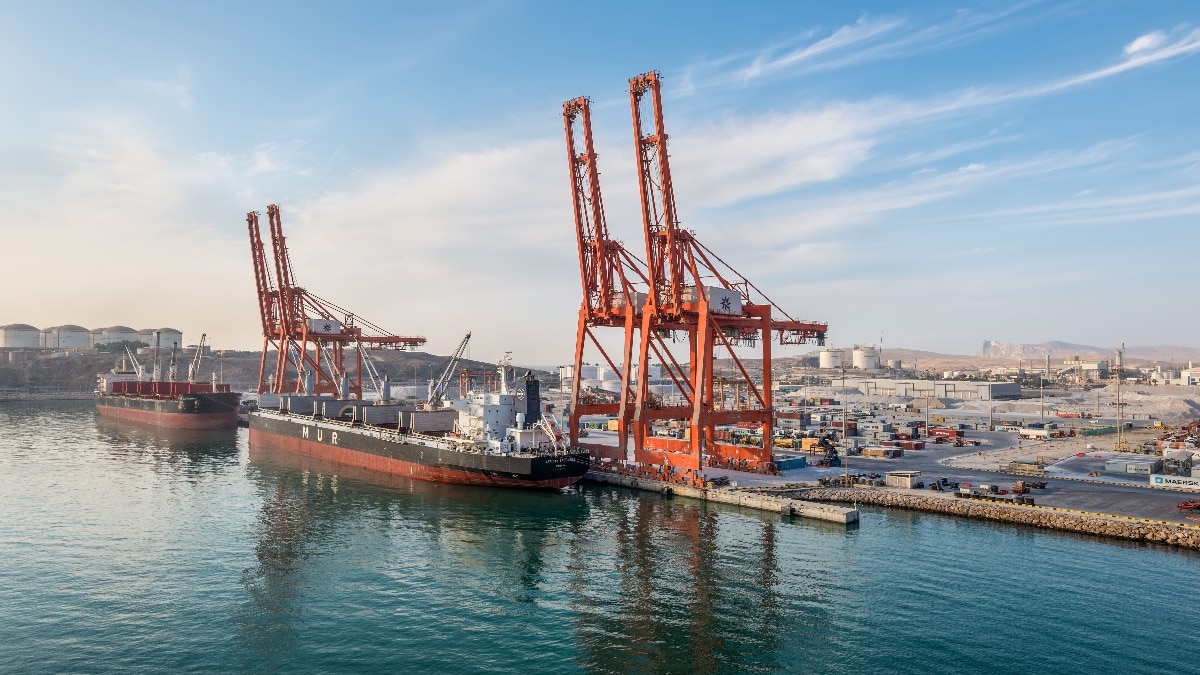
For decades, Gulf trade has revolved around a handful of major ports. Jebel Ali Port in Dubai, Khalifa Port in Abu Dhabi, Dammam in Saudi Arabia, Hamad Port in Qatar, and Salalah in Oman. But the US-Israel-Iran war around the Strait of Hormuz is now forcing a rethink. Amid this, Oman's Sohar Port has suddenly emerged as a crucial trade gateway, especially for India.Oman is positioning Sohar Port as an alternative gateway for Indian businesses seeking access to the Gulf region. The port's geography has now become an asset. It is beyond the narrowest part of the Hormuz chokepoint. That does not make the route risk-free, but it gives shippers another location from which cargo can be moved by sea and road, with a planned rail link to the United Arab Emirates (UAE) expected to add another route into the Gulf.Reports suggest that the port, on the Gulf of Oman coast and outside the Strait of Hormuz, is attracting attention from Indian logistics companies, manufacturers and exporters. Not just freight companies, Sohar Port is also emerging as an important transit point for Gulf oil shipments, with Saudi Arabia using ship-to-ship transfers off the Omani coast to keep crude moving towards Asian buyers.The pitch to India was made in New Delhi in mid-September during an investment and promotional programme, which brought together Indian businesses and Omani officials, focussing on Sohar Port and Freezone. The Freezone is an industrial and logistics hub adjoining the port. The Associated Chambers of Commerce and Industry of India (ASSOCHAM), which hosted the interactive session, said the discussions covered investment, manufacturing, trade and logistics, with a focus on Sohar's strategic location, infrastructure and connectivity.A separate session with the Federation of Indian Export Organisations on September 16 focussed on manufacturing, investment, exports and regional market access. At the New Delhi event, CEO of Sohar Freezone, Raid Al Rubaiey, pitched for deeper Indian participation. "India represents an important and growing dimension of Sohar's international investment landscape, with established Indian businesses already contributing to our industrial ecosystem. There is significant potential to deepen this relationship through investments that complement our industrial clusters, strengthen value chains and create new opportunities for growth," Al Rubaiey was quoted as saying by The Hindu.The timing of this development is significant.INDIA-SOHAR CARGO MOVEMENT HAS SURGEDThe crisis has already changed the movement of Indian-origin cargo.Feeder vessel services between India and Sohar have increased fourfold since the beginning of the Middle East crisis, according to Business Standard. Al Rubaiey told the newspaper that cargo which would earlier have travelled directly to Gulf Cooperation Council (GCC) destinations in larger vessels is increasingly being moved through Oman before continuing by road.The shift is part of a wider scramble by logistics companies to redesign supply chains around the Strait of Hormuz disruption. Ports such as Sohar, Salalah and Khorfakkan have reportedly seen greater activity as shipping lines are seeking routes that reduce exposure to the most vulnerable parts of the Gulf.Sohar Port and Freezone has attracted more than $30 billion invested across its ecosystem and can handle more than 72 million tonnes of cargo a year. During the first half of 2026, container throughput at Sohar Port rose by 40% year-on-year to reach 545,000 Twenty-Foot Equivalent Units (TEUs), while breakbulk volumes nearly doubled to 1.24 million metric tonnes, according to Maritime Logistics News.The port is now looking beyond simply handling additional cargo. Al Rubaiey said that Sohar is in discussions with Indian companies interested in operating terminals there.SOHAR'S ROLE GOES BEYOND CONTAINERSThe port's importance in the current crisis is not limited to Indian exports.Saudi Arabia has turned to Sohar as an alternative point for moving crude to international markets after attacks by the Iran-aligned Houthi militia disrupted its East-West pipeline, which connects oil-producing regions in the kingdom's east with Yanbu on the Red Sea.The pipeline had provided Saudi Arabia with a way to avoid Hormuz. Its disruption, combined with instability around the Red Sea and Bab al-Mandeb, has left Riyadh with fewer straightforward export options.Saudi crude is being moved to Sohar and transferred between vessels offshore before being carried onwards to buyers. The scale of these transfers is huge. Saudi has planned to move around 60 million barrels of crude from its Gulf terminals through ship-to-ship transfers at Sohar during September and October, equivalent to roughly 1 to 1.5 million barrels per day, reported commodities and petrochemical market intelligence website Chem Analyst.Alongside the waters off Fujairah in the UAE, Sohar has now emerged as one of two important locations for ship-to-ship transfers. Fujairah and Sohar are roughly 100 km apart along the Gulf of Oman coast.Though ship-to-ship transfers are happening, they involve moving oil directly between tankers at sea. Ship-to-ship transfers can provide a workaround when conventional port calls or shipping routes are disrupted, but they also introduce additional operational and insurance risks.Sohar has now become a part of the emergency architecture keeping Gulf energy exports moving.A NEW ROAD ROUTE TO SAUDI ARABIA ALSO IN THE PICTUREOman's strategy is also extending beyond the sea.Oman and Saudi Arabia are moving to strengthen direct overland trade through a new logistics arrangement designed to speed up cargo movement and create a more efficient supply chain between the two economies, according to Oman-based newspaper Muscat Daily.Oman-based Arkan Logistics and Saudi Arabia's SPARK Logistics signed a strategic cooperation agreement on August 5 to activate the Secure Green Land Corridor, using the direct road connection between the two countries.The corridor builds on the road across the Rub Al Khali desert, with the 564-km Saudi section running from the Batha-Haradh intersection in the Eastern Province to the Rub Al Khali border crossing.This corridor adds another layer to Sohar's growing importance. Instead of depending entirely on maritime access into the Gulf, cargo arriving at Sohar can potentially move overland towards Saudi Arabia. That creates a multimodal alternative at a time when both Hormuz and the Red Sea are exposed to disruptions.Oman is also developing its rail connectivity with the UAE. Omani officials have said the Oman-UAE rail corridor is expected to strengthen cross-border freight movement, potentially linking Sohar more closely with the wider Gulf logistics network.Taken together, the port, freezone, road connections and future rail link give Sohar a proposition that is broader than simply being a safe harbour outside Hormuz.WHY OMAN MATTERS TO INDIAFor India, the significance is twofold — energy and trade.India is heavily dependent on imported crude and has traditionally relied on Gulf producers. Any prolonged disruption around Hormuz therefore has implications not only for oil availability but also for freight rates, insurance costs and the movement of Indian exports to Gulf markets.Sohar offers Indian companies a way to insert an additional logistics node between Indian ports and GCC markets.The relationship with Oman also extends beyond the immediate crisis. India-Oman bilateral trade reached $11.19 billion in the financial year (FY) 2025-26, according to the Indian embassy in Muscat. There are more than 6,000 India-Oman joint ventures operating in Oman, while energy and industrial commodities remain important parts of bilateral trade.The current crisis has therefore accelerated a relationship that is already expanding.Sohar's pitch to India is not that it can replace established Gulf hubs overnight. Jebel Ali, Fujairah and other major ports are deeply integrated into regional trade. Instead, the crisis has shown the value of having multiple routes.A supply chain that can move cargo through Sohar, transfer it by road into Saudi Arabia or the UAE, and connect onwards through alternative maritime routes is less dependent on any single chokepoint.In that sense, this might be the emergence of a Gulf logistics map in which Sohar plays a larger role than it did before the crisis.- EndsPublished By: Anand SinghPublished On: Sep 22, 2026 09:00 IST
India's Hormuz replacement? How Oman's Sohar Port can become a new Gulf gateway
Full Article
Original Source
Read the full article at Indiatoday →KhanList aggregates and links to publicly available news content. We do not host full articles from third-party sources. Always verify important information with original sources.