
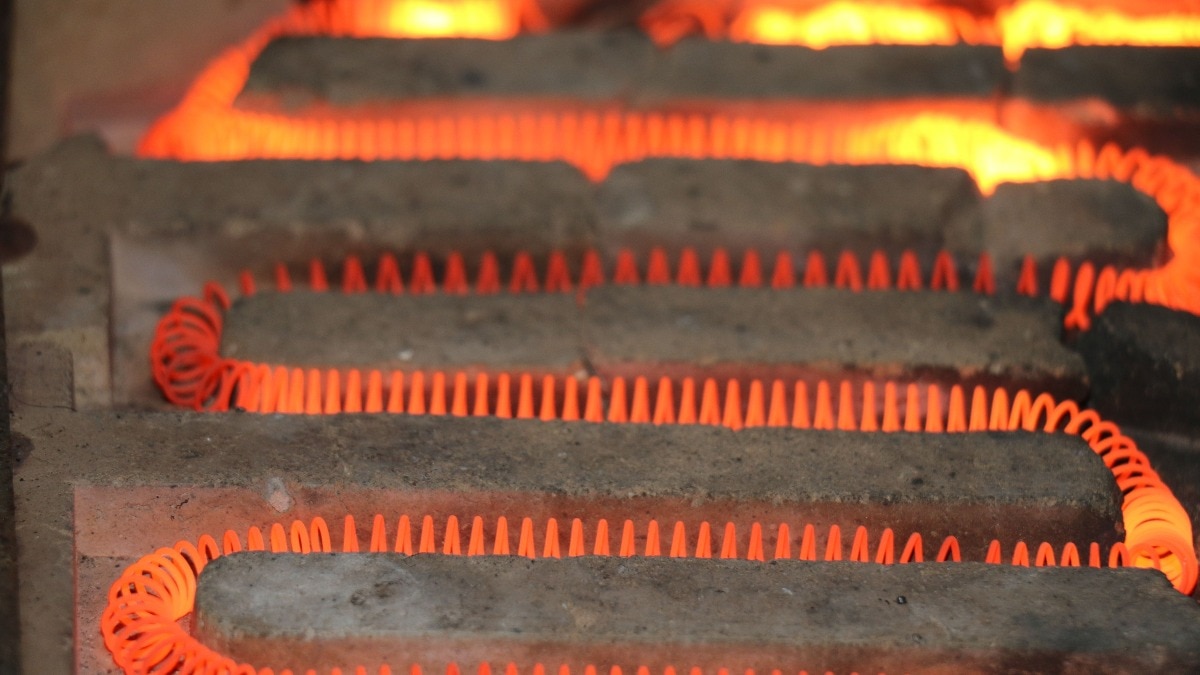
The breakthrough could open new possibilities for sensing heat and extremely weak light.A view of a electric heating element with a coiled structure emitting heat. (Representational Photo: Pexels)Scientists in India have discovered a way to generate an unusually large electrical voltage from a small temperature difference, challenging a limit that has guided the understanding of solid materials for over a century.The breakthrough involves a specially engineered semiconductor made from scandium nitride (ScN).Researchers from the Jawaharlal Nehru Centre for Advanced Scientific Research (JNCASR), the University of Sydney and the Indian Institute of Science found that the material can produce a thermoelectric voltage far beyond what was previously considered possible in crystalline solids.The findings were published in the journal Science. An electronic band diagram of heavily doped, highly compensated ScN showing thermopower exceeding the Boltzmann limit. HOW DOES HEAT MAKE ELECTRICITY?The discovery is based on the Seebeck effect.In simple terms, when one side of a material is hotter than the other, moving charge carriers can create a voltage. This effect is already used in devices such as temperature sensors and systems that convert waste heat into electricity.For decades, scientists believed there was a practical ceiling on how much voltage a temperature difference could generate in a crystalline solid.The new research challenges that assumption.The team created thin films of ScN and deliberately introduced magnesium into the material. This altered how charge moves through the crystal and produced what researchers call a heavily doped, highly compensated semiconductor.The result was rather prominent.Researchers measured a Seebeck coefficient exceeding -124.6 millivolts per kelvin near room temperature in one of the films, which is nearly 100 times beyond the earlier reported ceiling for crystalline solids.The effect became even stronger as the films were made thinner. The researchers have already built a preliminary photon sensor using the material. (Photo: PIB) HOW CAN THIS INNOVATION HELP?The finding could eventually lead to much more sensitive devices for detecting heat and tiny temperature changes.The researchers have already built a preliminary photon sensor using the material.When a laser illuminated one of its contacts, it created a tiny temperature difference that generated a measurable voltage.The device produced a Seebeck response of -102.4 millivolts per kelvin and showed a fast, repeatable response during repeated tests.The researchers say further development could potentially make such technology useful for detecting extremely weak light, including at the single-photon level.The research could also have applications in sensitive temperature sensors, thermal imaging, heat-flow detection and future quantum technologies.An Indian patent application has been filed covering thermoelectric thin-film materials and sensors based on the work.- EndsPublished On: Sep 2, 2026 17:39 IST
Indian scientists break century-old limit on turning heat to electricity
Full Article
Original Source
Read the full article at Indiatoday →KhanList aggregates and links to publicly available news content. We do not host full articles from third-party sources. Always verify important information with original sources.