
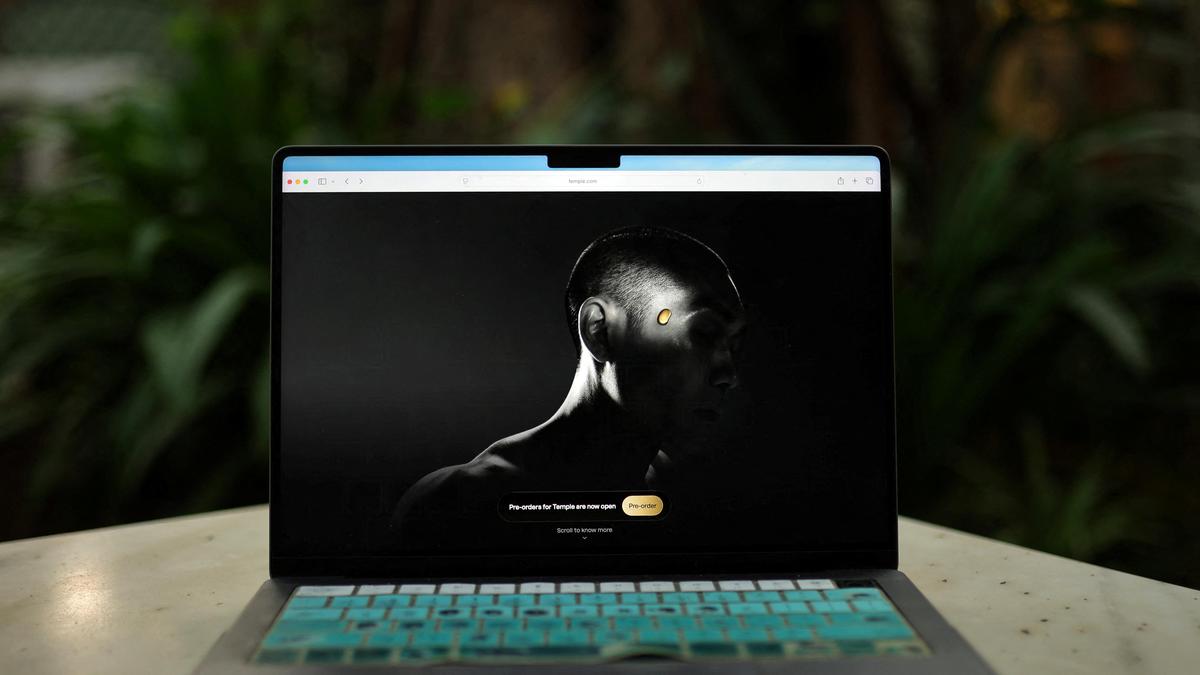
The head-worn fitness tracker Temple on the company's website | Photo Credit: REUTERS A tiny, $900 wearable device being developed by an Indian billionaire entrepreneur and showcased by some of the country’s top sportspersons has sparked criticism from doctors who say its claims of tracking blood flow to the brain are exaggerated.The Temple device is less than 1 inch (2.54 cm) wide and weighs under 2 grams (0.07 oz). It sticks to the side of the head between the forehead and the ear, or the temple area.Promotional materials for the device, developed by Deepinder Goyal, say that its BrainFlow feature shows how well the brain is being supplied with blood in real time and its Entropy feature can detect how hard the body works to shed heat.It can also measure thermal, immune, digestive, cognitive and emotional readings that help to transform how a person regulates their health, they say.Priced at 85,000 rupees ($907), the device comes in six colours. India’s cricket captain Shubman Gill and Olympic medal-winning badminton player P.V. Sindhu have worn it.Some well-known doctors in the country, however, are sceptical of the claims, saying the device’s capabilities are not backed by peer-reviewed research. In prime-time shows and on social media, they are calling for the device to come under the purview of medical regulators.Prominent Indian hepatologist Cyriac Philips, known as “TheLiverDoc”, has been criticising the device on his X account with 328,000 followers, calling Temple “the biggest health scam”.“People must be aware of wellness hacks such as wearables also, even though they are not marketed as health devices,” he told Reuters.On one prime-time TV discussion, paediatrician and nephrologist Sanjeev Bagai called Temple a “gimmick”, saying it had “no formal approval or clearance”.Goyal has hit back at the criticism from doctors, saying Temple is a “fitness tracker, and wellness device”, not a medical one.Indian doctor Jason Philip wrote on X that assessing blood flow to the brain was not easy, and optical signals placed over the temple skin would only give data on the “superficial temporal artery” that supplies blood to the face and skin.In a statement to Reuters, Temple said BrainFlow and Entropy were new metrics “with emerging science”, and that more research would follow, adding that some metrics would eventually need regulatory approval.India’s health ministry did not respond to Reuters queries, and the government has so far not reacted to the public debate.The debate on Temple comes as wearable makers overseas also face questions on when a fitness feature becomes a medical one.Some Apple Watch features, such as hypertension notifications, have received US Food and Drug Administration clearance as software-based medical features. Last year, the US FDA warned Whoop, saying its wrist-worn fitness tracker’s blood-pressure feature looked like a medical one — a view the company disputes.Goyal is best known for co-founding Eternal, which houses India’s biggest listed food-delivery company Zomato and has a market value of about $35 billion. The 43-year-old stepped down as chief executive of Eternal this year to focus on Temple.Temple, which has professors from the University of Ottawa and Harvard on its advisory board, raised $54 million in February at a valuation of about $190 million.Goyal said Temple has received orders from more than 62 countries since November 1.On its website, Temple says it is also working on detecting conditions including snoring and jaw clenching. Published - November 12, 2026 09:25 am IST
Indian billionaire, doctors spar over $900 brain blood-flow tracker Temple
Full Article
Original Source
Read the full article at Thehindu →KhanList aggregates and links to publicly available news content. We do not host full articles from third-party sources. Always verify important information with original sources.