
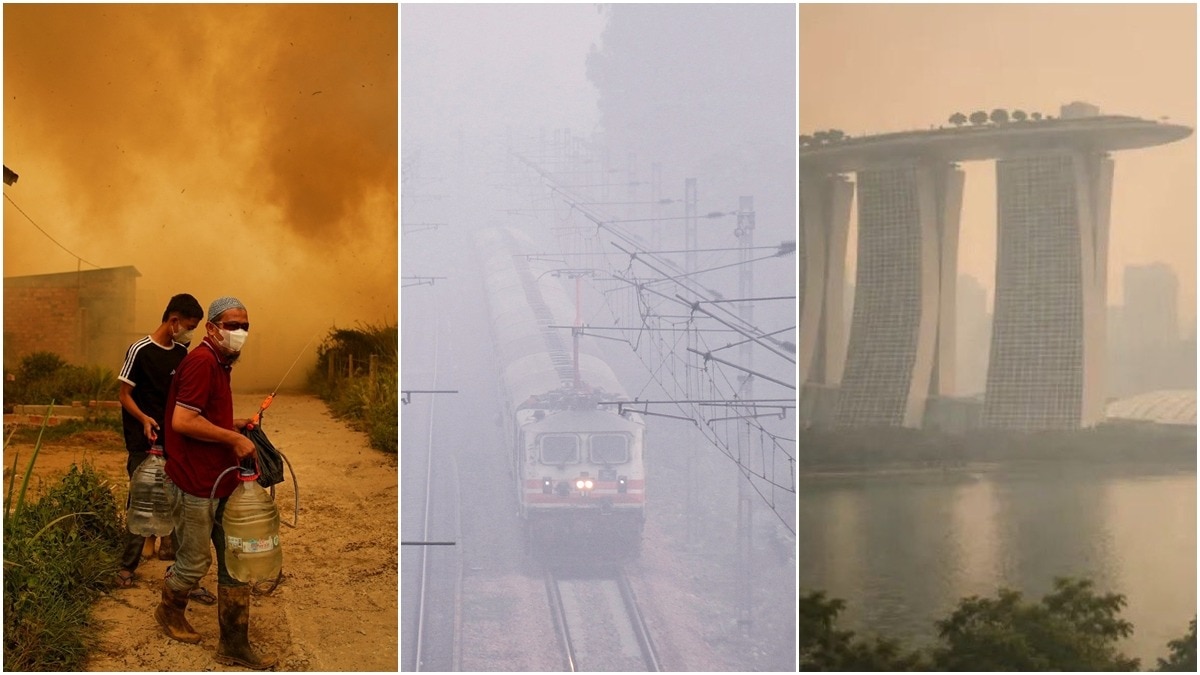
As winter approaches, the annual haze is settling over northern India.The air is turning heavier, pollution levels are climbing and millions of people are once again facing the prospect of breathing unhealthy air for weeks.But the problem often associated with Delhi and its neighbouring cities is far wider.Across parts of Asia, communities are grappling with a similar crisis, driven by different sources but carrying the same threat to public health. India Gate is seen shrouded under a layer of air pollution in New Delhi. (Photo: PTI) An October 23 ranking by AQI.in illustrated the scale of the issue.Palembang in Indonesia topped the list of the 20 most polluted cities in the world, with an Air Quality Index (AQI) of 447, followed by Sampit at 408 and Palangkaraya at 356. Amritsar was the highest-ranked Indian city, at 354, while Lahore in Pakistan recorded 341.India accounted for 14 of the 20 cities on the list, while Indonesia had five. These are snapshots from AQI.in, not official national averages, but they show that toxic air is not confined to one country. People walk on the Ampera Bridge as haze blankets Palembang, in South Sumatra, Indonesia. (Photo: AP) INDONESIA'S BURNING FORESTSIndonesia’s pollution crisis has been driven by forest and land fires, which send smoke across towns and cities.Palembang and several locations in Sumatra and Kalimantan have faced persistent haze amid prolonged dry conditions.The country is experiencing its worst fires in 11 years, news agency Reuters reported on October 22, citing officials. Although fire hotspots have declined, scattered rainfall has not been enough to extinguish the blazes. Firefighters move as they attempt to extinguish a wildfire Palembang, South Sumatra, Indonesia. (Photo: AP) Indonesia has deployed more than 69,000 firefighting personnel and 50 aircraft for firefighting, water drops and weather modification.The smoke has also affected Singapore, where air quality deteriorated sharply earlier this month.On October 14, western parts of the city recorded PM2.5 pollution levels of 284 micrograms per cubic metre, classified as “very high” by authorities.Singapore’s National Environment Agency warned on October 22 that smoke from fires in Indonesia could continue drifting towards the island, although rain and changing winds were expected to offer some relief. People walk amid haze in Singapore as air quality remained poor due to Indonesian forest fires. (Photo: X) The fires have also triggered widespread respiratory illnesses, highlighting the immediate human cost of the crisis.PAKISTAN AND INDIA SHARE SMOGIn Pakistan, Lahore regularly experiences severe smog between October and February.Vehicle exhaust, industrial emissions, smoke from brick kilns, construction dust and the burning of crop residue all contribute to the problem. Anti-smog guns are being used to bring down pollution levels in Lahore, Pakistan. (Photo: X/@bilalshn) Punjab authorities have stepped up inspections and action against polluting vehicles, industries and brick kilns. However, cooler temperatures and weak winds can trap pollutants near the ground, allowing smog to build up.Northern India faces many of the same challenges.AQI.in recorded Amritsar's AQI at at 354, Hapur at 319 and Bathinda at 316. Greater Noida, Bulandshahr and Aligarh each recorded 306, while Ghaziabad and Jalandhar registered 304. Smog engulfs the city skyline, in Noida. (Photo: PTI) Traffic emissions, construction dust, industrial pollution, waste burning and crop-residue fires contribute to the region’s dirty air.As winter approaches, weather conditions can make the situation worse.SOUTH ASIA NEEDS TO WORK TOGETHERThe World Bank estimates that nearly one billion people across parts of Bangladesh, Bhutan, India, Nepal and Pakistan breathe unhealthy air.Pollution from transport, industries, household fuels and farming can travel across state and national borders. A view of the city skyline shrouded in haze amid poor visibility, in Gurugram, Haryana. (Photo: PTI) The bank has called for coordinated action across the region, rather than relying on individual cities to tackle the problem alone.For India and its neighbours, emergency restrictions may bring temporary relief, but lasting improvement will require reducing pollution at its source and enforcing rules throughout the year.- Ends
India not alone in toxic air crisis. Its neighbours too are breathing heavy
Full Article
Original Source
Read the full article at Indiatoday →KhanList aggregates and links to publicly available news content. We do not host full articles from third-party sources. Always verify important information with original sources.