
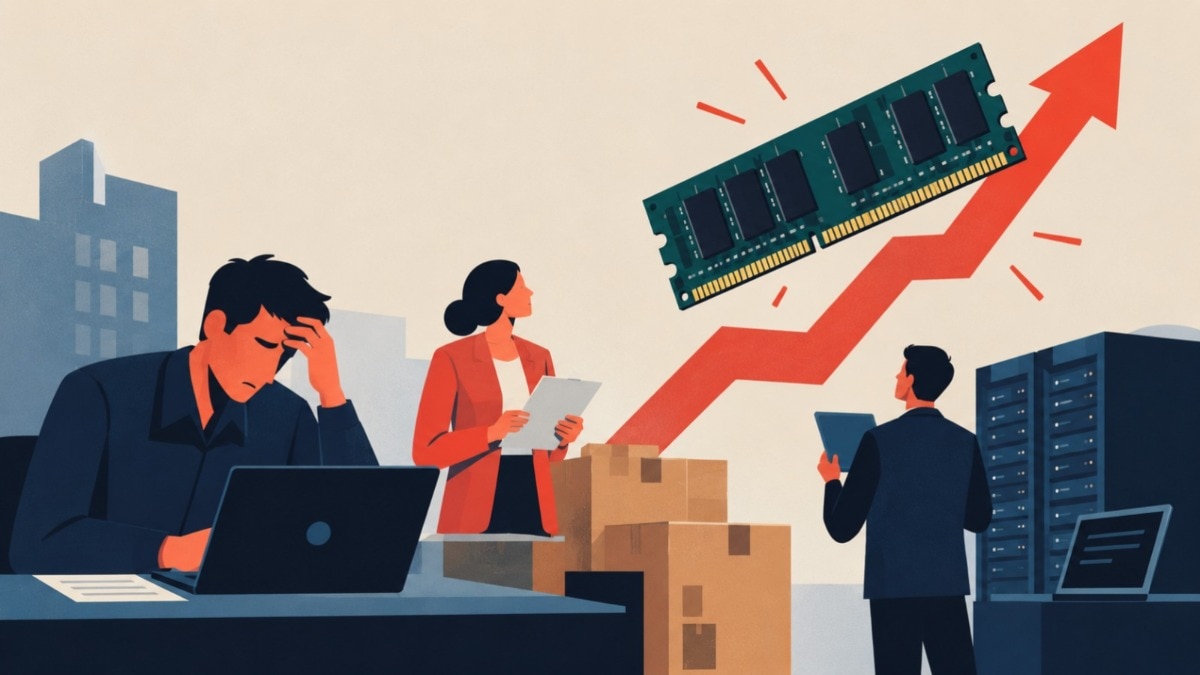
The AI era has changed the way we work. But it has also led to a rise in memory prices, something that is impacting businesses in India. India Today Tech spoke to some Indian companies that were trying to manage costs as RAM prices continue to rise.The ongoing AI-led RAM crisis is making things difficult for businesses in India. (Representational image made with AI)The rise of AI tools has transformed the workplace as we know it. Today, most of the code is written by Claude Code or OpenAI’s Codex, while even presentations and research work is handled by AI. All of this may have made your life easier, but it comes with a hidden cost – rising memory prices. In the past year, prices for memory – RAM and NAND – have gone up by as much as 500 per cent. This increase is hurting businesses around the world, and things are no different in India.The increase in memory prices can be attributed to the demand from AI data centres. AI companies like OpenAI are willing to pay big sums to procure memory for the data centres. While the demand has continued to increase, supply remains fairly limited, leading to rising prices. India Today Tech has consistently reported on the rise in memory costs in recent months. Today, average prices for fast DDR5 memory may set you back by as much as $425 (roughly Rs 40,000), compared to just $90 (roughly Rs 8,600) a year ago, as per a report from Tom's Hardware.The same was pointed out by Zoho co-founder Sridhar Vembu last month. “Memory prices, along with AI token prices, have made business very difficult. We have held back from raising prices but it is becoming hard,” he wrote on X.AI is impacting Indian businessesWhile you may have seen many phone makers hike prices in the past few weeks, the impact goes way beyond smartphones. “Infrastructure operators feel it first,” says Vishal Sirohi, CEO of AI infrastructure company Island Computing. “We buy and operate our own hardware across three availability zones, so this lands directly on our procurement line.” Sirohi believes that the impact is greater for a country like India which does not have a mature supply chain just yet. The weakening of the Indian rupee has also made things more difficult. “India feels it harder than most markets: hardware supply chains here are still maturing, the pricing is dollar-denominated, and every quarter the rupee weakens the same module costs more,” he explains. “For any Indian company running its own servers, memory has moved from a line item to a board-level cost conversation.”Yogesh Agrawal, co-founder of Consistent Infosystems, which specialises in IT hardware, tells India Today Tech, “The sharp increase in RAM prices has significantly impacted the market, with sales declining by around 30–40 per cent in some segments.” He adds, “The continued price volatility is making it increasingly difficult for businesses to maintain margins and plan inventory.” For SaaS-based companies too, there is an impact. Tapan Acharya, chief revenue officer of HR platform Keka, explains, “The change everyone sees is the price tag on electronic infrastructure. The change that actually matters is happening underneath it – the entire industry is now running on a spending cycle so large that even the biggest companies in the world are betting enormous sums on AI paying off eventually, not necessarily today.”The rising cost has changed the way companies work, with AI features particularly becoming a noticeable cost. “The cost of running the AI features inside the platform has gone from being a rounding error to a real, visible line item and our customers are starting to notice when a feature doesn't actually save them time or money,” Acharya tells India Today Tech. “The transactional work we've always built still earns its cost every single day, while the flashier, exploratory AI features get a much harder look before we commit budget to them.”How are businesses reacting?Given the rising costs, companies may have no choice but to try and adapt. While the bigger companies may have the means to afford higher prices, Vishal Sirohi explains that for many, that is not an option. “The structural reaction, and the right one, is moving workloads onto shared, pooled infrastructure where utilisation is an order of magnitude better, so the same business outcome needs less total memory,” he notes. “Scarcity is forcing the industry to do what it should have done anyway: stop wasting the resource.”Tapan Acharya believes that businesses should not panic just yet. Instead, they should focus on getting the most out of their resources. “On the hardware side, that means stretching device lifecycles and locking longer, calmer vendor contracts instead of buying in a rush,” he says. “On the AI side, it means not betting our whole product roadmap on compute getting cheaper instead prioritising the automation that already pays for itself for our customers.”But the situation may have another impact, one that impacts the way software is created. Previously Sridhar Vembu said, “For a long time, programming languages were designed with the assumption that memory is ‘free.’ That era has now ended.”Vishal Sirohi concurs. He predicts that the software industry could see one of the biggest shifts in decades. “For two decades, software has been built with languages and frameworks that trade memory for developer convenience. That trade no longer clears,” he says. “We made the efficiency call before the crisis priced it in – our data plane is written in Rust, which runs a fraction of the memory footprint of the managed runtimes most platforms are built on, and our multi-tenant pooling and overallocation extract far more useful work per gigabyte than the single-tenant and bare-metal deployments common in India.”Sirohi believes that this may be the best way for businesses to absorb the impact without creating a burden on consumers. “When memory is ten times off its lows, utilisation is the difference between absorbing the shock and passing it to customers,” he notes.When will the memory shortage end?Companies today are investing millions, if not billions of dollars, into AI infrastructure. There is some debate over whether this shortage can ease if the demand slows or the supply catches up. Tapan Acharya gave a rather unfiltered response when asked about RAM prices coming down in the future. “Nobody honestly knows, and I'd be careful of anyone who tells you they do,” he replied.“There are really two scenarios worth planning for. In one, AI infrastructure demand keeps growing the way it has, memory stays scarce, and prices keep climbing for years. Some people in the industry think this could run well past 2030,” Acharya adds. “In the other, spending eventually outpaces what AI is actually earning today, and the market corrects the way it has after past infrastructure booms.”Yogesh Agrawal had a dimmer view. “Prices are already at elevated levels, and based on the current market trend, further increases cannot be ruled out in the near term, he said. “At this stage, it is difficult to predict a definite timeline for the crisis to ease.”On the other hand, Vishal Sirohi claims that given the demand for AI, even with more supply, we may never go back to older RAM prices. “AI demand is permanent, and manufacturers are prioritising high-bandwidth memory for AI accelerators over the commodity DRAM everyone else buys. So prices will come off the peak, and the era of carelessly cheap memory will not return,” he explained. “The durable answer is not waiting out the cycle. It is efficiency – memory-frugal languages, better utilisation, pooled infrastructure.”- EndsPublished By: Armaan AgarwalPublished On: Sep 3, 2026 11:50 IST
India feels AI-led RAM crisis more than most markets, experts say
Full Article
Original Source
Read the full article at Indiatoday →KhanList aggregates and links to publicly available news content. We do not host full articles from third-party sources. Always verify important information with original sources.