
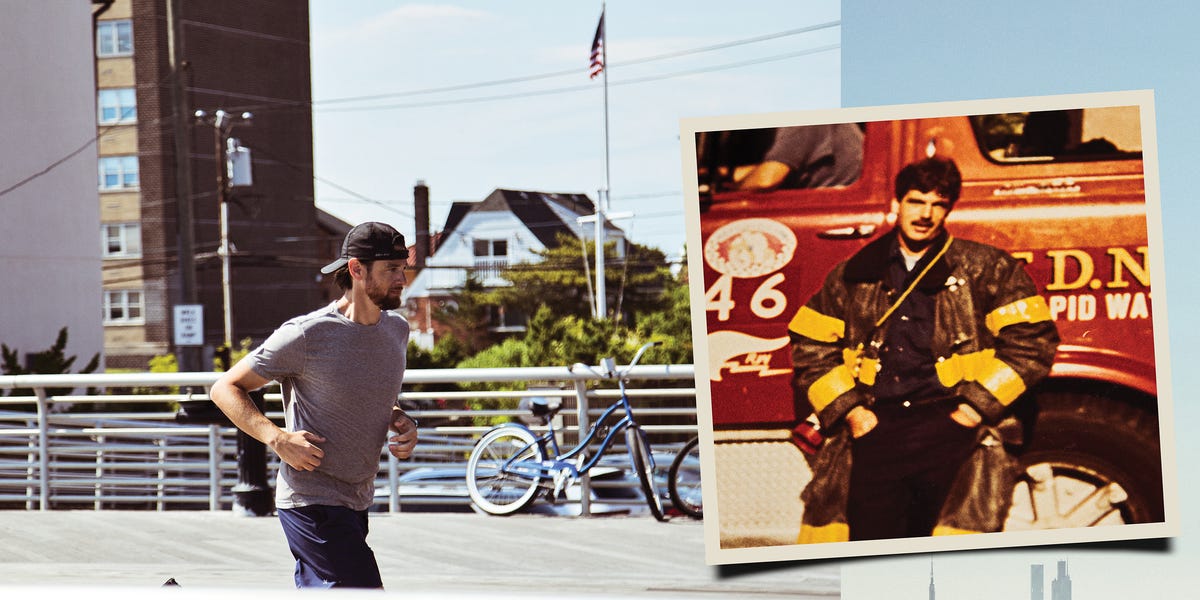
The burgers and hot dogs and beer couldn’t start flowing until Wojo crossed the finish line. And that took some time because Wojo, at 5 feet 10 inches and topping 250 pounds, a “Clydesdale,” needed at least two and a half hours to run the half marathon on Long Island every spring. But what was the hurry? The burgers and Bud would last well into the night on the deck of 82 East Beverly Parkway. Mope would make sure of that.Mope was Orio Palmer, and Mope was what Wojo called his firefighter buddy and running partner almost from the day they met in their Bronx firehouse. Wojo arrived first at Engine 46/Ladder 27 in 1981, and on his first day the captain looked at his name—Bill Woytkiw—and said, “I can’t pronounce that. From now on you’re Wojo.” The name stuck for Wojo’s 26 years in the FDNY. When Palmer got to the firehouse the next year and started showing everyone what would one day make him an icon in the department—an energy, a diligence, a cheerfulness, a willingness—Wojo took an instant liking to him. He remembers Mope, early on, painting the firehouse using nothing but a small brush. “I said to him, ‘What, are you bored?’” Wojo recalls. “And he says, ‘No, I just like keeping busy.’”That impulse took other forms in the years that followed. Mope had studied electrical engineering at community college before joining the FDNY, and he could unscramble problems that bedeviled others. He devised new telecom systems to help firefighters communicate better with command posts while underground in the NYC subways. He figured out more efficient ways for firefighters to use hoses in cramped apartment buildings and stay farther from the flames. He published his findings in the FDNY magazine and rewrote training manuals. Friends like Wojo say Mope never stopped looking for ways to make firefighting safer. That’s one reason Orio Palmer got the nickname “Hummingbird on Speed” and why some people thought he could one day run the department.But Wojo simply called him Mope “because the last thing he does is mope around.”For 11 straight years, starting in 1991, Wojo and Mope and anybody else they could corral from the department would run the Long Island half. Mope—in white socks up to midcalf, short shorts, and an FDNY muscle tee—got around the course in 1:45 or so. He went 5-foot-11, was lean, big in the biceps but few other places, the opposite of his friend. “You’re a Fiat,” Wojo would tell him. “I’m a Mack truck.” But after finishing every half, Mope, sweat dripping into a dark mustache, waited for his buddy.They’d then head to Mope’s deck, the one he’d added onto the back of the colonial he and his wife, Debbie, had bought in Valley Stream just before the first of the three Palmer kids arrived. The house was a few blocks from Hendrickson Park, where he liked to run. He’d start grilling, and the Bud got tapped and the music got louder. All of Mope’s favorites—the Eagles, Lynyrd Skynyrd, The Rascals (he could listen to “A Beautiful Morning” all day long). And the busting of chops and the storytelling would kick in, too.His son, Keith, would often be nearby. “He was like a puppy dog,” says Gerry Kelly, the Palmers’ next-door neighbor. “He’d be hanging out with us, even though he didn’t know what we were talking about. He just wanted to be with the guys.” Keith would listen as they told stories, Mope and Wojo rehashing long-ago fires. With each retelling, a trash can fire from a decade ago somehow turned into a four-alarmer. Everyone would laugh, and so would Keith.Burgers and dogs and nothing fancier than Budweiser. And family. The simple ingredients to an annual party that started once Wojo crossed the finish line and lasted deep into an early spring night, on the back deck of Mope’s house in suburban Long Island.It’s how Keith Palmer remembers his dad in the hours after a long run, and before the planes took down the towers.On Monday, September 10, 2001, Orio Palmer needed to leave the house by 4 p.m. for the commute to Manhattan and an overnight shift at the firehouse on West 19th Street. The kids were home from school—Dana had just started high school, Alyssa was in fourth grade, and Keith was in sixth. He said goodbye to the girls and said to Keith, “You’re the man of the house,” as he usually did when he left for work. Then he got in his Oldsmobile Cutlass for the five-minute drive to the train station.Orio was nearly 20 years into his career and now a battalion chief. Keith idolized him. He coached third base for Keith’s Little League team, played Nintendo 64 with him when the kid should have been doing homework, let him steer the family motorboat when he could barely see through the windshield. “Keith was such a daddy’s boy from the time he was a baby,” Dana says.Winston ZhouKeith stretches at home before a run.Winston ZhouOne World Trade Center, where the annual Tunnel to Towers Foundation Tower Climb NYC takes place.Mostly Keith loved just being with his dad, but when he wasn’t, he did what most 11-year-olds did in the early aughts: play with Crazy Bones, follow Derek Jeter and the Yankees, ride bikes with his friend Nick Mancini, his best buddy since third grade.Usually, after a Monday overnight, Orio would be home on Tuesday to pick the kids up from school; Tuesday was the day Debbie worked in the city. But he was on a mutual, a 24-hour tour. So a little after 1 p.m. on Tuesday, September 11, Gerry Kelly, the Palmers’ neighbor, took the three kids home.It’s been nearly 25 years, and Keith’s memory is fuzzy, but a day later, maybe two, he was sitting on the sidewalk in front of his house, looking every so often up or down East Beverly. His dad hadn’t been home since Monday afternoon.Keith Palmer would rather forget those days ever happened. But he remembers he was outside playing with Crazy Bones. The late afternoon sun was warm. He looked up once more and saw the Cutlass coming.Keith jumped up and the whole neighborhood could hear him scream, “My dad’s home! My dad’s home!”For the first 14 years of his life, Orio Palmer lived in a walk-up tenement apartment in the South Bronx with his parents, two older brothers, and three sisters. He shared a small bedroom—as well as underwear and socks—with his brothers. “We were all the same size,” says Vincent, 16 months older than Orio. “You couldn’t be closer.”The South Bronx in the late 1960s and early ’70s had sky-high crime rates and lots of mischief. Kids would often pull the fire alarm box just to get the engines to come down the block. Orio never pulled the alarm, but when he’d hear the sirens, “he’d run to the window,” his sister Aggie McCaffrey remembers. “He was fascinated by the fire trucks.” And the prospects of one day becoming a fireman.If the Bronx was rough, Orio Palmer made sure he could handle it. His tiny bedroom had just enough room for a weight bench and dumbbells. After dinner he’d head there and lift. Another reason to toughen up was the teasing he sometimes got. “Kids on the block would call out ‘Oreo cookie,’” Vincent says. The name had been passed down from his father and grandfather. No one knew the name’s origins, but Orio III knew no son of his would inherit it.Just before Orio started high school, the family moved to a more docile section of the borough, Woodlawn. The apartment was near a schoolyard, and Orio and his brothers spent hours there. “We played stickball, stoop ball, handball, things that the kids don’t do anymore,” Vincent says. “Orio was always on the move, never stopped.”Winston ZhouA collection of Orio Palmer’s running keepsakes as well as the helmet Keith wore the first time he visited Ground Zero, an engraved bracelet in remembrance of his dad, and pieces of steel from the South Tower.That extended to running, which Orio began doing consistently in his early 20s after seeing his brother do a marathon. He and Vincent would lace up their Converse high-tops and head to the 400-acre Woodlawn Cemetery, where they’d talk their way through four-mile laps before grabbing a Bud at a local tavern. “We didn’t need a team or any expensive equipment,” Vincent says. “We saw it as offering both mental and physical health benefits. More importantly, it was fun.”They started running 5Ks and doing triathlons, too. After the bike leg, the brothers would start the run with a mission. “You do head-hunting,” Vincent says. “We used to pick the guy in front of us and think, He’s got nothing on me, and you catch him.” Vincent and Orio would keep going until there were no more runners to reel in.This was in the early 1980s. Orio was dating Debbie Doyle, another kid from the Bronx, and waiting for the call to join the FDNY. In the meantime, he worked for an elevator company in lower Manhattan, not far from the World Trade Center. He learned everything he could about elevators, especially how to fix a broken one. It was a good job, but nothing could keep him from being a firefighter when the call finally came.For days after the Towers came down, the family waited for news. Orio was on an FDNY unaccounted-for list, but they kept hoping. Maybe he was in a pocket of the fallen towers’ rubble, waiting to be discovered with other first responders and employees from the Trade Center.Neighbors came to the house with meals and asking how they could help; one drove Orio’s car back to East Beverly Parkway from the train station. Others tied yellow ribbons to trees, and one kept pumping Springsteen’s “Born in the U.S.A.” from a window. On September 13, following an evening church vigil, Debbie and the kids returned home to see neighbors lining the block holding candles.Debbie thought a little normalcy might be good, so she sent Keith, Alyssa, and Dana back to school that Friday.After school, Keith hung out with Nick Mancini, playing ball and riding bikes. They didn’t talk about Keith’s missing dad. “We don’t know what to say, we’re 11 years old,” Nick recalls. One night, Nick’s dad took the boys to a Yankees game. It was the first one at Yankee Stadium after Major League Baseball resumed play following September 11. Nick doesn’t remember who won, but he does remember “my dad holding Keith the whole game.”Around the house it was hard for Keith not to think about his dad. There were photos, for sure. There was the piece of paper, the size of a Chinese fortune cookie slip, that his dad had taped to the refrigerator years earlier, with the words: “Remember, as always: Live while you’re alive.” And there was the pull-up bar that hung across a bedroom door where Orio would often crank out a couple of sets after a run. The FDNY had a fitness test, and for the longest time Orio Palmer had the record for completing it. Each time he was up for a promotion, he took the test. Five times over his 20 years in the FDNY he passed the requirements: 50 push-ups, 8 to 10 dead-hang pull-ups, 72 sit-ups in two minutes, and a five-mile run in 40 minutes. In the 40 or so years the test has been given, fewer than 10 percent of firefighters have earned the medal that comes with completion.Winston ZhouOrio Palmer’s helmet and helmet shield from when he was chief.Winston ZhouThe view from One World Trade Center.Mike Cacciola, a former FDNY lieutenant who used to administer the test, says the sit-ups were the hardest. “Everybody bangs out 50 in the first minute,” Cacciola says, “but the last 22 are brutal.”Orio made sure he was ready. He’d prep by taking off from the house and heading left, to Hendrickson Park, for a five-mile loop. He ran with a Walkman tuned to classic rock. He liked running in the heat; he wanted conditions he might face in a blaze. “I remember him saying, ‘I never want to be in a fire, doing something physical, and not be able to accomplish it,’” says neighbor Gerry Kelly, who was a New York City police officer for 20 years.When he’d return home, the kids joined in. Alyssa or Keith would climb on his back during push-ups. Sometimes Keith would hang onto his biceps as he did pull-ups. When it came time for sit-ups, Dana held down his ankles. It was a family affair; no one minded the sweaty dad making them all a little icky.As September inched toward October, though, it became apparent there would be no more fitness challenges and no more runs. Orio Palmer, 45, wasn’t coming home. A funeral Mass was held on October 13. The church filled with family, old friends from the Bronx, and new ones from Long Island. Wojo, of course, was there, with fellow members of the Bronx house where Orio’s career started. And there were firefighters from the houses in Brooklyn, Queens, and Manhattan where he’d been stationed. Orio’s last firehouse, in Chelsea, had lost five men, including their battalion chief.Twenty-five years later, many of those firefighters still choke up when recalling portions of the letter Dana read to her father at the funeral. She would soon turn 14; for her first birthday, Orio ran his only New York City Marathon, dedicating it to her. “You never took anything for granted,” Dana read to the congregation. “Any baseball game we were at or any sunset we saw, you taught us to appreciate, because we’d never see anything like it ever again.”A light rain starts to fall, so Keith Palmer gathers up the photos and albums and other mementos he had put on an outdoor patio table at his home in Long Beach. The house is not far from the one he grew up in. It’s a June Saturday, and Keith has the place to himself for a few hours. His wife, Kristin, is with the couple’s two young daughters at a ballet class. He plans to go for a run in the afternoon, but not a long one. He has a race tomorrow, so no need to work the legs too much today.Now, at his dining room table, he pulls out photos of his dad playing softball, his dad skiing. There are some with Debbie at family events, and a bunch of postrace photos with Wojo and other firefighters. There’s a frame with photos of Keith and his dad fly-fishing. He recounts the time his dad and mom took the kids to Maine. They hiked Cadillac Mountain in Acadia National Park, but once they neared the top, Alyssa was wiped. “My dad ran down the mountain, got the car, came back for us,” Keith says. Then they went for ice cream.Keith points to the medals his dad earned for completing the FDNY fitness challenge and a mug from the 1988 New York City Marathon, which he finished in 4:14:29. Keith plans to run the marathon this November, hoping to beat his dad’s time.Orio Palmer’s job required him to be fit—so he ran. Keith Palmer has other reasons to run.Keith did not want to be known as a 9/11 kid, one of the young survivors of the 2,977 killed on September 11, and for a long time he tried not to let the date identify him, or the memory of his dad overwhelm him. “I think a lot of people keep people’s memories alive by talking about them after they’re gone,” he says. “I couldn’t do that.”Debbie understood and let the kids grieve in their own manner. The girls took advantage of counseling the FDNY offered, but Keith resisted. On days a counselor was due after school, he dawdled getting home. Debbie saw what Keith was doing but avoided forcing treatment on him. She also wanted him just to try living. So, she let Keith find his way, as a teen and then as a budding college student, even though it was hard—for both of them. He’d remember his father’s last words to him, and wonder, “Shouldn’t I be the man of the house?”Winston ZhouKeith and his brother-in-law, Joe Runfola, wearing Team Orio shirts at the 2026 T2T Tower Climb.In many respects, the years that followed were otherwise typical. Keith made his high school varsity baseball and football teams. He hung out with friends, got A’s and B’s, went to parties, was into video games, looked ahead to college. And, when he was up for it, he did things other 9/11 kids would do, like attend memorials for his dad and other victims. Other times, he avoided events altogether. Each September, the Palmers would attend a remembrance service on Long Island for local residents who died on 9/11. Keith accompanied his family the first few years, then decided he’d rather remember his dad by going fishing or for a run.When strangers discovered Keith’s 9/11 connection, he’d be polite and share something about his dad. But with family and friends, he was tight-lipped. He had his memories. The backyard barbecues. Hanging from his biceps. He wanted to hear his dad blasting “A Beautiful Morning” one more time while he and his sisters tried to sleep in. He wanted to look up to the bleachers from the baseball field and see his dad. “Keith shut down, he shut down for a long time,” says Ken Doyle, his uncle. “I took him camping once to try to get him into a setting that maybe he would want to talk—because there’s nothing else to do when you’re out camping in a tent. And he still wouldn’t talk.”For sure, other 9/11 survivors felt the sadness of losing a parent. It wasn’t easy for anyone, and Keith understands that. But his burden got especially heavy when the family, and the world, learned what Orio Palmer did in his final moments.Initially, Keith and his sisters and mom only knew that Orio had died when the South Tower collapsed at 9:59 a.m. on September 11, the first of the two towers to implode. Then, the following summer, the FDNY notified Debbie that they’d gotten access to recordings from the day—and her husband’s voice was prominent on them.On an August morning, she headed to a hotel near Penn Station with Orio’s sister Aggie and her husband, Jim McCaffrey, an FDNY lieutenant, to listen to the tapes—and discover how every decision Orio Palmer made in his final 75 minutes reflected the way he’d chosen to live his 45 years.Winston ZhouA memorial plaque in Hendrickson Park in Valley Stream, N.Y., where Orio used to run.Winston ZhouOrio Palmer’s firefighter jacket.Orio and members of his Chelsea firehouse arrived at the Trade Center shortly after the first plane struck the North Tower at 8:46 a.m. He immediately put his engineering skills to work, repairing faulty radio receptors, which allowed fire officials to communicate inside the high-rises. Then he got a disabled elevator in the South Tower to function. From the tapes Debbie heard a distinctive Bronx accent emerge between the squawks and white noise:This is Battalion 7 on Floor 40 of Tower 2. We got one elevator working up to the 40th floor. That’s as high as the elevator would go. From there, those days of lifting in his crowded Bronx bedroom, of running in the summer heat, of racing half marathons with Wojo, took over. Hundreds of people were stranded above the 78th floor, the start of the impact zone. To get them down, firefighters needed to get up there and above. There was only one way. Orio Palmer—the man nicknamed “Mope” because he was anything but, the man nicknamed “Hummingbird” because his energy seemed endless—started climbing a dark stairway that would get smokier the higher he rose. He climbed while Trade Center employees rushed down. He carried 50 to 60 pounds of gear and equipment. It would take somewhere around 30 minutes, about the time to run a 5K.Debbie, Aggie, and Jim listened in silence for Orio’s voice to puncture the static.We’re on the 43rd floor, Stairway B.I’m up to 5-5.We’re going to have to hoof it. I’m on 69 now, but we’re going to need a higher bank.10-4. Six more to go.The closer he came to floor 78, the more his breathing became labored, and what he witnessed more disturbing.B stairway walls have been compromised on 73 and 74. The walls are breached so be careful.Battalion 7…Ladder 15, we’ve got two isolated pockets of fire. We should be able to knock it down with two lines. Radio…radio that, 78th floor numerous 10-45 Code 1s [civilian casualties].By 9:58 a.m., Orio had made it to the 78th floor, and for a brief moment he gave those stranded reason to hope. Then his final recorded words:Battalion Seven to Ladder 15— Debbie knew what would happen seconds later. Still, she kept silently urging her husband to hurry up, then turn around and come home. She later told The New York Times, “I didn’t hear fear, I didn’t hear panic. When the tape is made public to the world, people will hear that they all went about their jobs without fear, and selflessly.”Keith Palmer is 36 years old now. He has a job that combines his affinity for technology with the marketing degree he earned in college. He oversees more than 30 websites for an automotive finance and insurance company. His résumé shows he’s worked for major global brands during his career. On paper, success.But being the son of Orio Palmer brings reminders, and expectations.Once news of Orio’s heroics, of climbing 38 floors in hopes of saving lives, got out, the media descended on 82 East Beverly Parkway. Producers, from 60 Minutes to independent documentarians, wanted to know more about the man who raced up while others hurried down. Honors and recognition came as well. The FDNY posthumously made Orio a Deputy Chief. Streets in Valley Stream and the Bronx were named after him. A firefighter in South Carolina named his Dalmatian service dog Orio. Starting in August 2002, firefighters who completed the FDNY fitness challenge received the DC Orio Palmer Memorial Physical Fitness and Health Award. Google “Orio Palmer” and the links are in the hundreds. The name that once annoyed a kid from the South Bronx was now seemingly everywhere.“After 9/11,” Keith says, “he was still my dad, but for everybody else, he was a 9/11 FDNY hero.” And that weighed heavily.When his college newspaper learned about his dad, it wanted a story. The headline: “This is me: A hero’s son.” And if people weren’t asking questions about Orio, they wanted to know, Are you going to become a firefighter like your old man? The answer was no. Keith didn’t grow up charging to the window looking for fire trucks. He grew up playing Nintendo; he liked tech gadgets. He didn’t aspire to the life of a civil servant. “My goals took me in different directions,” he says.When the questions mounted, he did what his dad did: He went for a run. At Quinnipiac University, in Connecticut, he was known to suddenly bolt from his dorm and go four to five miles. Running came easily. One year he ran the Long Island half marathon, the one his dad did for years, on little training. He ran 5Ks with family members that raised money for families of fallen first responders and veterans. “Running was my outlet,” he says. “Whenever I was in a bad place mentally, it was always running.” The rest of life was more complicated.After college, Keith worked at a series of digital advertising jobs. Shortly after he got married, in 2018, to Kristin McAteer, a fellow Quinnipiac graduate, he took a sabbatical from work. “Keith has this intrinsic pressure,” Kristin says, “of ‘Wow, I’m Orio Palmer’s son, and what the hell am I doing if I’m not building something that I can pass on to my children?’”“After 9/11, he was still my dad, but for everybody else, he was a 9/11 FDNY hero.” And that weighed heavily.“I build things that you can never touch, other than with a mouse,” Keith says. His dad, meanwhile, “was out there having this very real impact on the world. He’s memorialized all over.” He pauses. “So, to have been able to carry on his legacy…it was something I struggled with.”Running helped, until it didn’t. One day in 2018, he was walking along the shoreline in Jersey City where he and Kristin then lived. “I was dissatisfied, feeling like I was doing meaningless work,” he says. “I was depressed.” He looked across the Hudson River to the New York City skyline, now highlighted by One World Trade Center, the replacement for the fallen towers. He felt nervous, jittery, frightened. A panic attack. “It was like the most severe case of fight or flight overpowering my body,” Keith says, “and the flight part winning.” He got back to his apartment, called Kristin, and settled down. In the weeks that followed, Kristin would insist he seek help.After years of holding back his frustrations and sadness, he opened up to an FDNY psychotherapist. He was eventually diagnosed with a form of depression. He also finally started to learn to live with the loss of a father, the hero to so many others. “I’ve gone down that road of meditation and mindfulness, and practicing gratitude for the here, the now, what you have, who you have,” he says. He sorts for the words, then says of his dad. “Having this label as a hero posthumously…it has been and will probably always be something I…try to live up to.”On a Sunday morning in June 2025, Keith Palmer crawled out of bed. It was still dark when he left his Long Island home and drove west toward Manhattan. As he approached the city, he glanced south. “I see the skyline come over the horizon,” he says, “and seeing that building I was about to climb—that was when I got emotional.”That building was One World Trade Center, the site of the Tunnel to Towers Foundation Tower Climb NYC, an annual event where 1,200 or so people raise money for the opportunity to ascend the 104 flights of the tallest building in the U.S. He’d been training the past two months, running, lifting, using the StairMaster. He told only a handful of people about his plans, including Dana, Alyssa, and a few other relatives. On the day of the climb, even Kristin stayed home. “It was just for me to feel closer to [my dad] and try to understand, at least from a physical standpoint, what he was doing that day, what he was experiencing,” Keith says.Winston ZhouOn the 104th floor observatory after the 2026 T2T Tower Climb: Keith Palmer and his wife, Kristin Palmer, center; his sister Alyssa Artoglou and her husband, Tony Artoglou, left; his sister Dana Runfola and her husband, Joe Runfola, right.At the tower, few people recognized him. The climbers went off as singles, some racing, others taking their time. Keith wanted to finish in about 30 minutes. He got close, clocking 30:09. “When I actually started making my way up,” he recalls. “I was focused on the task at hand and less in my own head.” When he got to floor 78, he slowed to touch the wall.In an off-duty room of Engine 289/Ladder 138 in Corona, Queens, there’s a framed copy of the letter Orio Palmer wrote to house members when he was reassigned to a new station in 1997. It mentions the 3,000 runs he went on with the crew, the people they helped, and what it meant to be their chief. In another frame is a copy of the letter Dana read at her dad’s funeral. Tucked in the corner of that frame is a Mass card for Debbie Palmer, who died at 61, shortly after being diagnosed with cancer in 2021.In the basement of Engine 3/Ladder 12/7th Battalion, on the west of side of Manhattan, is a small gym with some barbells, a StairMaster, a treadmill. On a cement post in the center of the room, scribbled in chalk, is the Orio Joseph Palmer Memorial Workout. It’s seven sets of five pull-ups, 10 push-ups, and 15 squats followed by a 72-story climb on the StairMaster. Daniel Apasewicz, 36, a second-year firefighter, was assigned to the station out of probie school. Like Keith, he was 11 when 9/11 happened. He has broad shoulders, a narrow mustache, and a clean-shaven head. Next spring he plans to go for the FDNY’s Deputy Chief Orio Palmer Memorial Fitness Award. “It’s definitely a challenge,” Apasewicz says in a clipped, Brooklyn accent. Then he adds the obvious: “The biggest challenge is probably the sit-ups: 72 in two minutes.” His voice tails off.When Keith Palmer hears about Apasewicz and that he’s training for the FDNY fitness award, renamed in honor of his dad, he smiles. He’s sitting at his dining room table looking through the old photos. The young Orio mirrors his son, the same dark hair, the lean frame. “I hear it all the time,” Keith says. “When I go up to his old neighborhoods, everyone says I look like my dad.” He moves his dad’s souvenir mug from the New York City Marathon in 1988. His dad’s time of 4:14:29 is embossed on it. When Kristin ran her New York, she finished in 4:36:24. She won’t be surprised if Keith tries to beat both those times in November. He says he might use ChatGPT to sketch out his training program.But first he has one more climb.The next day, nearly a year to the day after his first climb, he returns to lower Manhattan, this time not alone. Kristin has come to climb with him, and so have Dana and her husband, Joe. Alyssa is spectating with her husband, Tony. They had been out late the night before at a wedding and were not ready to climb 104 floors. “Next year,” she says with a smile.The four begin climbing, Keith taking an early lead, hoping to beat his previous time. But then he slows down, letting Kristin catch up. Dana and Joe make their way past. They’ll get to the top in just under 34 minutes. Keith and Kristin, 38 minutes. “Mid-climb, I realized I wasn’t doing it for time this year,” Keith says, “I just wanted to do it with them.”It’s crowded on the top floor—climbers who have been done for a while, others who’ve just finished and are catching their breath. Keith, his sisters, and their spouses make their way to a spot near a floor-to-ceiling window that looks out to the city. They drove into lower Manhattan in the dark, but now the sun is taking hold. It’s looking like a beautiful morning.
In the Footsteps of a Hero
Full Article
Original Source
Read the full article at Runnersworld →KhanList aggregates and links to publicly available news content. We do not host full articles from third-party sources. Always verify important information with original sources.