
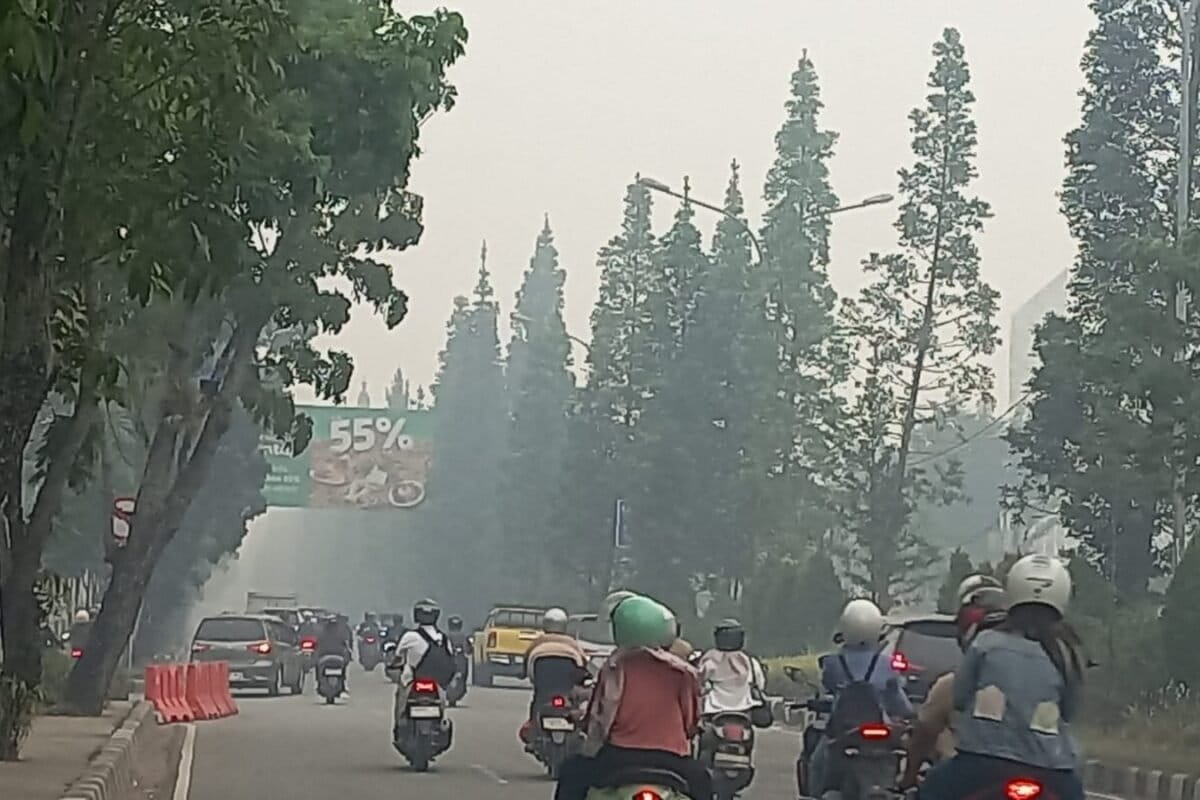
Air quality in cities and districts across Southeast Asia has reached hazardous levels in recent weeks owing to transboundary haze from wildfires in Indonesia.The pollution has limited outdoor activities, caused or contributed to health issues and forced children to stay home from school.Mongabay spoke to people in Indonesia, Malaysia, Singapore and the Philippines to find out how the transboundary haze and wildfires are affecting their daily lives. KUALA LUMPUR — Video editor Mohamad Haazim has lost count of how many times he refreshes Malaysia’s Air Pollutant Index (API) website every day to check air quality in the city where he lives. It’s been hovering between “unhealthy” and “hazardous” in recent weeks. Haazim, who asked to be identified only by his given names for privacy reasons, lives in Kuching, the capital of Malaysia’s Sarawak state. It is known as one of the cities with the cleanest air quality in the country, but since last month, Kuching has earned a dubious distinction of being the world’s “most polluted major city,” according to IQAir, a Swiss-based air quality technology company. The culprit? Smog from Indonesia’s wildfires. “It has deeply disrupted my daily routine,” Haazim said of the haze. “Outdoor routines are completely on hold; morning and evening walks are out of the question.” An avid marathon runner, Haazim no longer runs five times a week outdoors. “I am now down to just two indoor runs,” he told Mongabay last week. At home and at work, he said he ensures windows are shut tight, with air purifiers running at full blast. Kuching riverside in the city center is shrouded in thick haze in Kuching, Sarawak state, Malaysia, on Sept. 4, 2026. Image by AP Photo/Xpin Voon. He can’t forget his long drive home from Lawas, a Sarawak town located between Sabah and Brunei, on Aug. 31. “The haze became much thicker as we went back to Kuching,” he said. “As we arrived in Kuching, it was like a video game, like a Silent Hill type of scenery,” he added, referring to the popular survival horror video game. He said it was like he suddenly entered “another dimension.” Transboundary haze first arrived in Sarawak, in the northern part of Borneo Island, in mid-August this year. The toxic air has lingered since then, except for a few days of respite, thanks to rainfall induced by cloud-seeding operations. Earlier this month, the air quality was so bad that the Malaysian government declared a state of emergency in Serian, a border district south of Kuching, located about 50 kilometers (31 miles) from Indonesia. Nearly 200,000 students in Sarawak had to resort to online learning as authorities closed 647 schools in 12 districts from Sept. 7 to 11. Haze has spread to other parts of Borneo, including the Malaysian state of Sabah and the oil-rich sultanate of Brunei. It has also reached as far east as the Philippines, and as far west as Singapore and Peninsular Malaysia. Screenshot of a map from the ASEAN Specialised Meteorological Centre that shows the regional haze situation in Southeast Asia on Sept. 14, 2026. On Sept. 14, three major Southeast Asian cities — Kuala Lumpur, Singapore and Kuching — occupied the top three positions for worst air quality in the world, in that order. On the same day, the ASEAN Specialised Meteorological Centre detected haze in southern Vietnam. From headaches to skin rashes Youth activist and school teacher Priska Magdalena Sinem, who lives in Kota Belud, Sabah, in northeastern Borneo, said haze had affected her health, making it difficult for her to conduct outdoor activities, such as jogging and evening walks. “I’ve had headaches several times due to the heat and haze,” she told Mongabay. “The haze often causes dizziness and fatigue, which makes driving [to and from work] and meeting people throughout the day quite challenging.” In Peninsular Malaysia, people have posted photos of the Kuala Lumpur skyline, including the iconic Petronas Towers, blanketed in haze on social media. Theater practitioner Tarrant Kwok complained of having a sore throat several times in recent weeks, as well as coughing up phlegm. The Kuala Lumpur resident was concerned when his 88-year-old grandmother got a respiratory infection, saying that he was “worried that the haze would make it unmanageable.” Haze from Indonesia’s wildfires obscures the sun in Kuala Lumpur, Malaysia, on Sept. 15, 2026. Image courtesy of Estelle Ng for Mongabay. Elsewhere in Kuala Lumpur, Estelle Ng, a mother of two, discovered her eldest child, 4, had skin rashes, a common health effect of haze. She said she also heard from other parents at their kindergarten that children with asthma suffered from breathing issues after air quality worsened. Malaysian authorities warn that haze can cause various health issues, including itchy throat, coughing, sneezing, a runny nose, difficulty breathing, watery eyes, itchy skin and chest pains. In late August, the health ministry announced that within a week, cases of asthma had jumped by 259%, while upper respiratory tract infections rose by 124%. Singapore started issuing haze advisories on Sept. 4, when transboundary haze caused the 24-hour Pollutant Standards Index (PSI) to hit unhealthy levels — the first time since October 2023. The city’s haze task force began implementing mitigation measures, including opening air-conditioned rooms in community centers to the public and ensuring classrooms are equipped with air purifiers. “We use air purifiers,” Singaporean resident Jeannie Hoh told Mongabay. “We have one in the living room and one in the bedroom. The haze is bearable if you are mainly indoors.” Nonetheless, Hoh, who suffered from sinusitis, said she noticed that outdoors, “the smell in the air is quite nauseating.” Schools have also taken precautionary measures. When Hoh dropped off her two-year-old son at kindergarten last week, she said the teacher told her there would be no outdoor activities. Haze began to drift across the Sulu Sea in late August, reaching the Philippines from Indonesia. In the first week of September, air quality reached “acutely unhealthy” levels in parts of Luzon island, including Manila’s metropolitan areas; the Visayas island group; and Mindanao island. Authorities suspended schools in multiple cities, including Cebu City, where students had to learn remotely for several days, from Sept. 2 to 9. Haze shrouds the skyline of Antipolo, a city near Metro Manila, on the Philippines’ Luzon island, on Sept. 1, 2026. Image by AP Photo/Aaron Favila. Emma Santillan, a social worker in Cebu City, said she couldn’t smell the haze but could feel it. “The texture of the air was different,” she said, describing an itchy sensation in her nose and a gritty feeling in her eyes. She said the smog was so thick that for several days she could not see the cumulus clouds normally visible in the sky. People wore face masks when they went outside, she told Mongabay, “There were also people who were coughing.” In Quezon City, part of Metro Manila, Sally Truita, a mother of three, said the sight and smell of the smog made her uneasy, reminding her of a recent house fire in her neighborhood. “When I smelled it, I got scared because of what happened to our neighbor whose house burned down,” she told Mongabay. Playing with fire Wildfires have raged across Indonesia since July, exacerbated by a “super” El Niño, which brings extremely dry conditions. The government has dispatched tens of thousands of firefighting personnel, along with water-bombing operations and weather modification missions to bring rain, but fires and haze remain severe. Burnt peatland in Central Kalimantan province, Indonesia, in August 2026. Image by Krismes Santo Haloho/Mongabay Indonesia. As of Sept. 14, FireWatch, a satellite monitoring platform, had detected more than 617,400 fire hotspots, which indicate potential fire sites, across the country — more than double the number during the same period in 2019, one of Indonesia’s worst wildfire seasons. More than 895,000 hectares (2.2 million acres) had been burnt as of August 2026, 33% more than the same period seven years ago. Fire emissions from Indonesia from Sept. 1 to 7 this year soared to 19.7 million metric tons, the highest in the world, according to data from Fire Emissions Watch, a portal from the European Union’s Copernicus climate monitoring service. As in previous years, many fires burn on peatlands in low-lying areas in Sumatra and Kalimantan, Indonesia’s part of Borneo. According to the country’s National Disaster Management Agency (BNPB), wildfires have scorched more than 72,000 hectares (18,000 acres) of peatlands in six provinces across Sumatra and Kalimantan this year. Firefighters battling a blaze in Central Kalimantan in 2026. Image courtesy of Indonesia’s National Disaster Management Agency (BNPB). The recurring wildfires are closely linked to wide-scale deforestation. Between 1990 and 2024, 18 million hectares (45 million acres) of natural forest, an area about 60 times the size of Yosemite National Park in the U.S., disappeared in Indonesia, with peat swamp forests suffering the highest proportional loss rate. During the same period, oil palm plantations and timber concessions expanded dramatically. Fire is often used as a cheap, albeit risky, method to clear land. But once burning gets out of control and peatlands catch fire, it becomes very difficult to extinguish. The blaze can burn underground undetected for a long time before emerging to the surface. Indonesian officials and green groups agree that the majority of the fires were deliberately caused, either by individuals or corporations. Investigative journalists and environmental activists found that around half of hotspots, including those in Central and West Kalimantan provinces, occurred in industrial concessions. Besieged by wildfires Surrounded by peatland fires, residents in Indonesia’s Borneo see no end in sight, as air pollution indicators have reached “hazardous” levels for weeks in many areas, such as Palangka Raya, the capital of Central Kalimantan. Pontianak, the capital of West Kalimantan province, has topped the list of Indonesia’s most polluted cities since last month. Pontianak resident Tursih is worried about her children’s health. “My kids have been coughing and having a cold for several weeks,” she told Mongabay in late August. She and her family try to limit their outdoor activities, she said. They wear masks when they go out but cannot afford the recommended N95 masks. “These are the ones we bought,” she said, pointing to the surgical face masks they were wearing. Haze blankets Pontianak, a city in Indonesia’s West Kalimantan province, on Sept. 3, 2026. Image courtesy of Tursih for Mongabay Indonesia. Tursih’s children have been studying remotely for weeks. “The haze is thick. Schools are still closed; we’re learning online,” she said. A thousand kilometers away, Palangka Raya resident Ilma Naela Anjeli found that a fire was just 200 meters (656 feet) from her home. “We were worried the blaze would get worse,” said Ima, who lives with her 60-year-old mother and her five-month-old baby. “We were completely trapped.” Luckily, firefighters could put out the flames before reaching her house, but the smoke lingered, she said. “When the flames began to die down, smoke and ash actually seeped into the house and settled on the surfaces of all our belongings,” she told Mongabay in early September. “This made us feel short of breath and dizzy.” The Indonesian health ministry said at least four people have been killed by the wildfires, including three volunteer firefighters in Central Kalimantan. One of them was Akhmad Rizani, the head of a sub-district-level volunteer fire department in Palangka Raya. His colleagues said he collapsed while fighting fires on peatlands on Aug. 27. Shortly after Rizani’s funeral on Aug. 28, his colleagues went on to fight wildfires. In the afternoon, they raced to rescue and evacuate a family of eight who were trapped in a wildfire. Funeral of volunteer firefighter Akhmad Rizani in Palangka Raya, Indonesia’s Central Kalimantan province, on Aug. 28, 2026. Image by Krismes Santo Haloho/Mongabay Indonesia. Amid the disaster, a sense of solidarity emerged, with residents stepping in to help fellow residents. In Pontianak, Muhammadiyah, Indonesia’s second-largest Muslim organization, opened Rumah Oksigen (Oxygen House), giving free oxygen treatment and dispatching volunteers to deliver oxygen tanks door-to-door to residents and frontline firefighters. In Palangka Raya, the Central Kalimantan Wildfire Fire Haze Response Coalition (Rakat), consisting of civil society groups and student organizations, runs two safe houses for affected communities. They are equipped with air purifiers, nebulizers, oxygen tanks, infant formula, vitamins, baby diapers and masks. Adelina Saragih brought her seven-year-old son, who was coughing and wheezing, to a Rakat safe house. He had never coughed so badly, she said. She was also worried about how the haze would affect the health of her three-year-old. Adelina Saragih brings her two children to a safe house run by Rakat in Palangka Raya, Central Kalimantan, Indonesia, on Aug. 30, 2026. Image by Krismes Santo Haloho/Mongabay Indonesia. According to data from the Indonesian health ministry, reported by local media, as of Sept. 9, more than 12.5 million people had been affected by wildfires in seven Kalimantan and Sumatra provinces worst-hit by the inferno. It recorded 113,336 acute respiratory tract infection cases in 32 districts in Kalimantan alone. In a report released on Sept. 14, the Center for Research on Energy and Clean Air (CREA), a Finland-based think tank, said that air pollution from wildfires led to 1,700 deaths in August, with residents in West, Central and South Kalimantan provinces facing mortality risks three to four times higher than those on Java island. The number of haze-related deaths may increase, as historical data shows that during El Niño years, wildfires usually peak between late September and November, CREA said. “August was only the onset,” it added. Choo Ching Yee reported from Kuala Lumpur, Malaysia; Oliver Samson from Manila, the Philippines; Irfan Maulana from Jakarta; and Krismes Santo Haloho from Palangka Raya, Indonesia. Banner image: Haze blankets Pontianak, a city in Indonesia’s West Kalimantan province, on Sept. 3, 2026. Image courtesy of Tursih for Mongabay. Rescuers scramble to save orangutans as El Niño-boosted fires spread across Borneo Rescuers scramble to save orangutans as El Niño-boosted fires spread across Borneo Rescuers scramble to save orangutans as El Niño-boosted fires spread across Borneo Credits Topics
In Southeast Asia, residents grapple with life under Indonesia’s wildfire haze
Full Article
Original Source
Read the full article at News →KhanList aggregates and links to publicly available news content. We do not host full articles from third-party sources. Always verify important information with original sources.