
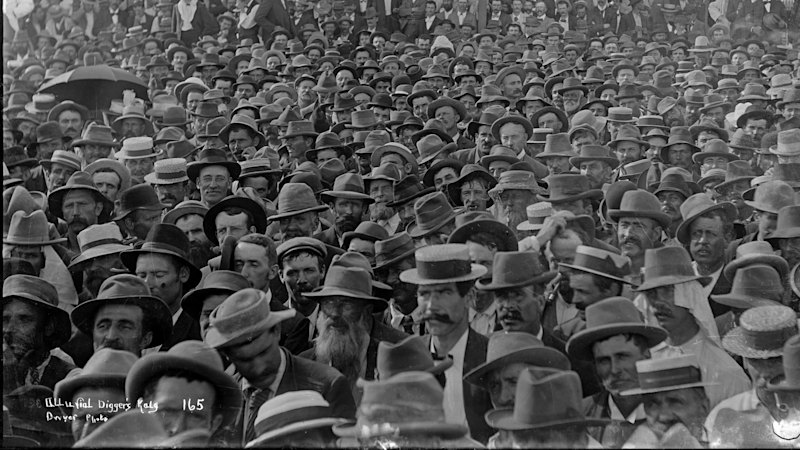
November 1, 2026 — 3:00amFollowing the discovery of gold in what would become known as Western Australia’s Goldfields region in the late 19th century, few would predict the impact the resources industry would grow to have on the fledgling state.In a bid to protect the interests of the local resources sector and promote miners’ right in the early days of the WA gold rush, several organisations formed that would grow to become known as the Chamber of Mining and Energy WA.In 1898, alluvial miners marched against proposed restrictions under the banner “Fair Play, Fair Laws and Justice to All”.State Library of Western AustraliaThis week, to celebrate its 125th year as an organisation, the CMEWA returned to Kalgoorlie where it all began.WAtoday takes a look back at the history of the chamber and the role it has played in shaping not just the Goldfields, but the entire state.Early historyThe gold rush of the 1890s drew people far and wide to the Goldfields, with discoveries in Coolgardie and Paddy Hannan’s famous find near Mt Charlotte in an area that would later become known as Kalgoorlie in 1893 sparking a flood of people hoping to make their fortune.By 1895 the state’s population had doubled to 100,515 and by 1901 had reached 184,124.In a move aimed at protecting workers and to guide legislation in the industry, the early iterations of the CMEWA were actually several separate organisations.In 1895 the Coolgardie Chamber of Mines & Commerce was formed, while the Kalgoorlie Chamber of Mines began in 1896.A short‑lived Perth chamber was opened in 1897, before the Chamber of Mines of WA, which would later become the CMEWA, was formally incorporated on February 28, 1901.Early influence on the GoldfieldsAt its first general meeting on March 11, 1901, Richard Hamilton was elected inaugural president of the new chamber.Remarkably, he held the position until his death in 1943 - a tenure of 42 years.During his time in charge, Hamilton saw some major changes in the area.In 1903, C.Y. O’Connor’s famous Golden Pipeline opened, delivering water to Kalgoorlie over 566 kilometres. It helped turn the Goldfields from a collection of boomtowns into enduring mining communities.The beginning of the gold squadGold theft was a serious concern for the industry and in 1907, the Chamber began financing the WA Police Gold Squad, initially contributing £2000 annually.This was dangerous work. In 1926, two gold squad detectives, Inspector John Pitman and Sergeant Alexander Walsh, were murdered while investigating gold theft. It’s an incident that still reverberates in Goldfields – and WA Police – history.Detective Sergeant Graham Baylor of the West Australian police gold squad.Trevor CollensIts successor, the Gold Stealing Detection Unit, remains part of WA Police and is the last remaining squad of its kind in the world.The squad also investigates other crimes that happen on mine sites, including assaults and deaths.They are also heavily involved in drug detection on WA mine sites.The emergence of an annual competitionThe chamber also established a mines rescue service in 1907, with rescue competitions becoming an annual fixture in the region from 1911 — the origins of a tradition that continues today and one of the major reasons the CMEWA returned to the region this week.Today’s mining practices, like the Super Pit in Kalgoorlie, are vastly different to those of the early gold rushAFRThe competitions play an integral part in mine site emergency training, offering competing teams the opportunity to test and hone their emergency response skills through simulated emergency situations while sharing their experience and knowledge with fellow participants.CMEWA and the Mine Emergency Rescue Competition Committee host two mine competitions each year, the Surface Mine Emergency Rescue Competition (SMERC) in April/May and the Underground Mine Emergency Rescue Competition (UMERC) in November.CMEWA influence todayBy the middle of the 20th century, the focus of the state’s mining industry had expanded beyond the Goldfields, with demand for iron ore, oil and gas in the state’s Pilbara region adding to the wealth of minerals for WA.While gold was still a major part of the economy of the west, other resources helped to turn the state into the economic powerhouse it is today.Mineral and petroleum exports make up roughly 90 per cent of Western Australia’s total merchandise exports.The focus of the CMEWA today is on competitive investment settings, efficient environmental approvals, reliable and affordable energy, workforce skills and community prosperity.However, despite the massive expanse of the current industry, the chamber will always recognise its humble beginning from the early days of the state’s gold rush in the Goldfields.From our partners
In pictures: CMEWA returns to where it all began for 125th anniversary
Full Article
Original Source
Read the full article at Smh →KhanList aggregates and links to publicly available news content. We do not host full articles from third-party sources. Always verify important information with original sources.