
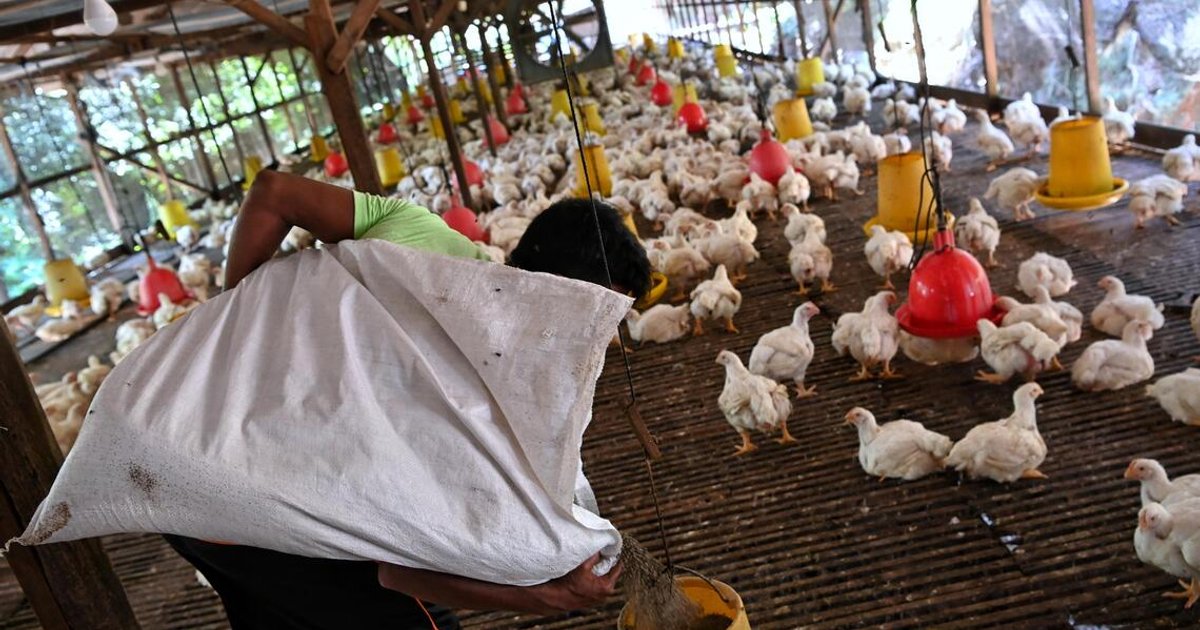
KUALA LUMPUR – The poultry farm in Johor was established first, in the 1990s, before a residential and industrial estate was built near it in 2021.While there is no chicken-or-egg question about who came first, the farm owner now plans to relocate, after persistent complaints about flies from nearby residents.“The local authority prefers that we move out. So I have to relocate with my own money – RM30 million (S$9.48 million),” the farm owner Lim told The Straits Times in early October. He asked to be identified only by his surname due to the sensitive nature of the issue.Like the Johor farm, many poultry and egg farms in different parts of Malaysia are increasingly grappling with complaints about flies, waste and odours amid rapid urban sprawl, which has led to new housing developments springing up closer to existing agricultural zones.These complaints have sparked tighter rules or enforcement, making operations more challenging for these farms.Only about 8% of Malaysia’s 16,316 poultry houses have fully adopted closed-house systems, according to the Department of Veterinary Services.Such systems are not compulsory at the federal level for poultry farms, though the state of Perak has made them mandatory from Jan 1, 2027.For Lim, his farm currently produces more than 500,000 broiler chickens, with lorries carrying up to 7,000 live chickens sent across the Causeway daily to supply Singapore.He worries that rapid urban sprawl will threaten Malaysia’s food security by forcing more small and medium-sized farmers to shoulder high compliance and relocation costs.At least five farm relocations in Johor have taken place in 2026, as at October.The issue may also affect Singapore consumers, given that Malaysia is one of the Republic’s top three suppliers of poultry and eggs.Singapore accounted for 97.7% of Malaysia’s live poultry exports and 80% of its egg exports in 2025, according to data from Malaysia’s Ministry of Agriculture and Food Security. This totalled 1.07 billion eggs worth RM415 million and 36.18 million live birds valued at RM668.26 million.Odour and fly complaintsPlayers in Malaysia’s poultry and egg farming industry told local media that the local authorities are tightening regulations, following residents’ complaints about odour and flies.One new rule, implemented in Johor, Penang, Perak and Selangor, for instance, is that farmers now have to obtain planning permission for their farms, even for existing farms, which is an unprecedented rule.Securing permission requires farmers to submit detailed architectural and engineering plans of all farm buildings.Among those affected is Ahmad, who manages an egg farm in Selangor. He asked to be identified only by his first name due to an ongoing application with the local council.Ahmad’s facility, which currently produces 800,000 eggs daily, was established in the 1990s. About a tenth of its production is exported, with the remainder going to the domestic market.Under rules introduced in 2023, his farm was granted only a conditional business licence, as it has not fulfilled some of the requirements.“We now hold only a conditional business licence that requires renewal every six months,” Ahmad told ST. “It makes expanding the business difficult, as certain clients require us to hold a full licence before placing orders.“We have been here for decades, yet now we have to start from scratch to secure planning permission. We must meet every single strict regulation within a year or risk being forced out of business entirely.”ST was given a tour of Ahmad’s three enclosed compost towers that process the layer hens’ manure. No foul smell was detected. The finished compost lay piled in dunes, ready to be packaged as organic fertiliser.Retiree Halim Baharum, 65, who lives 1km away, said Ahmad’s farm no longer attracts swarms of flies.“The farm used to have a huge problem with flies, but they control it well now. Before this, I was embarrassed to invite friends over because flies would literally blacken the food,” said Halim, who bought his house in 1992.Authorities acknowledge farmers’ plightA Malaysian agricultural official told ST he is aware of the issues faced by poultry farmers.“We acknowledge that poultry farmers face challenges such as rising compliance costs, lengthy licensing approval processes, and uncertainty over land-use arrangements,” said Agriculture and Food Security Deputy Minister Chan Foong Hin.A meeting was held in early October by federal and state agriculture ministers and executive councillors to discuss the challenges faced by these farmers, including zoning issues.“At the same time, farmers must continue to uphold proper hygiene, waste management, biosecurity, and environmental standards to minimise odour and other potential impacts on surrounding communities,” he added.The Town and Country Planning Department, which oversees land-use planning, told ST that existing guidelines encourage closed-house farming systems and proper waste management to strike a balance between food production and local development.While supporting the closed-house system, Johor farmer Lim is concerned that many small farmers may not be able to afford architectural and planning costs, which start at a minimum of RM200,000.“In the past, we had to seek approval from only the Veterinary Services Department. Now we have to go through 11 different departments,” he said.Sign up for our weekly Asian Insider Malaysia Edition newsletter to make sense of the big stories in Malaysia
In Malaysia, poultry farms face pressure to move as nearby residents complain about flies, smell
Full Article
Original Source
Read the full article at Straitstimes →KhanList aggregates and links to publicly available news content. We do not host full articles from third-party sources. Always verify important information with original sources.