
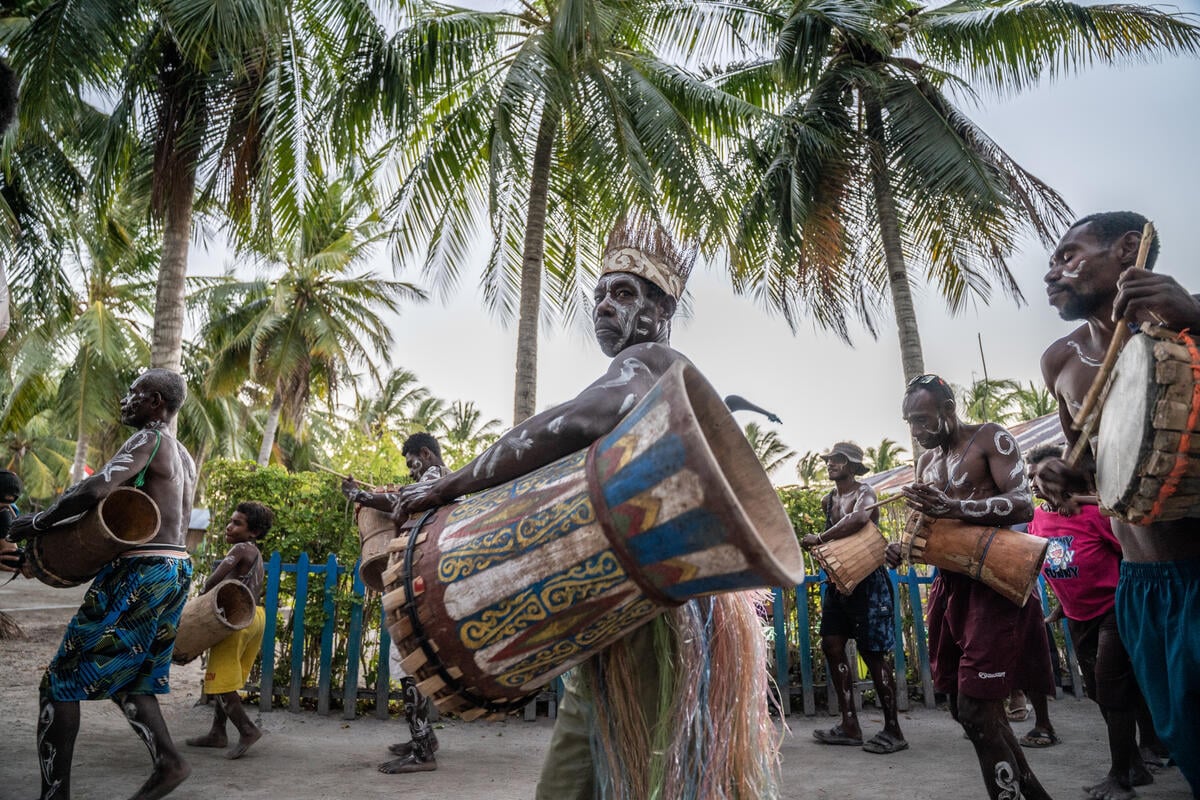
Representatives of 20 Indigenous subtribes in Raja Ampat gathered in Arborek for Heyul Pelei Koranu Fyak, a gathering to strengthen unity and find common ground over the future of the archipelago.The gathering came as nickel mining has created divisions within some Indigenous communities, including on Manyaifun Island, where opposition to a mining project led to intimidation and conflict among residents.Participants issued the Arborek Resolution, which rejects extractive activities that damage Raja Ampat’s landscape, seascape, culture and Indigenous communities, while calling for permanent protection of the region.The gathering also promoted a broader vision of Indigenous-led development and solidarity, the Arborek Declaration, bringing together communities from Indonesia, the Amazon and Sarawak, and committing to stronger customary rights, knowledge-sharing and cooperation led by Indigenous youth and women. ARBOREK, Southwest Papua, Indonesia — For generations, Raja Ampat’s Indigenous communities have governed different forests, reefs and islands according to their customary systems. Those communities have distinct identities and territorial claims, which sometimes overlap or lead to disputes. Recently, nickel mining has created new divisions, with some communities seeing the industry as an economic opportunity, while others fear it will damage the land and sea on which they depend. Against that backdrop, representatives of 20 Indigenous subtribes gathered in the tiny island village of Arborek from Aug. 20-23, 2026, to find common ground and strengthen their collective voice over the future of Raja Ampat. The gathering, called Heyul Pelei Koranu Fyak, takes its name from the two major Indigenous groups in Raja Ampat, the Maya and Biak. Heyul Pelei is a Maya term meaning grand gathering, while Koranu Fyak in Biak means Indigenous people. The gathering, , was the culmination of a consolidation effort among Indigenous communities in Raja Ampat that began in 2025. It was organized by the Forum Gelar Senat Masyarakat Adat Raja Ampat in collaboration with Institut USBA, an Indigenous-focused organization based in Southwest Papua, and Greenpeace Indonesia. As night fell on the first day, representatives from each participating subtribe introduced themselves and shared stories from their respective villages. Many spoke about struggles over land, resources and environmental protection. The gathering ultimately produced a common resolution opposing mining in Raja Ampat. The Indigenous community of Arborek village welcomed the participants of the Heyul Pelei Koranu Fyak gathering, held from Aug. 20 to 23, 2026. Image © Jurnasyanto Sukarno / Greenpeace. Fighting nickel mining in Raja Ampat Indigenous women’s leader from the Moi Maya community Ludia Mentasan, for instance, shared her experience fighting PT Nurham, a nickel mining company whose concession overlapped with its customary territory in Yensner village. Ludia, who has worked on Indigenous peoples’ issues since around 2000, . Their campaign gained wider public attention in 2025 when alongside those of other communities whose customary lands overlapped with nickel mining concessions in Raja Ampat. The #SaveRajaAmpat campaign then drew widespread public scrutiny of nickel mining in the archipelago, which lies in the heart of the Coral Triangle and is one of the world’s most biodiverse marine regions. Researchers have estimated that its waters contain about 75% of the world’s known coral species. The public outcry was followed by the government’s decision to revoke the mining permits of four companies — Nurham, PT Anugerah Surya Pratama, PT Mulia Raymond Perkasa and PT Kawei Sejahtera Mining — on June 10, 2025. The Energy and Mineral Resources Ministry said the four companies had “violated environmental regulations.” For generations, Raja Ampat’s Indigenous communities have governed different forests, reefs and islands according to their customary systems. Image by Rhett A. Butler/Mongabay. The Arborek Resolution Throughout the gathering in Arborek, participants continued to share their knowledge through dialogues and cultural exchanges, including dancing and singing. By the end of the event, the communities agreed on a common position against extractive activities, the Arborek Resolution. “From our togetherness at this grand gathering, we believe that the destiny and lives of the Indigenous people of Raja Ampat are not determined by efforts to extract what lies beneath the earth, let alone by being seduced by sweet promises that take away our ancestral islands and seas,” the resolution says. The resolution was signed by Indigenous people and members of affected communities who attended the gathering. But the significance of the gathering was not simply that 20 subtribes agreed to oppose mining; it was also an attempt to build a mechanism for cooperation among communities with different customary identities and, in some cases, competing interests. Participants hold a mass Papuan traditional dance locally called Yosim Pancar (Yospan) at a ceremony of the Raja Ampat Indigenous Grand Assembly. Image © Jurnasyanto Sukarno / Greenpeace. Repairing fractures Institut USBA director Charles Imbir said bringing the 20 subtribes together was significant at a time when nickel mining has deepened divisions within some Indigenous communities in Raja Ampat. He said conflicts had intensified since development and mining projects entered the region, “not only between these two groups [Maya and Biak], but all the way down to the grassroots level.” “We don’t want the government or companies, especially, to come and divide our social and human relations,” Charles said. “We are trying to prevent the threat of outside intervention that could eventually lead to horizontal conflict. And that can damage not only Indigenous people, but also nature, culture and development itself.” The divisions Charles described are not hypothetical; on Manyaifun Island, they have become personal. In 2024, Mulia Raymond Perkasa began exploring for nickel on the islands of Manyaifun and nearby Batang Pele, both part of the archipelago. At the time, the Energy and Mineral Resources Ministry described the company’s activities as exploration and drilling rather than mining. The project divided people in Manyaifun between those who supported mining and those who opposed it, according to Ronisel Mambrasar, a 35-year-old fisherman and Indigenous youth leader from the village. Ronisel opposed the project because he feared mining would damage an island whose people depend on fishing, tourism and other activities for their livelihoods. He began traveling from village to village by boat, raising awareness about the mining project and asking residents to sign a petition opposing it. His campaign was met with intimidation, he said. “I was confronted by local people, attacked and even beaten,” Ronisel said. “My lip was injured. They threatened and intimidated us.” He also said some people who intimidated him worked for or had connections to the company. The opposition group eventually left the village and moved to Waisai, where they organized and built support for their campaign, he said. Documentation of PT Gag Nikel’s mine, located on Gag Island, Raja Ampat. Image © Greenpeace. When the government ultimately revoked MRP’s permit in June 2025, the company was still at the exploration stage and had not begun mining. But the revocation did not immediately end the conflict. Some residents did not accept the government’s decision, Ronisel said, and subsequently blocked access to homestays operated by his family and other residents in Manyaifun. “There were even foreign guests staying there who were expelled and threatened,” he added. “In the end, the guests left.” The conflict later subsided after the police summoned those involved and mediated between the two sides, Ronisel said. For him, that experience made the gathering in Arborek especially important. “I hope this event will not just be an event,” he said during the gathering. “I hope it can unite all the Indigenous communities in Raja Ampat, and even those outside Raja Ampat, as well as our friends overseas who are able to be here with us today. We hope to build solidarity with one another and unite against environmental destruction.” A different path The gathering was also an effort to promote a different vision of development for Raja Ampat — one suited to an archipelago of small islands where communities depend heavily on the surrounding sea. Institut USBA’s Charles said development should not be modeled on mainland cities, with large buildings and urban centers. “The government should not think about developing Raja Ampat according to a mainland model, where you need large buildings and large cities,” he said. “That isn’t possible for the communities of Raja Ampat.” Instead, development should follow an archipelagic and Indigenous community-based model, he said. “That way, Indigenous communities can survive, can continue living there, and their economies can grow,” said Charles, who lives in Arborek village. “And this has already been proven in many places. One example is Arborek.” Arborek, a small island with a population of around 200, has built its economy around tourism, fishing and handicrafts. Its surrounding waters are rich in marine life, and the village has become a popular base for tourists visiting Raja Ampat. For Benoni Watem, a 43-year-old native of Arborek, tourism offered a way to make a living without extracting resources from the island. He began preparing to build a homestay in 2022 and started operating it the following year. “Tourism is sustainable; it won’t run out,” he said. “If mining comes in, the resources will eventually run out. So we reject mining in Raja Ampat.” Benoni says he worries that mining could damage the ecosystem that draws tourists to Raja Ampat, including the manta rays that are a major attraction around the islands. Forest in Raja Ampat. “The beauty of Raja Ampat is what brings tourists here,” says Benoni. Image by Rhett A. Butler/Mongabay. “The beauty of Raja Ampat is what brings tourists here,” he said. “But if mining comes in, the environment that we have protected will be damaged by mining, and then the beauty will disappear.” Charles said the experience of Arborek showed that communities could build their economies without destroying their natural surroundings. “Without cutting down trees, without taking the land, our land and water remain safe, and communities can develop their economies through services,” he said. From Raja Ampat to the Amazon The gathering was also designed to extend solidarity beyond Raja Ampat. Representatives of Indigenous communities from South Sorong in Southwest Papua, the Amazon and Sarawak in Malaysian Borneo attended, along with communities elsewhere in Indonesia affected by nickel mining on Wawonii Island in Southeast Sulawesi and in Kawasi village on Obi Island, North Maluku. Panh Ô Kayapó , an Indigenous Kayapó woman from the Amazon, shared her experience during a multiparty dialogue. Speaking about the extractive nature of colonialism and the need for Indigenous communities to resist it, Panh Ô said Indigenous people were central to protecting the environment. Indigenous women, she added, play a particularly important role in protecting biodiversity. “We women do not only take care of children, but also biodiversity,” said Panh Ô, who to the gathering in her native language through interpreters. “I speak as a woman not only for our generation, but, most importantly, about how we can pass [it] on for a better future.” The exchange reflected one of the gathering’s broader aims: Connecting Indigenous communities facing different forms of pressure from extractive industries and sharing strategies for protecting their territories. That commitment was reflected in an additional document and agreement, the Arborek Declaration, which brought together Indigenous representatives from four major rainforest regions — the Amazon, Congo Basin, Borneo and Papua. In addition to the stand against extractive activities in Raja Ampat in the Arborek Resolution, the declaration called for stronger cross-generational networks and global solidarity, recognition of Indigenous territorial rights, protection from discrimination and intimidation, greater support for Indigenous knowledge, and corporate accountability for environmental destruction. Indigenous Peoples from Papua sign the Declaration of Arborek, together with Indigenous people of Amazon Brazil, Cameroon, and Malaysia during the Raja Ampat Indigenous Grand Assembly in Arborek. Image © Jurnasyanto Sukarno / Greenpeace. Looking ahead The Arborek Declaration called for stronger unity among tribes and subtribes, including the establishment of Indigenous youth and women’s houses; recognition and mapping of customary territories and kinship relationships; greater exchange of knowledge across generations, tribes and islands; and stronger solidarity at the regional, national and international levels. It also gave Indigenous youth and women a mandate to lead those four priorities and organize another Heyul Pelei Koranu Fyak gathering in 2027. The commitments come as mining remains a concern in Raja Ampat. PT Gag Nikel remains the only active nickel mining company in the archipelago, but Greenpeace says three companies are still pursuing mining permits in Raja Ampat — two for nickel and one for coal. Greenpeace corrected an earlier version of its research after initially describing the three companies as seeking nickel permits. Greenpeace has also reported that Gag Nikel continues to operate despite environmental audit findings that identified problems including coastal sedimentation and inadequate erosion controls. For Charles, however, the gathering’s significance goes beyond the immediate mining debate. Raja Ampat’s geography can make it difficult for communities scattered across hundreds of islands to come together, he said. “In Raja Ampat, we have the challenge of the sea separating us,” he said. “But now, through something like this, the sea can also become a unifying force.” Banner image: The Indigenous community of Arborek welcomed the participants of Heyul Pelei Koranu Fyak (the Grand Gathering of Raja Ampat Indigenous Peoples), held from Aug. 20 to 23, 2026. Image © Jurnasyanto Sukarno / Greenpeace. In Raja Ampat, children learn that their knowledge can help protect their islands Just as Raja Ampat fetches UNESCO Biosphere Reserve title, nickel mining looms Credits Topics
In Indonesia, 20 Indigenous subtribes seek common ground amid mining divisions
Full Article
Original Source
Read the full article at News →KhanList aggregates and links to publicly available news content. We do not host full articles from third-party sources. Always verify important information with original sources.