
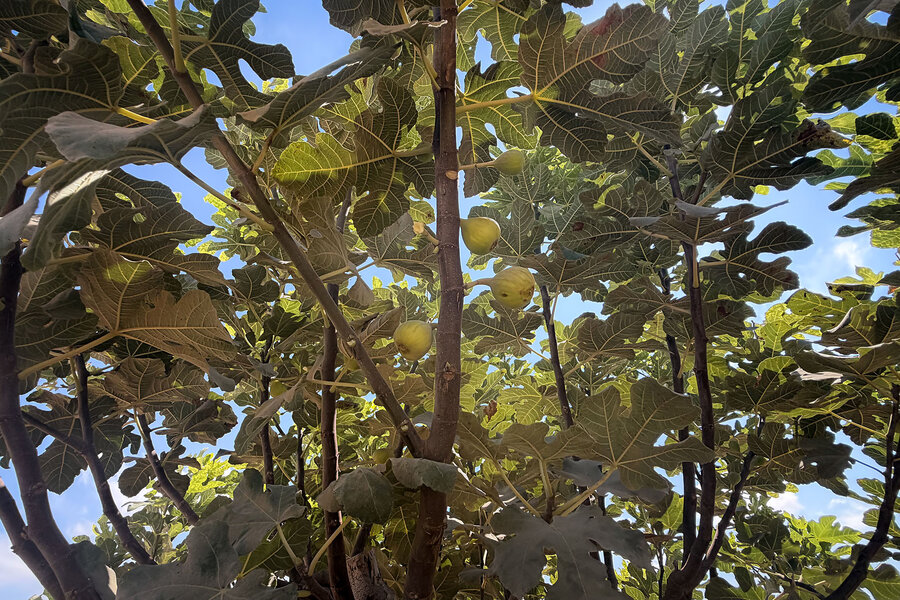
Gaza City, Gaza Strip | Oct. 02, 2026, 2:36 p.m. ET | 5 min read When Jumaa Abed Saad returned to his farm in Sheikh Ijlin in January 2025 after more than a year of displacement, the place that greeted him was nearly unrecognizable. His house looked like a crumbled concrete cookie, with its blown-apart walls, roof, and floors scattered across the ground. Nearby, the neat rows of grapevines and fig trees his family had tended for three generations had vanished under piles of rubble. The grass towered above his head.“Everything [was] gone,” he says of the farm in Sheikh Ijlin, a neighborhood on the southwest edge of Gaza City renowned for its grapes and figs.Or so it appeared. But as Mr. Saad and his sons cleared the debris and dug into the sandy earth, they found something extraordinary: roots. For three years, as Israeli bombs made ruins of the ground, some of the trees and vines had clung to life in the spongy layer of clay below. “Grapevines and fig trees don’t always give up as easily as they look like they have,” Mr. Saad says.The taste of homeIt is this quirk of soil, more than anything else, that has made this small corner of Gaza famous for grapes and figs for generations. Plant a vine or tree, and its roots reach down through the sand until they find the clay beneath. Through the driest months of summer, when nothing else in the ground has water left to give, the clay remains moist enough up to keep the tree alive. Ghada AbdulfattahJumaa Abed Saad holds figs from his farm in Sheikh Ijlin, where he has recently harvested his first crop in three years, Aug. 23, 2026. Sheikh Ijlin’s fruit is so well known that before the war Palestinian families working in the Gulf would often time their visits home with fig and grape season, arriving in time to sit under the trees and eat fruit as sweet as sugar.Now in his late 60s, Mr. Saad has farmed here his entire life. “Since my grandfather was here,” he says proudly. So when the Israeli evacuation orders drove his family to the Nuseirat refugee camp in October 2023, the shape of his orchard remained mapped in his mind – row upon row of grapevines and grids of fig trees, each 4 yards from its neighbor. “I know where each tree stands,” he explains. “I have been walking among the rows for ages.”Not all the roots survived, but those that did allowed him to start over more quickly, particularly with the grapes. When tended to, Mr. Saad says, a buried grapevine root reestablishes itself within a year. Where he found no roots, meanwhile, he planted cuttings from healthy vines until the old lines of the orchard began to reappear.Then he waited to see what would grow.Picked cleanA few fields away, Nayef Shamalakh is also starting over.When the evacuation order came three years ago, the father of five assumed it would be brief. He told his wife, “a week, 10 days at most,” he remembers, assuring her she didn’t need to worry.At the time, his 4 acres of land were full: tomatoes, cucumbers, eggplant, peppers, cabbage, cauliflower, and lettuce, all midseason. The last thing he harvested before leaving, in August, was figs. He left the trees picked clean. “No one expected it would last forever,” Mr. Shamalakh says.When he returned in January 2025 during the first ceasefire between Hamas and Israel, he braced himself for what he would find. Still, nothing quite prepared him for the moment itself. “I saw nothing of my trees,” he says. “Nothing.” Ghada AbdulfattahNayef Shamalakh stands on his land in Sheikh Ijlin, where he has returned to planting grapes, figs, and other crops after a long displacement, Aug. 23, 2026. Once the rubble was cleared, Mr. Shamalakh and his sons also started replanting. They began with lettuce, chosen because it grows through both summer and winter and asks less of a farmer whose wells, drip lines, and greenhouses no longer exist. The first harvest came without warning: a handful of lettuce, green and curled tight. “I didn’t pick it right away. I just looked at it,” he says. What he was seeing felt unimaginable, “to see the land that endured a lot of bombs be revived again.”Now, every time he walks among the rows and spots a new head of lettuce breaking through, he calls someone over – a neighbor, his son, whoever is nearby – just to see it.The costs of starting overEven with roots to work from, however, the arithmetic of recovery is sobering.Before the war, there was real profit in farming, Mr. Shamalakh says. Now, farmers are often losing money just to keep working.Three years ago, a packet of seeds cost 400 to 500 shekels (roughly $130 to $161). Today, the same packet costs more than 15 times as much due to Israel’s ban on importing seeds. The same is true of the price of pesticide, which is brought into Gaza via informal channels and sold by traders at a steep markup. Supply is extremely limited, and what exists is sometimes expired, “rendering it useless,” Mr. Shamalakh says.Meanwhile, without the animal manure that farmers once used to enrich the soil, the farmers’ seedlings struggle to germinate. And then there is water. Every liter must be extracted from a damaged well using a small pump that costs about 150 shekels an hour to run. That is, when diesel can be found, and when the generator is working, which isn’t often. With Israeli bans on importing fuel, engine oil, and spare parts, breakdowns often become indefinite. Ghada AbdulfattahFresh figs and grapes harvested from Jumaa Abed Saad Farms in Sheikh Ijlin sit ready to be transported to Gaza City for sale, Aug. 23, 2026. Before the war, Mr. Saad says he could farm 20 tons (44,000 pounds) of grapes in a harvest season. This year, from the entire season, he expects perhaps 50 kilograms (120 pounds). He estimates the land will need five to 10 years to recover something close to what it once produced. Despite the vast uncertainty, Mr. Saad has found his own roots alive beneath the ground in Sheikh Ijlin, too. Each morning when he wakes, he says, the first thing on his mind is the orchard. “You come, you farm, you plow, you get some peace of mind,” he says. “That is how it is.” After years of sitting idle in a displacement tent, his days are once again full. He moves tirelessly between the rows of tentatively growing plants, checking whether anything needs picking, spraying, or weeding, and watching for what the farm is asking for.“He loves the land,” his eldest son, Haidar, says, “maybe more than he loves anything else.” Deepen your worldviewwith Monitor Highlights.Politics with respectGet political stories with respectful analysis.There‘s a world of new ideas in everyBooks newsletter.There‘s more to life, enrich yours withCulture & Learning weekly.Follow humanity‘s discoveries withScience & Nature stories in your inbox.Gain a spiritual perspectivefrom the stories in your inbox.Want to understand the deeper impact of critical events? Learn the Monitor‘s insight.Already a subscriber? Log in to hide ads. Asked what he tells himself as he works land that might not fully recover in his own lifetime, Mr. Saad quotes an ancient Persian fable. A traveling king comes across an elderly man planting fig seedlings. Why, he asks, is the man planting a tree whose fruits he will never see?The man gives a simple reply: The previous generations planted, and so we ate. So we plant, and the next generation eats. ALREADY A SUBSCRIBER? LoginReal news can be honest, hopeful, credible, constructive.The Christian Science Monitor was founded in 1908 to lift the standard of journalism and uplift humanity. We aim to “speak the truth in love.” Our goal is not to tell you what to think, but to give you the essential knowledge and understanding to come to your own intelligent conclusions. Join us in this mission by subscribing.
In Gaza, farmers rescue roots buried under rubble to grow fruit again
Full Article
Original Source
Read the full article at Csmonitor →KhanList aggregates and links to publicly available news content. We do not host full articles from third-party sources. Always verify important information with original sources.