
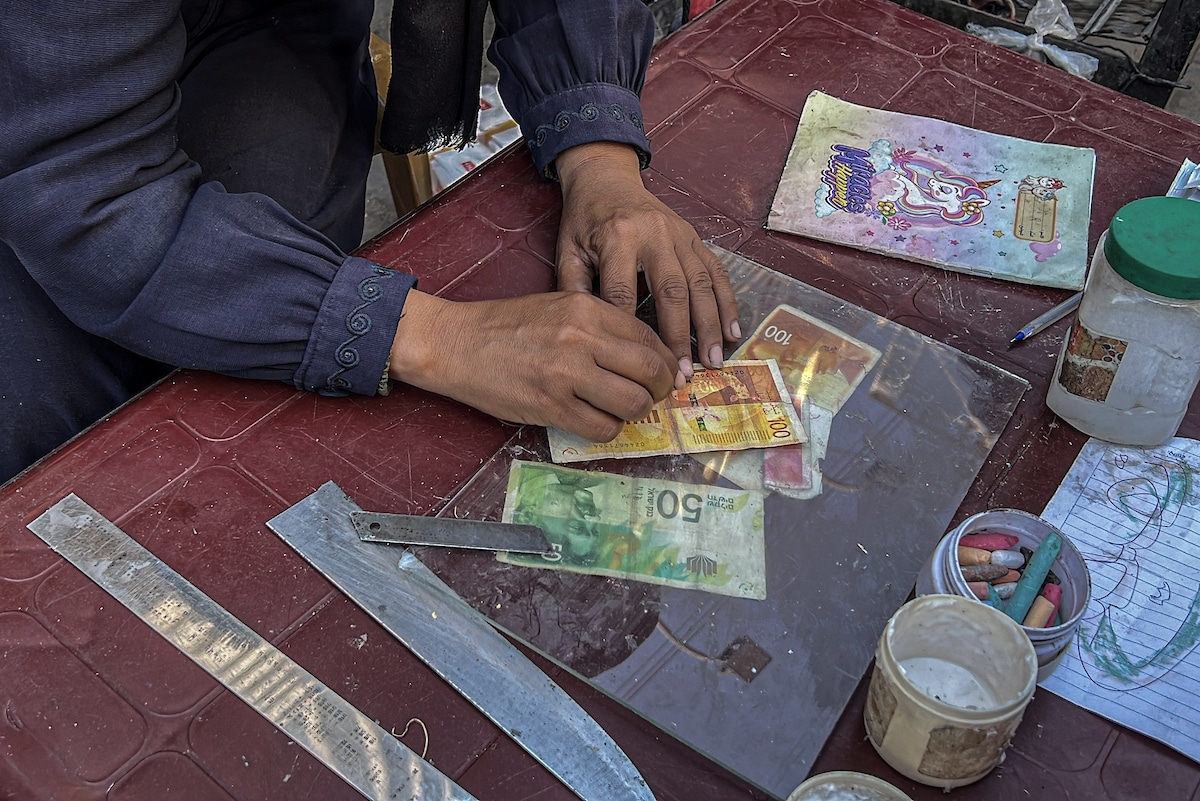
Muhammad Hussam thought the 200 shekels (approximately 65 USD; 1 shekel equals 0.3253 USD) he had received in cash from a humanitarian organization would bring a little joy to his children. The 38-year-old father, who was displaced from Shuja’iyya to Tel al-Hawa in western Gaza City, was struggling to provide food for his family, who were living in a tent. Delighted by the cash assistance, he went to a grocery store near the displacement camp to buy some fruit. But when he handed over the 200 shekels to pay for two kilograms of apples, the shopkeeper refused it. He told Hussam that he only accepted bank transfers — Cash was no longer welcome. Hussam tried another seller and received the same answer, with one exception: this shopkeeper would accept his cash only if he agreed to a 10% commission. He could then buy goods with whatever remained. Hussam’s struggle to make ordinary financial transactions with cash — a predicament that would have once been unthinkable in Gaza, a society that until recently ran mostly on cash transactions — represents a new financial emergency facing Palestinians in Gaza. Financial transactions in Gaza have been upended since the early stages of the Israeli war on the enclave. In the height of the genocide, Palestinians once paid commissions of up to 50% to withdraw cash from their own bank accounts. Now, as electronic payments spread and the banknotes in circulation deteriorate, some depositors are being charged for adding cash to their bank accounts, while others are charged for spending the cash they already have. With bank branches either closed or bombed, residents have limited ways to withdraw their money, with many resorting to cash dealers. These dealers receive electronic transfers from customers’ bank accounts in exchange for physical banknotes. However, they charge heavy commission fees that could reach up to half of the original transfer. Today, financial applications, including Jawwal Pay wallet and Bank of Palestine’s banking app, have become widely used for buying and selling. Even taxi drivers receive fares through electronic transfers. Cash, meanwhile, has become increasingly unwelcome, largely because the notes are aged and damaged. In addition to this, Israel has prevented new banknotes from entering the Strip since the beginning of the war. Hussam, and many others in Gaza, see this shift as part of an Israeli effort to tighten control and track Palestinians’ access to money. Palestinians, he says, have no choice but to use whatever means are available. When obtaining cash meant losing 50% of their money, they accepted the deduction because they had no alternative. Now, he says, they are being pushed toward electronic payments for the same reason. And if a place like Gaza becomes wholly dependent on electronic payment infrastructures, it means that those in control — in this case, Israel — will have even more power over the society. A financial siege Ismail al-Thawabta, director general of Gaza’s Government Media Office, describes Israel’s actions as a deliberate economic and financial war, no less dangerous than its military campaign. Its direct aim, he says, is to undermine the government and paralyze its ability to provide basic services. “This financial siege involves preventing cash from entering Gaza, destroying banks and banking infrastructure, freezing accounts and clearing funds, and targeting vehicles transporting money,” al-Thawabta said. He argues that these measures are intended to bring about a complete breakdown in administration and services and push Gaza into social chaos as part of Israel’s broader policy of genocide. He calls the financial restrictions “collective punishment directed at the population as a whole, with ordinary residents bearing the greatest harm.” Sami al-Khaldi, a financial and economic expert based in Ramallah, paints a more detailed picture. He attributes a large part of the crisis to traders who exploited conditions in Gaza and now need to replenish their bank balances to pay suppliers outside the Strip. “Israel indirectly controls payments in Gaza by imposing specific policies on Bank of Palestine, the largest Palestinian bank, which implements those policies out of fear of further restrictions,” he said. “Under these policies, banks will not accept cash deposits without knowing the source of the money. This has pushed traders away from cash and toward electronic transfers because they cannot deposit the cash they hold. In this way, Israel can exert control over society through electronic payments.” The banknotes circulating in Gaza are also deteriorating, he said. According to al-Khaldi, around 17% of the cash in circulation needs to be replaced each year. With no such replacement taking place in Gaza since the war began in 2023, he said, a substantial share of the banknotes now circulating is worn out and unfit for use. Al-Khaldi also pointed to Israeli restrictions on cash transactions, describing a limit of 6,000 shekels (approximately 1,950 USD) after which payments must be made electronically. He said these measures are intended to “strengthen oversight of financial transactions and curb tax evasion.” Government employees are part of that same social fabric, al-Thawabta added. Whatever cash salaries the government can provide from its severely limited resources are spent immediately in local markets, helping keep the economy moving. The siege, he says, seeks to choke everyone without exception and impose “starvation and submission.” According to al-Thawabta, the lack of cash strikes at the heart of the local economy. It prevents residents from collecting money transfers and stops families of those killed or wounded, as well as recipients of cash assistance, from withdrawing funds to meet their basic needs. The lack of cash also paralyzes trade. Al-Thawabta says that the committee overseeing government affairs in Gaza is taking steps against traders who accept worn banknotes in exchange for electronic balances while charging commissions that have risen to 10%. “The committee views these practices with the utmost seriousness and considers them an economic crime and a vile exploitation of our people’s blood and sacrifices during the genocidal war,” he said. “We will not allow any party to profit unlawfully from citizens’ suffering.” Al-Thawabta told Mondoweiss that the Ministry of National Economy, supply police, and public prosecution have pursued and arrested people accused of manipulating exchange rates and hoarding cash. Authorities have also confiscated money received through financial extortion and referred offenders to the courts on charges of exploitation and harming the national economy during a state of emergency. Government authorities have issued binding directives requiring traders and retailers to accept circulating banknotes, including damaged notes, provided they retain their legal value under the Palestinian Monetary Authority’s standards, he says. Refusing these notes or charging a commission to accept them has been criminalized. Consumer protection teams and supply police conduct regular market inspections to monitor compliance, al-Thawabta explains. “Authorities have opened direct channels for residents to report traders who refuse banknotes or exploit the crisis. Enforcement measures include closing shops, imposing fines, and, in some cases, detention and prosecution.” Civilian employees under pressure For Abu Ibrahim, a 43-year-old civilian employee of the Hamas-run government, the cash crisis compounds restrictions he says have affected his access to banking services since the first month of the war. ‘Abu Ibrahim’ spoke to Mondoweiss using a pseudonym for his protection. He previously received his salary through the National Bank or the Palestinian Production Bank, both of which were destroyed by the Israeli military early in the war. He says he still has money in the bank that he cannot access. Abu Ibrahim previously received 2,000 shekels every 30 to 35 days. Now, he receives 1,500 shekels every 45 to 50 days, paid in worn banknotes that are difficult to spend. He says transferring his salary through banks is not an option. He fears that whoever transfers the money could be targeted in an airstrike once identified, while his own account could be frozen or closed because he is a government employee. Abu Ibrahim says the Bank of Palestine blocked his account in the first months of the war without giving a reason. He believes Israel exercises control over Palestinian banks. His difficulties spending cash began during the famine. When he went to buy something, shopkeepers would tell him he had to spend the full value of the note he handed over because they had no cash to give him change. Otherwise, he had to pay by bank transfer. “Now, some sellers demand 120 shekels in cash for goods worth only 100 shekels.” “Just as we struggled to get cash at the beginning of the famine, we now face the same struggle to deposit money into our bank accounts and turn cash into a bank balance,” Abu Ibrahim said. One of his greatest difficulties is finding a seller who will give him change. If he hands over a 200 shekel note, he may have to spend the entire amount, sometimes buying things he does not want to use. At other times, he leaves the full amount with the shopkeeper and spends from it over several visits. “I give the seller 200 shekels and buy with it in stages,” he said. “Today I buy 50 shekels’ worth, then I come back tomorrow to spend the rest, or part of it, until I have used it all.” Even then, the shopkeeper deducts a commission for accepting the payment in cash. Abu Ibrahim also believes that militias affiliated with the Israeli military are draining cash from Gaza. For instance, the gangs who control the trade of cigarettes only accept cash payments. With cigarette prices soaring, he believes a substantial share of Gaza’s cash has left the strip through this trade and has not been replaced. These challenges are on top of other economic pressures that Abu Ibrahim sees as part of Israel’s effort to choke Gaza’s economy and its population. Before the war, he says, 100 shekels bought enough vegetables, fruit, and meat to feed his family for a week. Now, the same amount does not cover a single day’s food. He sees these practices as “part of an Israeli effort to empty Gaza of banknotes, leaving electronic payments as residents’ only option. Once that happens, Israel can track who sends and receives money, making it easier to identify and cut off funding for Gaza’s government and its employees.”
In Gaza, even cash comes at a cost
Full Article
Original Source
Read the full article at Mondoweiss →KhanList aggregates and links to publicly available news content. We do not host full articles from third-party sources. Always verify important information with original sources.