
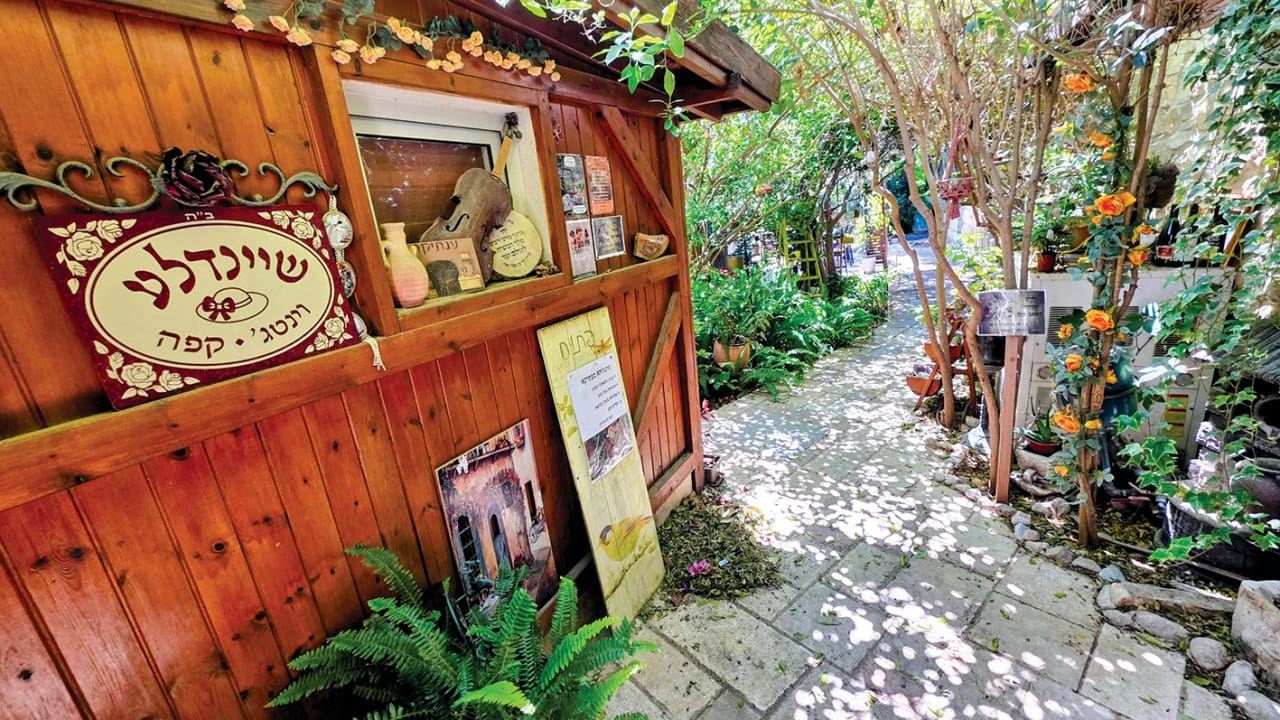
AUGUST 29, 2026 19:42By our second morning at the Khan Ein Karem Boutique Hotel, something had already begun to shift. Roi and Tomer, the hotel’s warm and attentive hosts, understand this quiet rhythm perfectly. Their hospitality philosophy is simple: Give visitors tranquility, space, and a nourishing breakfast, then let the valley do the rest.What Adi and I discovered over the weekend is that Ein Kerem’s deepest wellness offering isn’t the landscape alone but the remarkable concentration of people who have chosen to build their lives inside it. In a country navigating complex realities and social fractures, Ein Kerem holds an unusual number of individuals who have each developed their own philosophy of healing and chosen to share it openly with those who arrive.“It is a capsule of this multicultural, interreligious encounter that is so special and sadly almost doesn’t exist in Israel,” Roi told us over breakfast at the hotel’s inviting dining table. “Here, when you go out and start walking, you meet. You have no choice.” Meeting, as our weekend unfolded, turned out to be the most restorative act of all.Food for the soul: Café ItahOn Friday morning, Adi and I made our way down the stone stairs to Café Itah – meaning “woman” in Aramaic – a courtyard kitchen that operates as a model of social healing and community hospitality. Our host, Moti Levi, a local contractor who lives a minimalist lifestyle in renovated buses in nearby Givat Ye’arim, founded the café as a social enterprise under the Tirosh Association.The Khan Ein Karem Boutique Hotel’s renovation folds modern boutique comfort into the ancient stone terraces it’s built into, so the architecture itself feels like part of the valley’s healing. (credit: NOAM BEDEIN)Its mission is to provide dignified, therapeutic employment for young women and teenage girls navigating personal crises, trauma, and institutionalization. The café also acts as a safety net for girls who age out of closed state welfare facilities at 18 and suddenly find themselves without shelter; Moti frequently steps in to give them a safe place to sleep.Head chef Amit spent 12 years managing kitchens in high-end catering and luxury hotels, including the King David Hotel, before reshaping her career around a double purpose. Under her direction, the café delivers a genuinely high-level culinary experience – zucchini latkes, rich shakshukas, house-made pestos, and hand-preserved lemons – but the quality of the food is ultimately a vehicle for something deeper.“I had no satisfaction in just working in a restaurant and serving food to a customer,” Amit said. “I wanted satisfaction in my heart at the end of the day – the satisfaction of doing something good for someone.” Of the kitchen itself, she added, “I am a very hyperactive person, and the kitchen is a place of creation to release that. The world of pastry and cooking is a therapeutic path.”This approach demands a forgiving business model. Amit gives the girls time and space to process crises and anxiety attacks, noting that “in any other restaurant, they wouldn’t give you the space; they would just kick you out.” Her guiding rule: “The customer is temporary… but for her, this is her life. My girls come before the customer.”Anchoring this support system is Avraham, a 60-year-old retired village resident who sits on a wooden bench in the courtyard each day between noon and 4 p.m. – a calm, steady figure the girls can sit beside to regulate their breathing when anxiety rises mid-shift.The impact runs deep. One young woman told us she’d once spent an entire year shut inside her home, paralyzed by depression; another said, “I never managed to hold a job for five days a week… but here it’s like family. You aren’t treated like a robot; you are seen as a human being first.”Sitting in the sun-kissed courtyard over this exceptional food, you understand that its therapeutic value is inseparable from the well-being of the hands that prepared it.The scribe of lost stories: Avshalom EshelBetween the village’s stone alleys and the ridge where the Music Center awaits, we met one of Ein Kerem’s most remarkable figures: Avshalom Eshel, who moves between the hassidic religious world and the creative world of arts as though they were never separate.Avshalom is officially a sofer stam – a traditional Jewish scribe who writes Torah scrolls, tefillin, and mezuzahs by hand. He playfully reinterprets the Hebrew acronym STAM as “Stories, Tricks, and Plots.” Outside his studio hangs a sign describing his daily mission: “Conductor of roads for lost stories.”Inside, he directs theatrical plays, including an upcoming production of Rabbi Nachman of Breslov’s The Seven Beggars. His own return to religion was sparked by reading Rabbi Nachman’s stories and falling in love with a religious woman who happened to sit beside him on a bus – an encounter that led to their marriage and six children.His calligraphy, he explained, is a spiritual remedy for the modern age. Teivah in Hebrew means both “ark” and “word.” Since a physical ark can no longer shelter a person from the flood of modern noise and anxiety, Avshalom crafts tiny “arks” out of positive words, writing them by hand on parchment to give to visitors as a portable refuge. Every person, he teaches, is like a single letter in a Torah scroll; if even one letter is cracked or missing, the whole scroll is invalid. “This is our medicine,” he said, “to return and be parts of one big story.”That philosophy runs through his workspace: a building that houses a secular yeshiva downstairs and a joyful, “hippie” Orthodox synagogue upstairs. Before we spoke, he picked up his sitar – a stringed musical instrument – letting its resonant tones settle the room, then pressed our personalized parchment tags into our hands.Because Avshalom lives intentionally offline and refuses a smartphone, our visit ended with him offering his wife’s WhatsApp number – a fitting close for a man whose life is devoted to genuine human connection.Sacred soundscapes and open tablesOn Friday afternoon, we visited the Eden-Tamir Music Center on the village’s upper ridge, welcomed by Prof. Rami Eden (son of co-founder Bracha), Dr. Dror Semmel, and longtime host Saleh. Founded in 1968 by the piano duo Bracha Eden and Alexander Tamir, the center has anchored Jerusalem’s classical music scene for nearly six decades.Its intimate 120-seat hall houses a rare fortepiano – a replica of an 1819 Viennese instrument built by master craftsman Paul McNulty – whose lighter, softer sound lets us hear Beethoven and Schubert nearly as their first salon audiences did, without the volume of a modern grand piano. The center still hosts chamber concerts every Saturday morning and biweekly Friday performances for young Israeli artists.During our Shabbat walk, we found a striking blend of art and tradition at the Jewish House, the local Chabad House run by Rabbi Shaya and Nechemi Kedelburg. Housed in a restored stone building that doubles as an art gallery and vintage boutique, it felt unlike any conventional Chabad house – artistic, localized, and rooted in Ein Kerem’s bohemian character.Over a long Shabbat conversation, we watched secular artists, traditional residents, and international travelers share the same table, a quiet proof that belonging can be one of the most powerful forms of harmony.The gathering tableOn Thursday evening, we dined at the Ein Kerem Courtyard Restaurant, one of the village’s few kosher establishments, over baked cauliflower with tehina and cheese-stuffed phyllo.The meal set the tone for how Ein Kerem functions as a crossroads where social boundaries dissolve. On any afternoon, its limestone alleys host Christian priests beside barefoot anthroposophical families, secular tech workers, and haredi (ultra-Orthodox) families who’ve driven in from central Jerusalem for a change of pace.That spirit peaks every Thursday night in the courtyard of Avshalom’s building, where wooden tables go up under the open sky for 80 to 100 people – an evening of cholent, live theater, and acoustic jam sessions that bypass political and religious divides entirely. Among the regulars is a woman who drives every week from Ofakim, in the South, just to be part of it.As the weekend closed, Adi and I sat on the Khan Hotel’s upper balcony watching the sun cast long shadows across the terraces, our Shabbat table catered by chef Eli Fadida of Beit HaKerem and the celebrated Pasha in Talpiot.Community, it turns out, is the oldest and most effective wellness intervention. Ein Kerem doesn’t offer it packaged; it offers it in the raw, unscheduled way of a village where the streets are too narrow to walk without meeting someone. The healers, scribes, chefs, musicians, and rabbis who have built their lives here are its greatest therapeutic asset. We left rested, fed, and quietly altered, carrying what the valley gave us back into the city above – the way water carries minerals from ancient stone.Part I of this piece appeared in August 7’s issue. Read it here.Follow us on Google
In Ein Kerem, Israel’s most unlikely wellness retreat becomes a source of healing
Full Article
Original Source
Read the full article at Jpost →KhanList aggregates and links to publicly available news content. We do not host full articles from third-party sources. Always verify important information with original sources.