
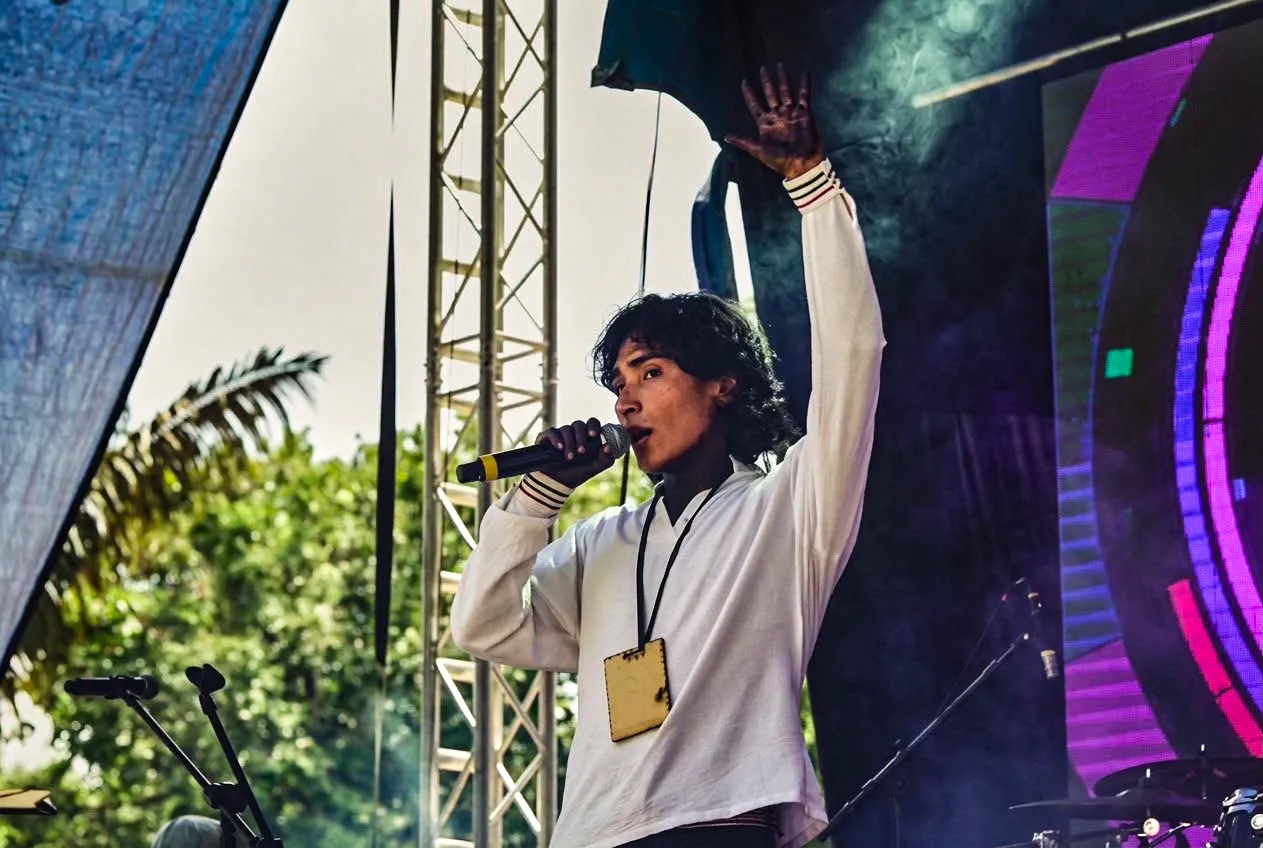
In the Ecuadorian Amazon, young people from several Indigenous nationalities are turning to rap to speak out against the toll extractive industries take on their home territories.Each track is performed in the artist’s native language (some of which are on the verge of disappearing), with some incorporating Spanish verses to connect with listeners from other cultures.Indigenous rappers include Willan Gualinga (Taki Supay) of the Kichwa nationality of Sarayaku; Misael Elías Criollo Grefa (Misa17), from the A’i Cofán community; Raúl Vargas (Robenban), Kichwa from Pastaza; and Tzitzanu, from Sapara.Their music is reaching national and international audiences, with Misa17’s track “Ingi Tsampi” drawing more than 400,000 views on TikTok just a month after its release. Willan Gualinga first stepped onto a stage in his home community of Sarayaku, in the Ecuadorian Amazon, in the province of Pastaza. He recalls his hands sweating, his body trembling, and his mouth freezing up as words crowded his mind. Three years after that debut, he performed the same song at the Rizoma 2026 Festival in the Amazonian city of Puyo. This time, he was no longer in front of dozens of people. He was seeing thousands chanting his lyrics in his Indigenous Kichwa language. On this occasion, his body moved with the rhythm and with the strength his message demanded: “Allpamanda kawsay manda jatarishun,” or “Let us rise up for the land and for life.” That was the title of his first track and the phrase he shouted at the top of his lungs throughout his performance. The song draws on elders’ stories about the origins of Sarayaku (his traditional territory) and, like his other compositions, spotlights the threats facing his people. “Through music we can transmit the knowledge of our ancestors and, above all, defend the territory,” said Gualinga, a 23-year-old artist known on stage as “Taki Supay.” Like him, a new generation of Amazonian artists is using rap to bring attention to the threats facing Indigenous peoples and nationalities across the Ecuadorian Amazon — and to show why the rainforest must be protected. “Rap is talking about what you feel, what is happening, and our struggle,” Misael Elías Criollo Grefa, better known as Misa17, said. He is the first rapper from Ecuador’s A’i Cofán Indigenous nationality, and his track “Ingi Tsampi” has already surpassed 9,000 views on YouTube and topped 400,000 on TikTok just one month after its release. In the southern part of the Ecuadorian Amazon, the music of Zona Verde, a duo formed by Raúl Vargas (Robenban) and Alejandro Moya (Naruman), champions calls from their Kichwa and Shuar communities in Pastaza province for access to clean water. In the same province, within Sapara territory, artist Tzitzanu raps against the oil industry and fights to keep his culture alive. Misael Elías Criollo Grefa, better known as ‘Misa17,’ is the first rapper from Ecuador’s A’i Cofán nationality. His track “Ingi Tsampi” has already surpassed 400,000 views on TikTok. Image courtesy of Cristhian Luna. Across these songs runs a deep connection to the rivers, the forest, the wildlife, and the world around them. But mostly, they draw directly on what the artists have experienced since childhood, when they first joined their parents and grandparents in defending their homeland against extractive projects that scarred their ancestral landscape. Each sings in their native language, a form of resistance meant to protect their identity and share ancestral knowledge with the rest of the world. While the music of these five artists has crossed borders, the road has not been easy. A lack of recording studios in the Amazon and the high costs of video production remain among their biggest hurdles. Added to that are the dangers of publicly calling out economic activities seeking a foothold in their territories. Those public stances, the artists say, make them easy targets for attacks or retaliation. Even so, these young musicians trust that this new form of resistance through art and rhyme, rather than provoking further confrontation, will drive change by carrying their message to a broader audience, raising awareness, and inspiring other youth to get involved in defending the Amazon. Rapping to survive For Carla Vera, an Ecuadorian university lecturer and music journalist, rap’s growing appeal in these territories is no surprise. “It is a genre that aligns with the power of Indigenous discourse and resistance. It goes against oppression, promotes liberation, is direct, and generates that feeling of empowerment in those who make it and those of us who listen to it,” she told Mongabay. Understanding their lyrics means returning to the genre’s origins. Rap emerged in the Bronx, an impoverished borough of New York City, United States, in the 1970s. Rhymes loaded with protest against living conditions in the country burst onto the music scene amid a context of racism, precarious labor, and police brutality against the local population. Today, the genre retains that core essence and the political weight of its message. Vera says it makes sense that rap is gaining traction now, given the mounting threats facing the Amazon. According to the collective mapping initiative MapBiomas, data compiled by the EcoCiencia Foundation and provided to Mongabay, 71% of mining in Ecuador is located in the Amazon region. Nearly half of that activity (44.5%) sits within Indigenous territories. Meanwhile, oil concessions cover 63% of the land belonging to Amazonian Indigenous peoples and nationalities. Misa17’s songs focus on the importance of the forest to his people and describe what it is like to live under the constant threat from oil companies seeking to invade his community. Image courtesy of Cristhian Luna. “I don’t want to see our rivers contaminated, I don’t want to see our forest destroyed, I don’t want illnesses because of oil, I don’t want to see more death in my territory,” Misa17 raps in “Ingi Tsampi,” which means “our forest” in his native A’ingae Indigenous language. Dressed in a shirt that keeps the lines of a traditional cushma tunic — but cut loose for a more urban touch — with the number 17 on the back, he delivers line after line without pausing for a breath. The 19-year-old was born in Dureno, an A’i Cofán community in Sucumbíos province in the northern Ecuadorian Amazon that has long opposed operations by the oil company Texaco and state-owned Petroecuador. One of the most visible figures in that resistance was his uncle, Eduardo Mendúa, who was murdered in February 2023. “Eduardo lives and the struggle continues, strength, strength in honor of our leader,” Misa17 raps, as an image of the late land defender appears behind him in the music video. Since he began writing rap songs two years ago, Misa17 has found refuge in the genre. Recognizing himself as a reserved person, he found that music gave him the outlet he needed for personal expression. Although his parents did not support his musical ambitions at first, seeing his dedication and results has turned them into his biggest advocates. Through his music video, the rapper’s message has traveled far beyond Ecuador. “The world is going to realize all the problems we go through in my community and one day more help will arrive,” he says. Robenban also hopes his songs will highlight the importance of protecting the forest, particularly the Puyo River basin, which runs past his home in the San Jacinto commune, in Pastaza province. Communities in the watershed are currently pursuing a protective action to demand the cleanup of the river — which is contaminated primarily by untreated wastewater discharges. Raúl Vargas, better known as ‘Robenban,’ of the Kichwa nationality, and Alejandro Moya (Naruman), of the Shuar nationality, formed the group Zona Verde six years ago to speak out against the destruction of the rainforest. Image courtesy of Zona Verde. Together with Naruman, Robenban is writing a song about rivers and plans to release it in the coming months. Their goal is to describe how the contamination harms community health and undercuts tourism, their primary source of income. Robenban has touched on similar themes before. “The crying of the fish is heard while the rivers dry up,” he raps in “Decepcionado y triste,” a track criticizing governments for destroying the rainforest and “creating wars.” Romantic songs caught his attention most when he began his career. However, after witnessing the resistance led by his elders, he decided to focus instead on “promoting conscious protest to defend the forest through music.” Hearing friends freestyle for the first time drew him to rap. He began imitating them, never imagining that a decade later he would have six tracks of his own on YouTube. What started as a hobby became a profession six years ago when he met Naruman and together they formed Zona Verde (or “Green Zone”), naming the duo after their rainforest home. The group has performed on stages across the Amazon and in coastal cities such as Guayaquil, the capital of Guayas province and one of Ecuador’s largest cities. They also have followers in neighboring South American countries such as Colombia, as well as in the United States. Fans send them messages and follow events in their respective territories. “We want children and adults to come to understand that we live thanks to the land, the waters, the trees, and we must not destroy them anymore,” Robenban, 28, said. Music, the universal language Composed by one Shuar member and one Kichwa member, Zona Verde blends phrases from both Indigenous languages with Spanish sentences. In Gualinga’s case, performing as Taki Supay, the lyrics are entirely in Kichwa, while Misa17 rhymes in A’ingae, adding Spanish subtitles and occasional Spanish verses. “I liked this rhythm as soon as I heard it, but I wanted to do it in my language,” Misa17 said. With A’ingae in danger of disappearing, he is convinced rap can encourage younger generations to keep speaking it. Robenban, a member of Zona Verde group, entered the rap scene 10 years ago. He currently has six tracks alongside his partner Naruman. Image courtesy of Zona Verde. Tzitzanu finds himself in a similar battle, as the Sapara language is also at risk of extinction. In 2001, UNESCO proclaimed the cultural expressions of this nationality, who live along the Ecuador-Peru border, a Masterpiece of the Oral and Intangible Heritage of Humanity. The agency recognized the language as a repository of knowledge and the “living memory of the entire region.” When the Sapara language was inscribed on the UNESCO list, only five people, all over 70 years old, spoke it fluently. Today, only one grandmother remains. Tzitzanu is part of a new generation of young Sapara learning the language to keep it alive. As a child, he traveled with his father, a Sapara language teacher, to communities across the territory to deliver books, dictionaries, puzzles and games to encourage his people to reclaim this vital piece of their culture. Now, he works to keep his ancestral tongue alive through rap songs. For the 28-year-old artist, whose father is Sapara and whose mother is Achuar, rapping in multiple languages is essential to ensure the message reaches a wider audience. “Speaking in our language is interesting, but we are clear on what is happening and what we need is to make our vision known to the outside world,” he says. His name, Tzitzanu, means “the first man who came to Earth to teach science and art.” He has honored that name since 2015, when a cousin taught him what rap was. From that moment on, he decided music would be his weapon to defend his rights and those of his homeland, which forms part of the Yakuruna Cultural Ecological Community, an experiential tourism project in Ecuador’s Pastaza province. ‘Tzitzanu’ is a rap artist from the Sapara nationality. Through his songs, he speaks out about threats while also working to keep his language and culture alive. Image courtesy of Tzitzanu. “I like it because you can express many things in a short time,” Tzitzanu told Mongabay. Resisting the impact of oil operations on his territory is also a central theme in his tracks. “We are a revelation, evolution, revolution against their betrayal, exploitation and destruction,” can be heard in his song “Enraízate” (“Put down your roots”) or “Aiteka kaja pawetsa kaje” in the Sapara language. Spreading the rhymes Tzitzanu also works to bring others from his community into the rap world by sharing tracks by other artists and discussing the impact their rhymes can have. Gualinga agrees: “We have to give a clearer message that shows how everything is changing and how we can lose our knowledge.” The young Kichwa artist knows firsthand what it means to oppose extractive operations on Indigenous territory. His community of Sarayaku has received international recognition for resisting an oil company that attempted to set up operations without consulting the community. The case went before the Inter-American Court of Human Rights, which ruled in 2012 that the state had violated the collective rights of the Sarayaku people. More than 14 years have passed, yet certain parts of the ruling remain unfulfilled, including the removal of explosives that the company left scattered across 25,000 hectares (61,800 acres) of community territory. Gualinga was 9 years old when the ruling came down. It left a lasting impression, driving him to find new ways to raise awareness about what is happening in his homeland. “My dream is to have a studio in Sarayaku where young people can come to make music and record what they are really passionate about,” he said since he’s familiar with the challenges of producing music in the heart of the Amazon. Gualinga, Tzitzanu, Robenban and Misa17 all note that producing a video or recording a track is expensive, requires specialized equipment (which is scarce in the area), and forces them to travel to cities like Puyo or Lago Agrio, the only places with recording studios. Willan Gualinga was one of the guest artists at Rizoma Fest, held Aug. 21, 2026, in the Amazonian city of Puyo, which brought together about 10 national and international singers. Image courtesy of Willan Gualinga. Those obstacles have slowed the release of their work. Misa17, for example, has written 12 tracks but has released only one video. Their common goal is to establish studios closer to their communities so children can follow this path. “We are going to create a community of rappers to continue resisting,” the A’i Cofán artist said. Their hope is that children in the communities will no longer need ‘outside idols,’ as they themselves did in the past. With each verse in Kichwa, A’ingae, Shuar or Sapara, this generation is shaping its own role models and proving that the forest can also be defended through music. The biggest challenge now, Gualinga says, is overcoming fear: Not only of stepping onto the stage, but of delivering their message with strength. Banner image: Willan Gualinga, known artistically as ‘Taki Supay,’ has been rapping for three years to share his people’s ancestral knowledge and highlight the threats they face. Image courtesy of Willan Gualinga. The story was originally published here, in Spanish, on Sept. 3, 2026. Brazil election could put 95% of the Amazon under right-wing governments Meet the DJs of nature, inspired by biodiversity Credits Topics
In Ecuador, Indigenous youth turn to rap music to defend the Amazon
Full Article
Original Source
Read the full article at News →KhanList aggregates and links to publicly available news content. We do not host full articles from third-party sources. Always verify important information with original sources.