
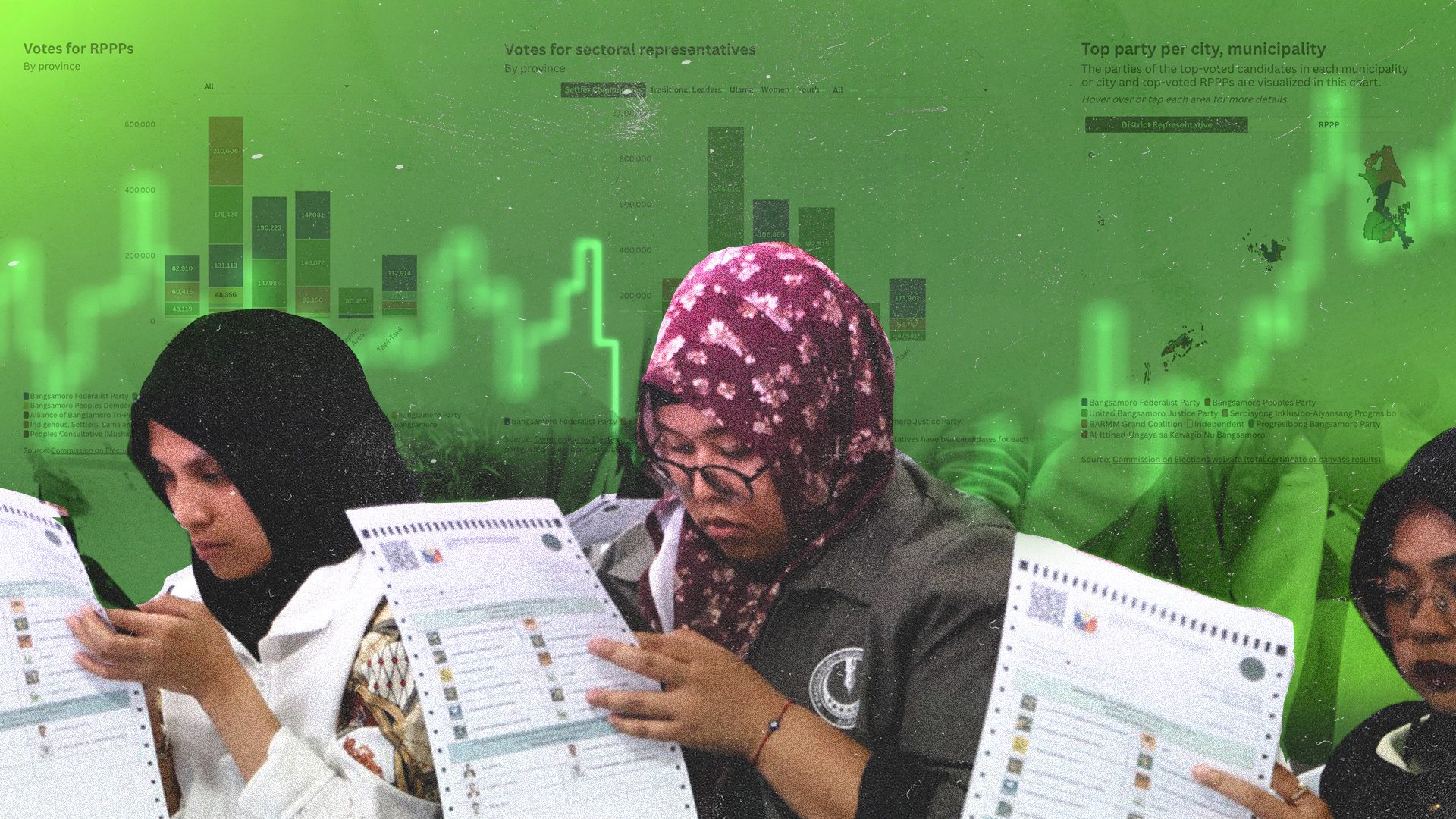
Local politics and key endorsements remained decisive in electing the Bangsamoro Parliament The BARMM election resulted in a mixed outcome with no single party achieving a majority, with the Bangsamoro Federalist Party (BFP) securing the most seats at 32, followed by the United Bangsamoro Justice Party (UBJP) with 30 seats. Local endorsements played a crucial role in the election results, with BFP dominating in four provinces due to support from local officials, while UBJP only won in the Special Geographic Area, its stronghold. Despite attempts to reduce patronage and dynastic politics, the election results indicate that clan politics remain influential in the Bangsamoro region. This is AI-generated. Read the article for full context. Report any errors. The historic Bangsamoro Autonomous Region in Muslim Mindanao (BARMM) election has concluded. How did the Bangsamoro people vote? The results are mixed, with no single party getting a majority of the seats. But the parties that did successfully get seats are: Bangsamoro Federalist Party (BFP) and its guest candidate from the Progresibong Bangsamoro Party – 32 seats United Bangsamoro Justice Party (UBJP) – 30 seats BARMM Grand Coalition (BGC) and its three member parties, the Bangsamoro Peoples Party, Serbisyong Inklusibo-Alyansang Progresibo (SIAP), and Al-Ittihad-Ungaya sa Kawagib Nu Bangsamoro – 15 seats Bangsamoro Peoples Democratic Party (Raayat Democratic Party) – 1 seat Non-Moro indigenous peoples representatives, who represent their tribes instead of parties – 2 seats A look into where all the votes came from showed that local politics and key endorsements remained decisive in electing the BARMM Parliament. Here’s a breakdown of the numbers. Votes per province The top three regional parliamentary political parties (RPPPs) secured votes in different ways. First placer BFP consistently got the most votes in four out of the BARMM’s six provinces: Basilan, Maguindanao del Norte, Maguindanao del Sur, and Tawi-Tawi. This could be due to the endorsements of local officials in these provinces. The governors of Maguindanao del Norte, Maguindanao del Sur, and Tawi-Tawi had endorsed the BFP. Basilan Governor Mujiv Hataman had a hand in founding two other parties — the BGC and Bangsamoro Peoples Party — but his nephew and Vice Governor Jim Hataman-Salliman was a candidate of the BFP. Eleven Basilan mayors also endorsed the BFP. Maguindanao del Norte is also the bailiwick of BARMM Interim Chief Minister and BFP president Abdulraof “Sammy Gambar” Macacua. He previously served as acting governor of Maguindanao del Norte. Second placer UBJP — which had initially been seen as the front-runner in the election — won in only one province: the Special Geographic Area (SGA), which is where Moro Islamic Liberation Front (MILF) and UBJP chair Ahod “Al Haj Murad” Ebrahim and his family reside. The party was a strong second placer in four other regions. The UBJP, the official party of the MILF, was the majority party in the region’s transition government for the past seven years. Support from the former rebel group’s members across the region was also expected. Third placer BGC’s voter base was more concentrated, getting 53.83% of the votes from Lanao del Sur alone. This province is the region’s most vote-rich, making up 30.4% of the voting population. This large showing in a single region is not surprising given that the BGC and one of its individual parties were established by the Adiong family, one of Lanao del Sur’s most entrenched and long-standing political clans. For the sectoral races, the UBJP swept all six seats up for election. But a look at the provincial breakdowns showed that voting patterns in the provinces were still largely affected by political dynamics. Top candidates and parties per municipality, city Going deeper into the municipal and city levels showed roughly the same pattern of key endorsements and strongholds, save for some breakthrough areas. But these areas were where candidates had their own hyperlocal pockets of power. For example, in BGC-dominated Lanao del Sur, some UBJP bets still managed to win in their own strongholds: one unopposed bet and two former mayors — former Kapai town mayor Hamza Gauraki and former Poona Bayabao mayor Lampa Pandi. In BFP and Macacua’s Maguindanao del Norte, former Maguindanao del Norte vice governor Abdulnasser Abas of the UBJP captured his own district. A scion of the Midtimbang clan is the lone UBJP winner in Maguindanao del Sur, where three other BFP bets won. While BFP bet Butch Malang lost the race, he was still able to capture one of the four towns in Ebrahim’s bailiwick of the SGA. Malang was administrator of the Special Geographic Area Development Authority until recently. Across its seven-year transition, the BARMM’s interim government — the Bangsamoro Transition Authority — had attempted to pass laws that would make the regional government move away from patronage politics toward more genuinely representative governance. Anti-political dynasty and anti-turncoatism provisions were put in place with the goal of making politics more about principles rather than prominence. Still, the results of the region’s first parliamentary elections showed that clan and dynastic politics continue to have a tight hold on the Bangsamoro people. Can the BARMM’s incoming elected parliament change that? – Rappler.com How does this make you feel? Loading
IN DATA: How BARMM voted in its first-ever parliamentary elections
Full Article
Original Source
Read the full article at Rappler →KhanList aggregates and links to publicly available news content. We do not host full articles from third-party sources. Always verify important information with original sources.