
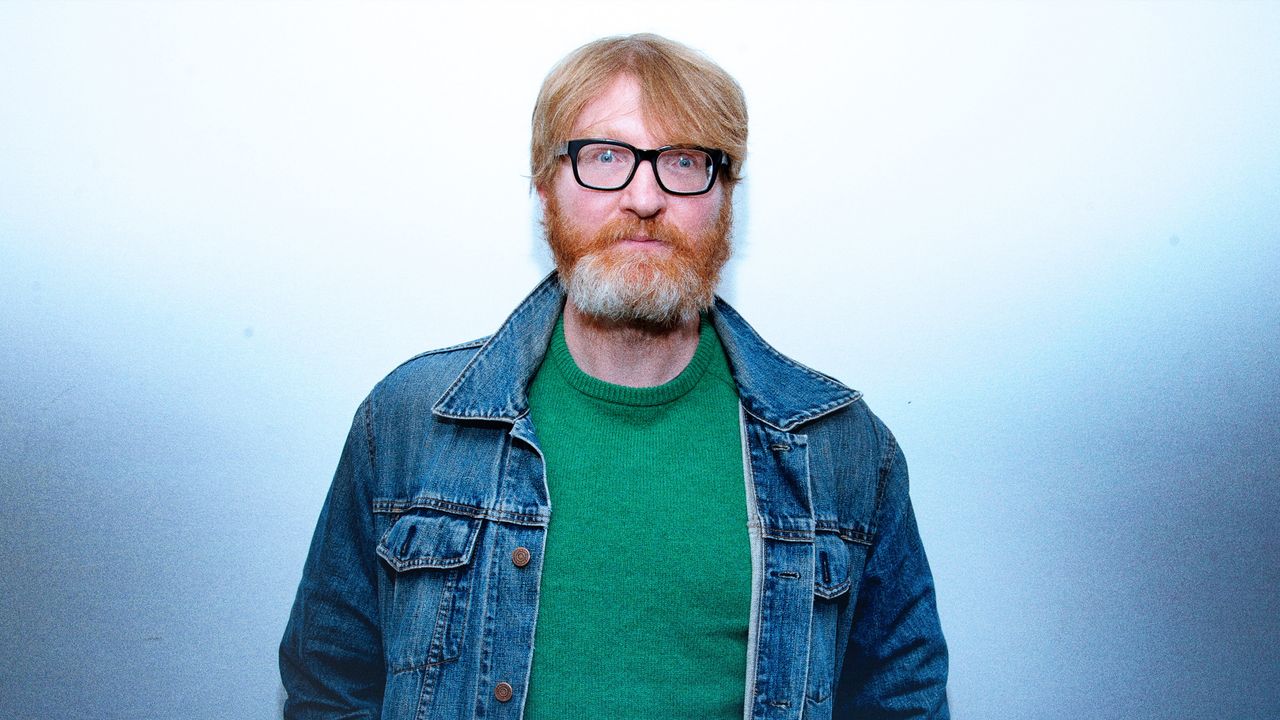
The essayist talks about inventing a world where the Fab Four fell off and the dream celebrity profile he'll probably never write.GQ; Getty ImagesRock*: A Mainstream Alternative History of Alternative Mainstream Music, Chuck Klosterman’s 14th book, maps a fictional universe in which the Velvet Underground somehow supplanted The Beatles—on the charts, with 1967’s The Velvet Underground and Nico, and in all of pop culture thereafter. A newly Velvets-crazy public spurns Sgt. Pepper’s Lonely Hearts Club Band as corny, Germanically deadpan “Nico-speak” becomes a trendy teenage affect, and punk is ultra-commercial on arrival. Narrated in comically sober prose by “Lester Bangs”—who’s lived to see the 21st century as a prosperous elder-hipster editor in the Jann Wenner mode—Rock* is a spiraling satire that sneakily interrogates slippery concepts like “importance” and “influence” and puts the “great man” theory of history to the test by replacing the great man with noted curmudgeonly drug abuser Lou Reed. It’s also a welcome corrective to Danny Boyle’s similarly-themed Yesterday, in which the Beatles never existed and the world is still more or less identical to ours. “That doesn’t make any sense, in a way,” Klosterman says, “because if the Beatles don’t exist, all these other things would have to change as well. You can't remove one thing and have everything else be the same. So this is premised on the idea that when one thing changes, everything changes with it.”This conversation has been condensed and edited, and for some reason contains minor spoilers for Frank Herbert's Dune novels, particularly the later, weirder ones.The first time you told me the idea for this book, I remember having this immediate and powerful flash of borderline-autistic frustration with the premise. I don’t think I voiced any of this in the moment, because we only had a few hours to hang out and I didn’t want to spend it arguing, but the idea of a universe where the Beatles stopped being popular but somehow Radiohead still existed—it just raised too many continuity problems for me. But in the book, you’ve managed to execute this concept in a way that makes it feel oddly plausible; the Velvet Underground having a huge hit record doesn’t, on its own, change the course of history, but it changes the way all other rock music is perceived and valued, and that ends up reshaping the world.Initially the thing I was most fixated on was the idea that everything about the world is different except for the records themselves, which would be identical and would come out when they came out [in reality.] Now as I began writing, I realized certain problems then emerged. If I killed [off] a band, obviously they can’t put out more records, nor can any of the records they influenced exist.This was a hard book to do. It was sort of like I had to write a non-fiction book entirely and then do a fiction book on top of it. I had to figure out how to do that. If I was just writing a straight history of rock from 1967 to 2002, how would it go? What would be the trajectory? And then go back in and essentially reverse engineer everything. So it was hard, and it wasn't very satisfying in a sense, because it really did feel like doing a bunch of chemistry experiments or something. I mean, [2025’s Football] was extraordinarily fun and easy to write because it was something that I'd been thinking about for 40 years and I just took every idea I had and just poured it into this text. This was similar, in that I'd been thinking about these things my whole life, but then I had to think the opposite of absolutely everything I've ever considered or believed before.So it was slow and it was arduous. When I initially presented the idea of this and it was going to be published by Penguin, they loved the concept and they were like, "Only you can do this!" But then when I actually did it, it was too weird for them. They were like, "I don't know what we imagined, but it wasn’t this." It got, essentially, rejected, or canceled. I wrote the football book immediately after that. That one came out, and now this one is coming out [from DaCapo Press] six months later.How did the process of writing this book change the way you viewed the real events of the era it covers, which is roughly 1967 through the early 2000s?I don't think it changed how I actually think about it. At times, people will say, "Well, so is this supposed to be a utopia or a dystopia? Are you describing something that you would like to have seen happen or is this some kind of warning about what could have happened? I suppose it might be slightly closer to the second one, but not by much. I just thought it would be fun. I mean, part of the reason that I was interested in music writing initially in my life was because I thought it was very funny. The writers who were writing about music, I thought were very funny. And I think the idea of taking lyrics literally or projecting the espoused political meaning of a band to its farthest possible extreme is just sort of entertaining and fun.I see much less of that in music writing now. In fact, I feel like it’s disappeared almost entirely. And I miss that, and I was like, "Well, this is just a way to make jokes about bands”—because so many of these bands have been written about so much that there really isn't anything left to be said about their actual identity. The Velvet Underground book that came out earlier this summer [Richie Unterberg’s Do What You Fear Most: The History of the Velvet Underground] is, like, an 800-page book about the Velvet Underground. There's not really many things to argue about them or the Beatles or Led Zeppelin if you take it as we understand it to be. A lot of those meanings are established. To write about The Beatles now, you have to find something that isn't really related to the music. Were they actually more reactionary than we thought? Were they actually less collaborative than we like to believe? But the only way to really write about things like that now is almost to take an adversarial position with it.Are you a fan of alternate history as a genre?Alternative histories are very fun to think about and they're very fun to create. They can be, at times, annoying to consume.I agree. But why do you think that is?I feel the same way about footnotes. I love using footnotes. I want to use footnotes constantly. And whenever I read a book where someone else uses footnotes, I'm like, "What the fuck are you doing? This is frustrating." So there's kind of a dissonance there. I try to get myself in the mind of the person. It's like, "Well, they're doing this for the same reason I do it."When I was first working on this, which I think was still during the pandemic, I was trying to reconcile this thing that I just said—“If anyone else did this, would I hate it?” I was in fact reluctant to send it to you for that reason, because I was like, If someone like Alex doesn't like this and finds it annoying, who could possibly enjoy it? But during that time, my son started watching this Marvel show, What If? And he explained the premise—that they’re taking these preexisting ideas [about the Marvel Universe] and going, “What if the Hulk was actually an urban planner in Tallahassee, Florida?” Anything can be anything. I don’t know that much about comic books, but I know who the good guys and the bad guys are, and [here] sometimes it would just be the opposite—a good guy would be a bad guy or whatever.And so your natural reaction when you hear that is sort of an annoyance because it's like, here’s something you’ve invested in emotionally, if you care about Marvel, if you care about comic books, and now here’s the opposite of it. And basically, you're almost removing the value of the time that I spent learning about this thing. You're basically saying, This fictional thing that you learned, who cares? We're just moving on and we're going to do it in a different way. But the more I thought about it, the more I realized how that is a negative kind of socialization in the sense that I have been socialized to be less intellectually flexible than a child—that my experience with rock music has sort of dictated that I have either the conventional belief system or the contrary opinion on that thing, and that was kind of all there was.But a book can be anything the writer wants. I mean, I think that this is probably one of the most difficult things to overcome, particularly if someone's writing their first book—they have this idea that books are supposed to be a certain way, that they're supposed to be a certain size, they're supposed to be structured in a certain way, and that it's not really a book unless it’s like other books you have read in the past, that your understanding of what a book is is actually controlled by all the books that came before. And that's actually untrue. You’re starting, basically, with either a blank sheet of paper, or a blank computer screen, and you have the ability to create that entire reality. So in some sense, that made me think, Why am I worried about this? Why am I worried about how someone could perceive this? Because it could be whatever I want. That's what's fun about writing. You get to create a reality.This is going to sound weird, but I also thought about the later Dune novels when I read this. At some point in those books, characters who’ve developed the ability to see thousands of years down the road of human history come to the conclusion that the only way to save humanity is to subjugate the universe—that someone will have to enslave the whole galaxy, because eventually the evolutionary pressure of living under that oppression will shape us into a more resilient species, but the only way we get there without destroying ourselves first is to be ruled by an all-powerful God-worm for four millennia. I think, in a weird way, this book makes the same argument about the history of pop music.How so?In our world, the real world, we’ve never stopped celebrating the Beatles and generally venerating the '60s-'70s Boomer rock canon—but you could make the argument that things like punk and hip-hop flourished in part because they had “rock music” as a suppressive force to push and define themselves against, and because the boringness of the canon meant a portion of the audience was primed for something different.The world you depict in this book does feel dystopian to me, because it’s stagnant. The Velvet Underground becoming a hugely popular band in 1967 might seem cool, but it leads rock music to an evolutionary dead end—the Melvins score a number-one single, but there’s not this sense that all these new ideas flower as a result of the Velvets hitting.I have several responses to this. First of all, the idea that there has to be this suppression in order for it to foster a more enriching reality, I do think that is true. I think, for example, the music industry, the record industry of the 60s, 70s, and 80s was very bad for individual artists, but probably good for the art form as a whole. And that many times the limitations put on things and the constriction of making something, essentially, into a commodity, even though it began as art, did have a sort of ancillary benefit, and a lot of the music from the rock era that’s become timeless was a product of that.Are you saying that, even though the Melvins have a number-one single [in the Rock* universe], what’s lost is what would have actually been meaningful about that? Is that what you’re arguing, kind of?I think I was thinking less about “meaning” and more about the way art evolves in response to what’s popular. In a world where transgression is institutionalized and normalized, which is what you suggest would happen as a result of the Velvets becoming hugely popular, where would the impetus to create new forms come from? There’s this implication that there’s never that kind of productive rupture in this post-Velvets world.My motive and my hope with this is that the book is entertaining. That's the main thing that I care about, that people find it entertaining, kind of interesting, and that it's an enjoyable experience. And yet, because of the way I've done it, it almost makes me feel like I'm in this position where I have to describe what it really is saying. Because in some senses, I guess some of the questions in it are, to me, the principal question is, Why do things happen the way they happen? Did they have to happen that way or could they have happened anyway? Is it arbitrary or is it sort of reasonable? There's this tendency, I think, whenever people talk about bands who succeeded or bands who failed, there tends to be these two arguments that people make. One is that it has to be because of merit or it has to be completely by chance.That the things that if someone just loves the Beatles and they're like, "It could only have been them that could have been that transformative, they're the only band who could have made that happen." And then there's other people who are like, "Well, it's going to happen to somebody. There was some band who was going to be them, and they were the ones who did it. They got there first or whatever."And the thing that is tricky and that is, I think, hard for people to reconcile is that it’s both of those things all of the time. Something succeeds or fails in part because of what it is and in part because of when and how it is received. In this book, for example, Steely Dan has the exact same career they had in our reality. They had the exact same career because that could happen, too. In this world, the same thing could occur. You could have the same records and the same amount of success and play the same role. And then in other examples, it's like the thing that was seen as impossible to be popular is actually the taste of the commercial public, and things that seem overtly commercial [in our world] are seen as insurgent and trying to pierce a hole in what this version of the mainstream is.As much as this book is about what would happen if the '60s had gone differently, it feels like it could only have been written by someone who lived through the '90s, and the moment when Nirvana came along to upset the applecart of mainstream rock, which is the closest thing in our lifetime to the kind of overnight pop-cultural changeover you’re describing. It’s almost like you’re asking what would have happened if 1967 had been the Year Punk Broke.So I was a sophomore in college when Nevermind came out, and I'm sure in some ways what you're describing was a very impactful moment, because it was weirdly visible, and there was a collective understanding that the way mainstream major pop music was had just completely altered itself. But at the same time, my awareness of what grunge fashion was actually came from either Newsweek or Time Magazine where it mentioned that they often wore flannel. I had seen them wear flannel. It had never occurred to me that there was any meaning to it. But I think that I also had, in some ways, a strangely bifurcated life in terms of my relationship to music, because growing up in North Dakota and then living in Akron, so from 1972 to 2002, my understanding of music was totally mediated.I had my own feelings, but then there was also a mediated world of music that suggested what was important and what wasn't important, and what certain things represent and what certain things didn't represent. And I would have to triangulate the way I felt with the way the world seemed, and what I was told about music. And then when I moved to New York, it was strange how almost everybody seemed to have, in general, a similar subjective take on what was good and what was bad. And it was jarring for me to realize that, because I went through this period—I wrote about this in my early books—where I thought people exaggerated the role the media played in their perception of the world. And then when I moved to New York, I was like, "Oh—it's not that it was exaggerated, it's actually downplayed." The degree to which the highest tiers of media are able to dictate, if not necessarily what people like, what that they have the right to think about or consider—that was much heavier than I guess I anticipated. I still think I’ve been dealing with the dissonance of that realization my whole life, since it happened.I was going to bring this up—that this book, more than maybe anything else you’ve written, feels like it was shaped by the experience of growing up in regular America and then moving to New York. And moving there specifically to work at a magazine like Spin, where you were surrounded by people whose job was to pretend the Velvet Underground actually had been more important than the Beatles, in some ways. In the back of The Spin Alternative Record Guide, from 1995, there’s this canonical 100-album list with the Ramones’ first album at the top and zero Beatles albums in the other 99. That’s an alternative history, too, in a way.I mean, that book changed my life twice. It changed it the first time when I got it in Fargo, and it was instantly my favorite rock critical book I've ever read—in terms of the reviews in there, the style, the ideas, these outsized descriptions of bands that to me didn’t seem remotely significant. The fact that it was funny. In terms of how to actually write about music, I think that book was probably the most important one I received.And then I got to New York and I was like, "Oh, there's actually a whole world of people who think this is real! They think this is true.” This makes me seem like a naive idiot, but [reading the Spin book], I was like, “This is funny and performative and interesting. The goal is to be interesting. The goal is not to persuade me to actually believe it.” I thought it was mostly a creative endeavor. And then when I got to New York and I realized these lines of thought existed in rock media in a real way—that was just a wild thing to realize.So you thought the Spin book was kind of like Fargo Rock City, in a way—that they were suggesting the Ramones were the most important band ever in the same way your book was this sort of tongue-in-cheek argument that Kix were as great as the Beatles.Or that it was as much a thought experiment as it is an expository text. During the ‘90s I was absolutely obsessed with postmodernism. I wanted everything to be postmodern. I could see postmodernism in everything that happened, because it was an interesting way to think about stuff. It is very strange now to live in a world where that thought experiment is how the world actually is. Now it seems terrible, and now I feel as though I was actually complicit in this—that I was actually sort of trying to promote this idea that there really isn't any kind of hard reality and it is just sort of the subjective view of the consumer. That was something that I loved as an idea, but hate as a kind of a concrete reality.I don’t want to suggest, though, that when I made this discovery upon moving to New York, that I was dismayed. I loved it. And every artist that’s in this book, it means I like them. I’ll be bummed out—even though I know it’ll happen—that some people will view this book as my attempt to satirize these groups, or say the emperor’s not wearing clothes or whatever. That’s not how it is. If they’re in this book, it’s because I like writing about them, not because I think they need to be taken down a peg, or elevated more than they are.I always talk to people about how Roger Ebert used to write amazing profiles of actors and directors, and in the what-if spirit of this book I always wonder what would have happened if he hadn’t chosen criticism as his lane. You’ve spent a number of years writing books that are these pure mind-palaces of argumentation and theory. Do you ever miss going out there and interacting with a Stephen Malkmus or a Britney Spears or whoever, as much as I miss reading those pieces and seeing these people react to your sensibility?Not really. I don't, and I'm kind of surprised that I don't. I think in one way, part of that is that, in my lifetime, journalism has changed a lot. And I think in a sense, I recognize that the kind of journalism I did is not really what's kind of wanted now.And also, I think, as a feature writer, I was able to do something that a lot of other feature writers I know don't want to do. With celebrity profiling there’s always this idea, like, "I’m not getting enough time with this person." People want to be more like Susan Orlean or whatever, and stay with this person and really get to know them, get really close to them. And [celebrity-profile writers] are always fighting for more time and fighting for more time. And I think because I came from daily newspapers, I was like, "I don't need that much time. Give me an hour. I get to talk to Kobe Bryant for one hour in a pancake house? That's all I need because I'm just going to immediately ask him the questions that I want to know about. We're going to have no relationship and I'm not going to be able to explain to someone or illustrate to someone who this person truly is. I can just ask the questions that I find interesting and [that] I hope somebody else does."So I think that I had a high utility as a feature writer because if there was a celebrity and there was not much time to deal with them and it was going to be hard to do a story, I could just do that. But I will say my favorite part of feature writing would be after the interview, when you get back to the car and you check the tape and the tape [worked] and I was like, "Oh my God, good. Okay. Now I just got to transcribe this and write it."I feel like the amount of research you would do and the amount of time you would spend with these people was something that I just wasn't super comfortable with. I would never let a reporter hang around me for a week. I would never do that. If somebody wanted to interview me for a week, I would never allow that. And now I think of that anytime that I interview someone else. In some ways I've become a better interviewer, but a much less effective one because I am much more empathetic about how it feels to have someone come and ask you a bunch of questions that you then have no control about being published.Sometimes I'll get asked to do a feature on someone and I almost always say no. I always thought I would like to do a feature on Axl Rose. I thought, I could do this better than most people. But he's a totally different person now, and I don't even know if a lot of the things I wanted to ask him about would actually be true reflections of how he felt at the time, because it's almost impossible to talk about your younger self without projecting your current self onto that person.Sign up for Manual to receive useful advice on style, health, and more, six days a week.Alex Pappademas is the Senior Culture Editor of GQ. He has been writing about music, film, television and other forms of popular culture for over 20 years. He is the author of Keanu Reeves: Most Triumphant— The Movies and Meaning of an Irrepressible Icon (2022, Abrams Image) and the coauthor, ... Read More
In Chuck Klosterman's Rock*, the Velvet Underground Beats the Beatles, and History Bends
Full Article
Original Source
Read the full article at Gq →KhanList aggregates and links to publicly available news content. We do not host full articles from third-party sources. Always verify important information with original sources.