
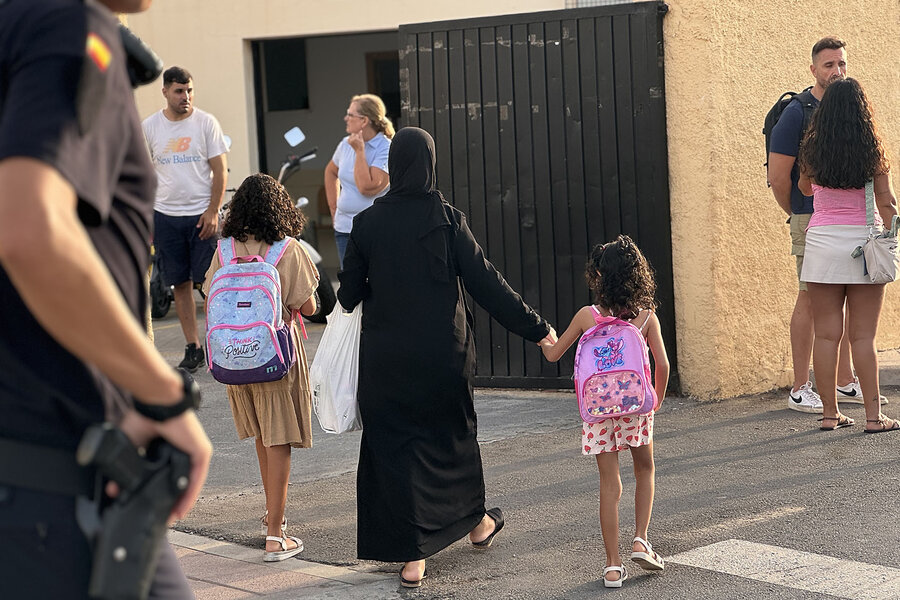
This week, as Spanish children across the country started their school year, the Reina Sofia primary school in Ceuta did its best to prepare for a normal first week, too – getting the front entrance clean and putting photos of teachers on the wall.But things have been anything but normal.Over two days in late July, around 80,000 migrants crossed into this autonomous Spanish city without authorization. Most have left. But until a few days ago, hundreds of migrant children were sleeping outside on the soccer field next door. Ismael, who is 13, was one of them. Why We Wrote This The school year is off to an unusual start in Ceuta, Spain’s exclave on the North African coast. Authorities are figuring out what to do with hundreds of unaccompanied migrant children who entered the city in recent months. The kids just want to go to school. The Monitor is only using first names to identify underage migrants in this story, for privacy reasons.“I won’t go back to Morocco,” says Ismael, who traveled from Tangier with his older brother to swim across the border to Ceuta. “I want to stay in Spain and go to school.”But going to school here in Ceuta feels remote to kids like Ismael. According to Spain, he does not exist.Spanish authorities have registered around 1,500 unaccompanied children since the 80,000 crossed over the Moroccan sea border into Ceuta on July 30 and 31. Although a majority of migrants have voluntarily returned to Morocco, hundreds of children like Ismael are still living on the streets.Though there are laws in place to protect underage migrants in Spain, the central government’s efforts to process them have encountered both domestic and European obstacles. As the crisis extends into its second month, the system is completely overwhelmed.In the meantime, kids like Ismael are missing their first week of school and can expect to miss many more – assuming Spain even decides to allow them to stay. The question of what Spain – and Europe, more broadly – owes migrant children has divided the Spanish government as well as the public. Here in Ceuta, located on the northern tip of North Africa, the sense of urgency is shared by everyone.“A 13-year-old kid can’t live on the street,” says Ahmed Efen-Dal, president of the residents association in El Príncipe, an Arab-majority neighborhood along Ceuta’s border with Morocco. “It’s impossible.”“We’ve reached our limits”As an “avalanche” of people filled the streets of Ceuta, doubling its population in the span of 24 hours in late July, Mr. Efen-Dal says he felt he couldn’t sit back and do nothing. Marcos Moreno/Europa Press/Abaca/Sipa USA/AP Despite having been cleared, the camp on El Trampolín beach in Ceuta, shown here on Sept. 7, 2026, resembles a makeshift town and remains occupied by people who continue to arrive in the city. Within days, he and other neighborhood volunteers started pulling aside unaccompanied girls sleeping on the nearby hillside and helping locate their families via WhatsApp. With assistance from a local aid organization, they set up a makeshift camp for 300 unaccompanied women and girls – and a few young boys like Ismael – to sleep safely in the empty soccer field next to the Reina Sofia school; gave them food; and donated clothing.However, residents say their volunteerism is meant to be a stopgap measure. Now, after more than 45 days, patience is wearing thin.“Of course we feel compassion toward these kids. We’re human,” says Rahma Enfedal, inside the office of the El Príncipe residents association.“But we’ve reached our limits,” says Abdel Malik Abdesalam, a local. “The government has abandoned us.”Spanish police are required to register unaccompanied minors, which allows the children to get temporary housing and begin the administrative process of either remaining in Spain or returning home. However, aid organizations say there aren’t enough beds for minors in Ceuta. As a result, migrants say they are being told to leave and come back another day before they can be registered.“If children aren’t registered, they don’t exist,” says Jennifer Zuppiroli, a migration specialist with Save the Children. The nonprofit group has been conducting relief efforts in Ceuta, and helping to count and place unaccompanied minors. “It’s impossible to give a response if you don’t know how many children are living on the streets.”Conflicting directivesTo some extent, the Spanish government has been forced to act slowly. In January 2024, Spain’s Supreme Court ruled that following a similar migration surge in Ceuta in 2021, the government had acted illegally when it returned around 1,500 underage migrants to Morocco without due process.Spain’s immigration law requires that authorities open individual case files into family whereabouts and hold hearings on a child’s maturity, if necessary, before returning children. Migrant camps for minors in Ceuta are overwhelmed by demand. A sign on the fence of this one, which houses women and girls, says "No more room." “Spain is being much more careful this time around,” says María Belén Zanzuchi, a policy analyst at Migration Policy Institute Europe in Brussels.The Spanish government is also at odds with the European Commission on how to deal with minors. According to an EU migration pact, children as young as 6 can be subjected to biometric screenings and detained in deportation centers at the border. Last month, the EU Commission said that irregular migrants in Ceuta, “including unaccompanied minors,” should be returned to Morocco.But there have been mixed messages about how Spain should proceed. The EU pact has only been in effect since June 12, which has not given member states adequate time to coordinate on procedure with EU agencies amid such a high number of cases in Ceuta, says Ms. Zanzuchi. Meanwhile, Spanish law requires that unaccompanied minors remain under the care of the state and cannot be summarily detained or deported.Spain has said that family reunification is a priority. However, aid organizations say that in order for unaccompanied minors to be sent home, the Moroccan government needs to do its part by helping to locate families in order to facilitate a child’s return.The Moroccan Foreign Ministry said in a statement on Thursday that there is no evidence of Morocco’s involvement in the July 30-31 Ceuta migrant crossing. However, declassified documents released Wednesday by Spain’s intelligence services suggest a high likelihood that Moroccan authorities acted in a negligent and passive manner. That has fueled doubts about how willing Morocco is to cooperate on returning migrants.“What we’re seeing is that Spain starts the process to ask for information about a child, but Morocco doesn’t do its part,” says Ms. Zuppiroli of Save the Children. “The process should work if there is the will to do it.”On the street, or in the classroomsAmid the bureaucratic confusion, children like Malak are waiting. At 17, Malak has one more year of high school left before she can get her diploma. She wants to study to be a lawyer, but isn’t sure what is going to happen now. This week, when city officials came to bring 300 girls from the El Príncipe soccer field to an official migrant center, she was not one of them.“I didn’t expect this,” says Malak, in a donated blue polo shirt, a line of braces crisscrossing her teeth. “I never imagined living on the street.”Yet Malak, like the thousands of migrants who remain in Ceuta, says she has no intention of going home. While adult migrants say they hope to find work in Spain, the kids just want to go to school. That is a reality that local educators are preparing for. School principal Francisco Javier García Padilla says he has tried to create a sense of normalcy at the Reina Sofia primary school during the first week back from summer vacation. For the last month, hundreds of migrant women and girls were camped out in the soccer field next door. “We will teach whoever is allowed to be here,” says Francisco Javier García Padilla, the principal of the Reina Sofia primary school in El Príncipe. “We’re preparing ourselves for more migrant children to arrive.”But Mr. García Padilla says his classrooms are capped by law at 20 students and he would need more teachers and classrooms in order to welcome a large number of new students.Educators across Ceuta share conflicted feelings about the current situation. “It’s heartbreaking to see kids on the street, alone,” says Ángel González, a local teacher, who participated in a street protest against migrants this week. While he knows some underage migrants left home without telling their parents, many Moroccan parents encouraged their children to cross. ”They’re taking advantage of our laws.” Many Ceuta parents say that while they feel sorry for the migrant children still living on the streets, they’ve had enough. This week, amid a public outcry over safety concerns, Spain promised to increase police presence at school drop-off and pickup. Many parents carried pepper spray during their school run, following reports that adult migrants had committed sexual assault and cellphone theft against other migrants. Thousands of people continue to sleep on city streets and beaches.But migrant children say they’re the ones who are scared. On a recent morning in the city center, Spanish police were kicking out young boys who had slept overnight on cardboard slabs, some of them bruised and bandaged. Nearby, a 9-year-old washed his face discreetly in the bushes with a bottle of water, a bright orange backpack slung over his shoulder.They, like 13-year-old Ismael, could in theory try to return home. But even that seems daunting.“Things are awful right now,” says Ismael, looking off into the distance. “But I’m hopeful it will work out.”
In Ceuta, Spain debates: Educate migrant kids or send them home?
Full Article
Original Source
Read the full article at Csmonitor →KhanList aggregates and links to publicly available news content. We do not host full articles from third-party sources. Always verify important information with original sources.