
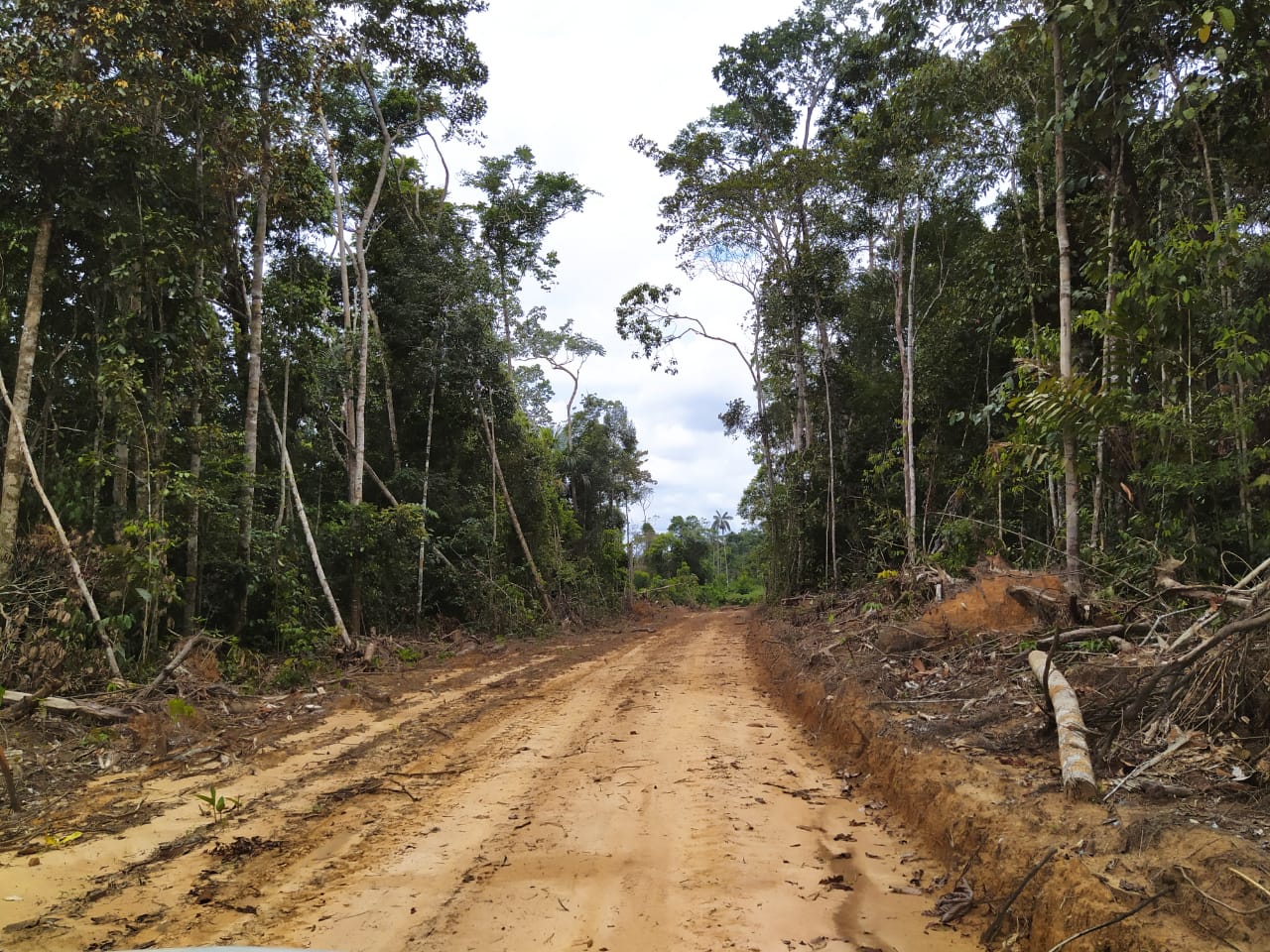
The 2024 inauguration of the Chinese-built Chancay Port in Peru has reinforced calls to build road infrastructure through the Amazon, connecting Brazil to the Pacific coast, with authorities in Acre, on Brazil’s border with Peru, wanting their state to be part of a strategic corridor to the Pacific.Acre already has a road connection to Peru through the BR-317 highway, but local politicians running for election this year defend the extension of the BR-364 from Cruzeiro do Sul in Acre to Pucallpa in Peru’s Ucayali department, saying it will ease connectivity for local communities and encourage economic development.A new report from NGO Amazon Conservation argues that this will increase areas at risk of forest loss and could drive additional deforestation of up to 68,500 hectares (169,270 acres) per year, while threatening Acre’s multimillion-dollar revenue from the sale of carbon credits, according to the report.Uncertainty around whether the extension of the BR-364 will go ahead is already driving land speculation between the town of Mâncio Lima and the Serra do Divisor National Park and encouraging criminal groups that are already established along the border, local environmentalists say. Along a freshly repaved stretch of the BR-317 highway in Acre, a Brazilian state bordering Bolivia and Peru in the Western Amazon, pasture stretches out as far as the eye can see. Solitary Brazil nut trees (Bertholletia excelsa), a protected species, are the only reminder of the tropical forest that once stood there. The road is part of the Interoceanic Highway, inaugurated in 2011 as the first paved road in South America connecting the Atlantic and Pacific oceans. Built through the Brazilian and Peruvian Amazon to help increase trade to Asia as well as between neighboring countries, the highway has been associated with deforestation on both sides of the border. “Roads are the main vector for deforestation and irregular [land] occupation,” says Sonaira Souza da Silva, a professor at the Federal University of Acre’s Floresta Campus and co-author of a recent paper on road expansion in Acre. The desolate landscape that now lines the BR-317 could be replicated elsewhere in Acre, environmentalists warn, if plans go ahead to build a second road connection with Peru. This is part of a renewed push to turn the state into a corridor to the Pacific for the export of Brazilian agricultural and mineral goods, following the 2024 inauguration of Chancay, a Chinese-built mega-port just north of Peru’s capital Lima. A new report from the NGO Amazon Conservation argues that expanding road infrastructure is incompatible with Acre’s deforestation commitments and that new corridors could add between 74,700 to 133,800 hectares (around 184,600 to 330,600 acres) of deforestation in the next 10 to 20 years. More forest loss would also threaten potential income from the sale of REDD+ (Reducing Emissions from Deforestation and Forest Degradation) carbon credits, which could then be reinvested in developing sustainable bioeconomy value chains. Newly paved road in Acre, Brazil. Image by Blaise Bodin, courtesy of Amazon Conservation. “There are some political choices that need to be made,” Blaise Bodin, director of strategy and policy at Amazon Conservation and the report’s lead author, tells Mongabay in a video interview. Deforestation in Acre soared between 2019 and 2022, coinciding with the presidency of Jair Bolsonaro, but has been falling since a peak of 88,900 hectares (219,676 acres) in 2021 – the third-highest annual figure since 1988 – reaching 32,400 hectares (80,062 acres) in 2025, according to PRODES satellite data from Brazil’s National Institute for Space Research (Inpe). Sustaining that trajectory depends in part on who wins Brazil’s presidential election and Acre’s gubernatorial election, both in October, says Miguel Scarcello, executive director of SOS Amazônia, a local nonprofit involved in the report. A new connection to the Pacific Despite Acre’s existing connection to Peru’s Madre de Dios department via the BR-317, decades-old plans for a road link between Cruzeiro do Sul, a city on the Juruá River in western Acre, and Pucallpa, in the Peruvian department of Ucayali, have never been abandoned. This would involve extending the BR-364 by some 150 kilometers (90 miles) and cutting through the Serra do Divisor National Park to reach the border. Crossing Brazil from east to west over roughly 4,300 km (2,700 mi), the BR-364 begins in the state of São Paulo and currently ends in Mâncio Lima, a town just after Cruzeiro do Sul. In 2019, Acre state authorities started opening a path for the new section of road from Mâncio Lima. As well as cutting through a unique protected area home to a rich biodiversity, the proposed road extension would also cross territories home to Indigenous groups in voluntary isolation. At the time, Indigenous communities that would have been affected said they were not properly consulted. The Chancay megaport, opened in late 2024, has triggered plans to build new infrastructure through the Amazon to increase trade through the Pacific. Image courtesy of Agencia Andina. The project was halted in 2023 after a federal court ruled on a legal challenge submitted by environmental groups, including SOS Amazônia, and suspended any work on the road pending the execution of a social, economic and environmental viability study. More recently, Brazil’s federal government presented plans to develop Amazon infrastructure that would link Brazil to Pacific ports, including Chancay, but these do not include a road connection between Cruzeiro do Sul and Pucallpa. Politicians in Acre continue to defend the need for this link, arguing that it will facilitate existing cross-border ties and bring new sources of economic development. “The road that will link Acre and Peru must become a reality for the good of the development of Acre and Ucayali,” state representative Luiz Gonzaga told Acre’s legislature earlier this year. A first step would be rebuilding the section of the BR-364 between the state capital, Rio Branco, and Cruzeiro do Sul, that becomes impassable when it rains. Candidates running for state governor, including Tião Bocalom and current Senator Alan Rick, have said they will work to make the road to Pucallpa a reality. “For those who live in isolated regions, roads represent cheaper products and the right to come and go [easily],” Rick told local media on the campaign trail. Rick also defended a more concrete infrastructure project giving Brazil a route to Chancay via Acre – the so-called Bioceanic Railway, which has been discussed by the Brazilian and Chinese governments but also raises serious environmental concerns. Deforestation risks Advocates and opponents of extending the BR-364 agree that a road connection to Pucallpa remains a distant prospect. “But even if it doesn’t become reality, there is a huge problem related to speculation around the process,” Silva tells Mongabay in a video interview. “This speculation about whether it will or won’t happen creates pressures on land use.” Scarcello from SOS Amazônia describes how private land around the prospective corridor between Mâncio Lima and Serra do Divisor National Park is already being sliced up and sold off. “This is going to create complex pressures in the future, including for the [Serra do Divisor] conservation unit,” he says. Protected since 1989, the Serra do Divisor National Park spans 837,555 hectares (around 2 million acres) and contains a unique biodiversity due to its location on the edge of the Andes and its varied altitude. It is home to 1,233 recorded animal species, of which 90 are of “special value” for conservation, and at least 1,163 botanical species. Scientists are continuously making discoveries there, such as last year’s discovery of a new species of tinamou, described as the Tinamus resonans. Panorama over the Serra do Divisor National Park. Image by Mário Broering via wikimedia. This new bird species “may be highly vulnerable … to proposed infrastructure projects that threaten the [park’s] integrity,” researchers note. In the border area south of the national park, local organizations such as the Organization of Indigenous Peoples of the Juruá River have for years denounced growing threats from criminal groups, which are responsible for illegally opening new roads and invading Indigenous territories on both sides of the border. “The Peruvian side has already [been suffering] from a series of illegal activities, logging, gold mining, coca plantations,” Scarcello says. “And now, [political] mobilizations [for a new road] incentivize these illegal groups further.” Should construction go ahead on the BR-364, Bodin says that the experience of the BR-317 should serve as a warning. “In the first years [of its construction], the road didn’t generate that much additional deforestation,” he says, as that coincided with a period of strong monitoring and enforcement by the state. “But then over time it starts picking up, and you see the rates of deforestation along the road overtaking the overall rate of deforestation in the state by a factor of five.” Amazon Conservation modelled the impact of these road developments across the three scenarios above, comparing S2 and S3 against the current-conditions baseline (S1) to estimate the increase in the area of forest at risk of deforestation and the increase in projected deforestation over the next 10 and 20 years. Images courtesy of Amazon Conservation. Roughly 1.3 million hectares (3.2 million acres) of forest have already been lost within 50 km (31 mi) of the existing unpaved BR-364 since 2000, according to Amazon Conservation’s report. Paving the BR-364 could add 63,000 hectares (155,700 acres) of deforestation per year compared to the business-as-usual scenario, the report calculates, with the caveat that this is not a precise projection. New corridors, including the extension to the border, could add a further 5,500 hectares (13,600 acres) of deforestation per year, leading to an accumulated deforestation of 74,700 hectares (about 184,590 acres) over 10 years and 133,800 hectares (about 330,630 acres) over 20 years. Lost carbon credit revenue The possible increase in forest loss would not just threaten a still-preserved area of the Amazon Rainforest and the Indigenous communities living there, but also the sale of carbon credits on the voluntary market, a key revenue stream for the state of Acre, the report says. A pioneer of a framework known as jurisdictional REDD+, Acre has received around 56 million euros ($65 million) since 2012 from the German and British governments as payment for verified emissions reductions, which has been redistributed to forest communities and used to improve the state’s capacity to implement its program for incentivizing environmental services (SISA). With public funding set to dry up, Acre signed a deal in 2025 with British banking group Standard Chartered for the joint sale of carbon credits worth up to $150 million. The potential revenue for the 2023-2032 crediting period could be as much as $1.8 billion, according to the Acre government’s own calculations — a significant amount for a state with a GDP of around $5 billion $26 billion reals (around $5 billion). Under the agreement, forest communities are to receive 72% of net revenues from carbon credit sales. A Brazil nut tree standing in a deforested area in Acre, Brazil. These trees are protected by law and cannot be cut down; however, when isolated from the forest, they stop producing fruit and eventually die, while becoming vulnerable to lightning strikes and forest fires. Image by Blaise Bodin courtesy of Amazon Conservation. But that depends on Acre not only meeting its objective of reducing deforestation by 50% in 2027 from the 2017-2022 baseline, but also on the state sustaining this reduction in forest loss in the future. Pushing for road infrastructure, like the connection from Cruzeiro do Sul to Pucallpa, sends the message that “these emission reductions are not going to be permanent and the private demand for these credits is going to walk away,” Bodin says. That would in turn jeopardize Acre’s capacity to develop a bioeconomy by reinvesting income from carbon credit sales into systems like processing capacity and certification for sustainable forest products, Amazon Conservation says. In Acre alone, it is estimated that sustainable non-timber forest products could add $71 million to the local economy every year, according to the report. However, Scarcello notes that even after 15 years of investment into sustainable production chains for products including açaí and Brazil nuts under the German-led REDD+ for Early Movers (REM) program, the development of a forest-based economy in Acre remains incipient. “There are good ideas but the mechanisms have not evolved that much,” he says. Acre Governor Mailza Assis Cameli, who will be seeking re-election in October, rejects the view that new roads and the sale of carbon credits are mutually exclusive. “When opening new roads, yes, there can be property speculation for cattle rearing and the expansion of agriculture, but there are other variables,” Assis Cameli tells Mongabay via written messages, pointing to the recovery of degraded areas through agroforestry systems as a way of contributing to the state’s positive carbon balance. Fabrina Furtado, a professor at the Federal Rural University of Rio de Janeiro who has worked with communities that received funds from jurisdictional REDD+ in Acre, also believes that “it is a false contradiction”, because she is critical of REDD+ as a tool for effectively fighting deforestation. “The carbon market, REDD+ policies, were not thought up to eliminate infrastructure projects,” Furtado says in a video interview, arguing that policies to avoid deforestation should focus on the main offenders, namely agribusiness. Banner image: Work in progress on the BR-364 highway. Image courtesy of Miguel Scarcello, SOS Amazônia. Citations: Silva, S., Nascimento, E., Souza, E., Melo, A., Fearnside, P. (2026) Relatorio Expansao de estradas e ramais no Estado Acre – 1989 a 2025. Cruzeiro do Sul: UFAC. doi:10.5281/zenodo.19208602 Morais, L.A., Crozariol, M.A., Godoy, F.I., Plácido, R.A.A. & Raposo, M.A. (2025) A new species of Tinamus (Aves: Tinamiformes) from the western Amazon, Brazil. Zootaxa, 5725 (2), 279–291. doi:10.11646/zootaxa.5725.2.6 FEEDBACK: Use this form to send a message to the author of this post. If you want to post a public comment, you can do that at the bottom of the page. Credits Topics
In Brazil’s Acre, calls for new roads clash with deforestation commitments
Full Article
Original Source
Read the full article at News →KhanList aggregates and links to publicly available news content. We do not host full articles from third-party sources. Always verify important information with original sources.