
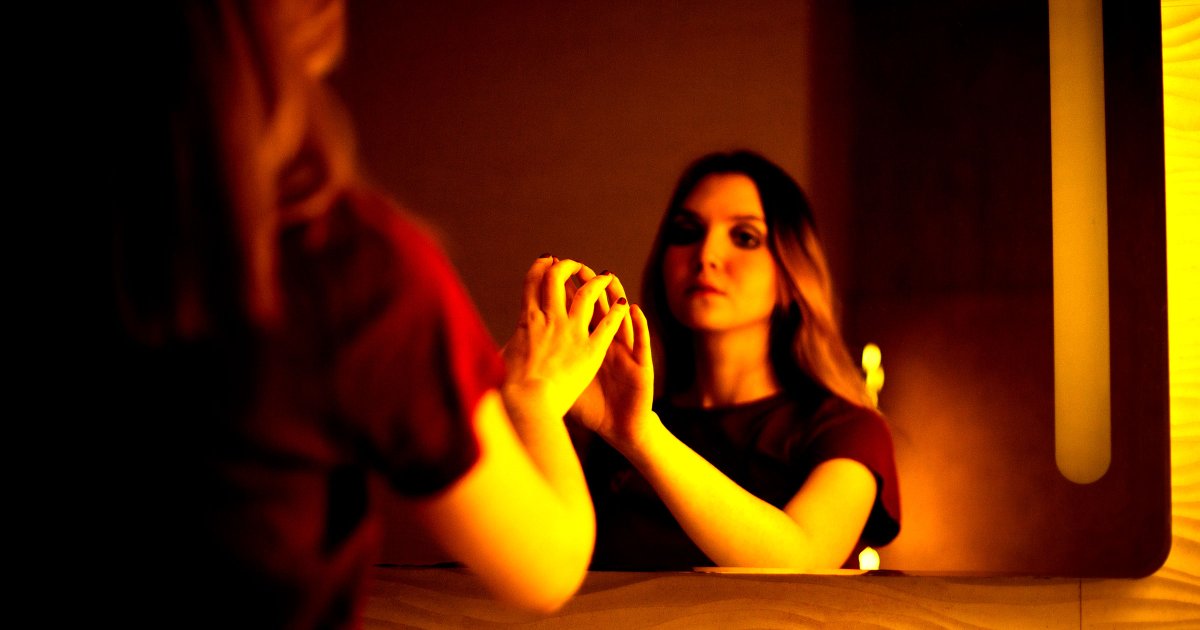
Shutterstock / Futurism How do rituals for communing with the dead affect the mind? And conversely, how does the way your brain is wired affect the perception that these experiences are real? A team of researchers decided to find out in pointed style: by isolating research subjects in a dark room where they were directed to sit in front of a mirror for nearly an hour. Strange things, they reported in a study in Journal of Anomalous Experience and Cognition, then ensued. The setup may sound familiar to paranormal enthusiasts: it’s what’s known as a psychomanteum, a place that supposedly lets you communicate with the spirits of the dead. Trapped in the darkness of the space, your only company is a mirror that’s tilted up at the ceiling so it reflects nothing but blank space, providing the canvas for ghostly forms to appear. For the experiments, the researchers recruited 30 people, with half of them being those who had reported a previous experience with a ghost, and the other half having a condition called synesthesia, in which the brain’s sensory pathways are jumbled up, commonly manifesting as tasting or hearing colors. Before going in, the participants were told to think of a deceased loved one for fifteen minutes. Then they sat in the psychomanteum, staring at the upturned mirror, for another 45 minutes. The researchers kept tabs on their heart rate, while also monitoring typical ghost-hunter environmental clues like electromagnetic readings and temperature variations. The participants could also press a button when they believed they detected a presence in the room or experienced strong visual imagery. After their time in the psychomanteum, the participants rated the intensity of their spooky encounters on a scale, and whether they felt the encounters were real. Some indeed felt very compelled by their experiences. “One participant experienced her hair being stroked by her loved one, which was meaningful and strongly impactful,” lead author Christine Simmonds-Moore, a psychologist at the University of West Georgia, told ScienceAlert. To the researchers’ surprise, those with synesthesia didn’t report feeling a presence more often, or having experiences that were more intense than those without the condition. But what they did find is that the participants who were deemed more creative, based on a survey they had them take beforehand, also tended to report more intense experiences and visual imagery in the mirror. Strangely, the data showed a correlation between geomagnetic fluctuations and the physical perception of a ghostly experience — but for synesthetes only. (As ScienceAlert notes, the study heavily relied on statistical comparisons, which raises the risk of finding patterns that may be down to simple coincidence.) The results suggest what you probably suspected: that people’s backgrounds, subjective differences in how they perceive the senses, and physical factors in the environment, all affect people’s supposed encounters with the supernatural. More on spooky science: Scientists Say They’ve Figured Out What Causes “Ghosts”
In Bizarre Experiment, Scientists Put Subjects in Dark Room With a Large Mirror and Instructed Them to Think of the Dead
Full Article
Original Source
Read the full article at Futurism →KhanList aggregates and links to publicly available news content. We do not host full articles from third-party sources. Always verify important information with original sources.