
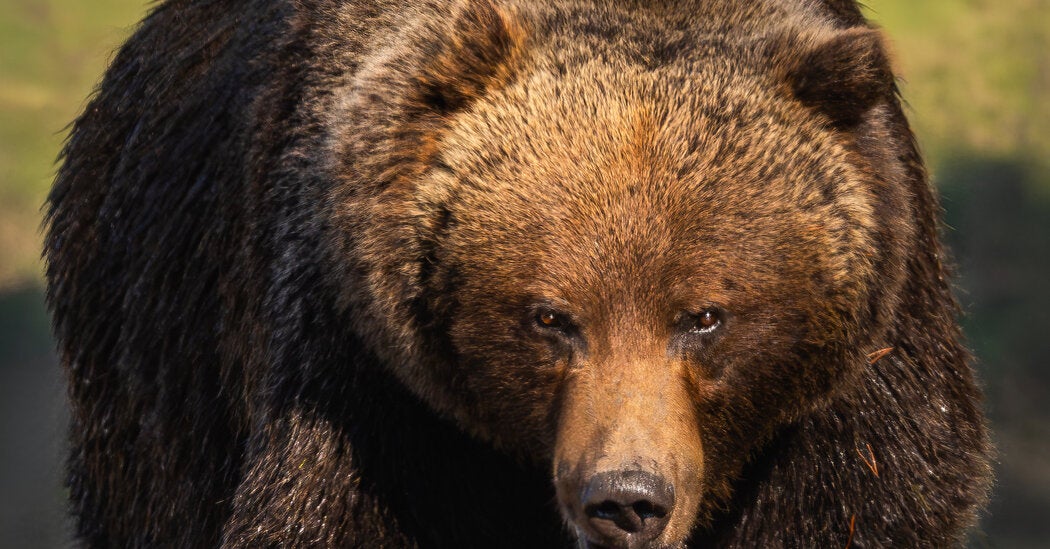
“The Boss,” the near mythical grizzly bear king of Banff National Park.Credit...All in the Wild PhotographyBear 122 has survived a train, cars and rival bears. Some fear the biggest threat to his life now is his own fame.“The Boss,” the near mythical grizzly bear king of Banff National Park.Credit...All in the Wild PhotographyTo the scientists and wardens of Banff National Park he is grizzly bear 122. But to everyone who lives in or near Canada’s oldest national park, and many of its 4.5 million annual visitors, he is the Boss.He has been struck by a freight train without apparent ill effect. He has shrugged off being hit by cars. Scientists have confirmed that he killed and snacked on a black bear at least once, and he is believed to have fathered many, if not most, of the bears in his 2,000-square-kilometer territory.Most of all, the Boss has become Canada’s 700-pound celebrity bear king. When he strolls along the Trans-Canada Highway looking for dandelions, “bear jams” swiftly follow. His battles with a rival bear known as Split Lip are legendary. (He caused the split lip.) His annual awakening from hibernation, usually in March, is reported by news outlets across Alberta.Galleries in Banff and neighboring Canmore ship giant photos of him worldwide. His image appears on fridge magnets, T-shirts and tote bags. A local restaurant is named for him, its main dining room dominated by a scrap metal sculpture of the bear.ImageThe Boss Kitchen and Bar in Banff, Alberta, features a scrap metal sculpture of the famous grizzly bear.Credit...Ian Austen/The New York TimesBut despite his fearsome demeanor, enhanced by four-inch claws, few bear experts consider the Boss a threat to park visitors or residents. Rather, they fear his celebrity and the legions of fans it have created, may be the biggest threat to his life and his dominance.Among those concerned about the cost of celebrity is Paul Kalra, a gas station owner and nature photographer who drew attention to the bear more than 20 years ago with photos in a local newspaper and is widely credited with naming him.“Give him a break,” Mr. Kalra said, sitting at a table at the restaurant in his service station in Dead Man’s Flats. “Even the movie stars that are most famous, they go incognito with sunglasses when they go to have a burger, you know? I want same thing for the Boss.”About 75 grizzly bears roam the mountains, rivers and valleys of Banff National Park’s 6,641 square kilometers. How the Boss came to stand out is a matter of geography as much as his size and legends. His home turf overlaps with the park’s main tourist gateway.ImagePaul Kalra, a gas station owner and nature photographer who first drew attention to the Boss more than 20 years ago, refuses to profit off the bear’s image.Credit...Ian Austen/The New York TimesGrizzlies can, of course, be dangerous. This month conservation officers in British Columbia killed a female grizzly and her three cubs after DNA connected them to a fatal attack on a women and her daughter.But although the Boss strolled into Canmore, a former coal mining town just east of the park three years ago, apparently looking for crab apples, David Laskin, a Parks Canada wildlife ecologist said the danger that most grizzlies pose is overstated.“A lot of people rob themselves of enjoyable experiences in the wilderness because they’re scared of bears,” he said at a park picnic table festooned with signs warning against feeding animals. “Bears need to be respected. Getting close to a bear: There’s a risk for you but also for the bear especially. We don’t want to put bears in a situation where they have to defend themselves.”ImageOfficials at Banff National Park have made the town of Banff off limits to the Boss. When he approaches they gently shoo him in another direction.Credit...Ian Austen/The New York TimesThe Boss has eaten other bears, but he and all of Banff’s grizzlies are largely vegetarians, Dr. Laskin said. Berries, roots and other plant materials make up about 90 percent of their diet. Maintaining 700 pounds on a berry-heavy diet forces grizzlies to range widely and eat vigorously. The Boss can put away about 200,000 buffaloberries a day, Dr. Laskin said. When he wore a tracking collar for most of 2012, he traveled about 1,400 kilometers in search of food.“They’re actually surprisingly delicate in how they pull berries from shrubs, from branches,” he said. “They’ll use their claws and they’ll just pull a branch to their mouths and just kind of nibble off the berries”Locals are quick to volunteer Boss stories. Bill Hunt, the former natural resources conservation manager at Banff, had an encounter about three years ago as he was packing to move from his Canmore house.“I was packing up the U-Haul and he came walking right up the street past my house, probably 12 feet away,” Mr. Hunt said. “That’s why he got that name. He could have gone around, he could have gone down the power line, 20 feet below the house. But he came right down the middle of the road — big white claws hanging over the front.”ImageAbout 75 grizzly bears roam the mountains, rivers and valleys of Banff National Park’s 6,641 square kilometers.Credit...Ian Austen/The New York TimesMr. Kalra won’t profit off the Boss by selling photos of the bear, but he displays some at his service station. Mr. Kalra, who was born in India and moved to moved to Canmore in 1989, said that, like Mr. Hunt, he has always been struck by the bear’s indifference toward humans.“The biggest thing is his gentleness and his respect towards the people,” Mr. Kalra said. “He has never done any harm to anyone. And that means more to me than anything else.”Under the park’s bear management plan, the Boss is “habituated,” a category for bears that don’t really care about people as long as they are left alone.That said, when the park’s network of trail cams, sightings and paw prints suggests that he’s headed toward Banff, Canmore or campgrounds, park workers gently shoo him in another direction while clearing visitors from his path. (It’s unclear if plans to eliminate 500 jobs at Parks Canada will affect that program.)Despite the large influx of visitors into Banff, serious bear incidents remain rare, Mr. Hunt said. They generally involve “wary” bears, the vast majority of the population, in remote parts of the park.“When you’re encountering a wary bear that hadn’t seen a person in three months, both sides are scared and terrified, and the bigger animal wins,” Mr. Hunt said. “It’s often just a quick swat and then they realize what they’ve encountered and they take off.”But the most worrisome bears, Mr. Hunt said, are those that decide that exploiting human activity — from garbage to bird feeders and fruit trees — beats looking for berries.“It’s very subtle, but it’s a very big change,” Mr. Hunt said. “That is when bears become dangerous.”In addition to the signs ordering park visitors not to feed animals, Canmore and Banff have strict rules around garbage and programs to replace fruit trees.ImageNotices about bear-related closings and restrictions at the visitor center at Banff National Park.Credit...Ian Austen/The New York TimesNow in his mid-20s, the Boss is getting old for a bear, prompting speculation about whether he will emerge from hibernation in the spring.Earlier this year, Dr. Laskin got up close with him. The Boss was found in a trap set for another study bear. “We thought he was too smart for that,” he said. The Boss was sedated, examined and fitted for a collar that soon fell off, most likely in a fight.Grizzlies typically peak physically at about 10 and then gradually shrink, but Dr. Laskin said that there’s no sign of that in the Boss.His teeth, however, are “worn, but that’s not unusual for a bear his age.”His odor? “Not a good smell.”When asked about the Boss’s fur, Dr. Laskin demurred at first.“I shouldn’t make any comments about the tactile characteristics of grizzly bears,” he said, apparently concerned that some visitors might treat the park as a petting zoo.Then he relented.“Their name comes from the characteristics of their fur, where you have a soft coat with guard hairs that extend beyond that coat,” he said. “They’re a bit lighter than the rest of the coat, and it gives that grizzled appearance. And, yeah, they’re soft.”ImageDowntown Canmore, a town visited by the Boss. Experts worry the bear’s fame could encourage people to try to engage with him.Credit...Ian Austen/The New York TimesIan Austen reports on Canada for The Times. A Windsor, Ontario, native now based in Ottawa, he has reported on the country for two decades. He can be reached at austen@nytimes.com.Related ContentAdvertisementSKIP ADVERTISEMENT
In Banff, a Grizzly Bear Known as ‘the Boss’ Rules the National Park
Full Article
Original Source
Read the full article at Nytimes →KhanList aggregates and links to publicly available news content. We do not host full articles from third-party sources. Always verify important information with original sources.