
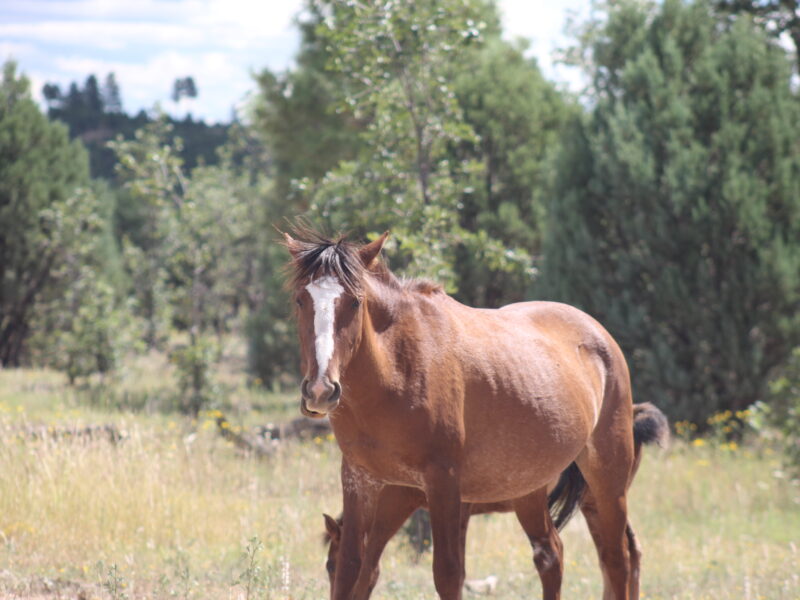
HEBER-OVERGAARD, Ariz. (CN) — Betty Nixon yanked hard on a downed wooden gate lined with barbed wire.Pointing out potential entanglement hazards, she hoisted the gate off the ground and around a post so horses could safely pass.Since April, she and members of an advocacy group that want to keep wild horses on the Apache-Sitgreaves National Forest have fought back and forth with a rancher who wants them removed.Whether those horses are actually protected may depend on how long they’ve been there. And whether state law prevents third parties from removing them depends on who you ask.For decades, a herd of what is now about 400 horses has roamed the ponderosa pine and mixed conifer forest along the Mogollon Rim under protection of the Wild Free-Roaming Horses and Burros Act of 1971. Three years after the act, the 19,700-acre Heber Wild Horse Territory in Black Canyon, south of Heber-Overgaard in east-central Arizona, was established.In March,**** the Forest Service abruptly removed that protection, reclassifying the entire herd as stray livestock in order to remove them from the range. Nixon, an independent wild horse advocate, partnered with the International Society for the Protection of Mustangs and Burros to stop the agency’s removals in federal court.But the advocates are also fighting on another front.After the reclassification, ranch hands working for the Black Canyon Cattle Company began removing horses that wandered onto its grazing allotments or private property. Nixon said she’s seen them remove at least 28 horses from the forest on seven occasions from April to July, but believes the total number to be closer to 100.She believes both the Forest Service and the ranchers’ actions are violating the Wild and Free-Roaming Horses and Burros Act.Using lenient Arizona stray livestock laws to claim the horses are theirs, the ranch hands either turn the animals into saddle stock or truck them to Mexico or Canada, where they’re slaughtered for food.Those defending the horses have tried everything to stop the removals: They’ve parked trucks in front of corrals, opened fence traps and have even run ranchers off the road.“We locked this place up like Fort Knox,” Nixon said, standing in a wide meadow surrounded by pines, overlooking the East Buckskin Tank grazing allotment south of Heber-Overgaard. “We wouldn’t let them take horses.”Roughly 400 horses roam Arizona's Apache-Sitgreaves National Forest on Heber Wild Horse Territory. (Joe Duhownik/Courthouse News)Wild horses have long been a center of controversy in the American West. While advocates revere them as “living symbols of the pioneer West,” conservationists and ranchers decry theirnegative environmental impacts and advocate for their full removal.**** When the government removes them, they’re sent either toexpensive federal holding pens or to slaughter.Researchers in 2016 found that horses, when combined with cattle and native species, can contribute to land overuse if not properly managed. More recent surveys by the Center for Biological Diversity showing forage availability before and after horses are introduced to specific areas of the forest indicate they often eat up grass and leave the landscape bare and lacking food for native species and habitat for smaller creatures.Nelson Shirley, owner of Black Canyon Cattle Company and the parent Spur Lake Cattle Company, wants the horses off his land.“We’ve been unable to use our allotment on that part of the forest for the last four years because of the amount of damage that the horses are doing,” he said.The Wild Free-Roaming Horse and Burro Act protects “all unbranded and unclaimed horses and burros on public lands of the United States.” But federal regulation narrows that definition to exclude “any horse or burro introduced onto the National Forest System on or after Dec. 15, 1971, by accident, negligence, or willful disregard of private ownership."That exception lets the Forest Service determine which horses have been on the range since the act’s inception, and which are simply strays invading the land. Arizona does not require branding for privately owned horses, and the Forest Service does not brand wild onesIn the case of the Heber herd, the Forest Service claims in court documents that the 2002 Rodeo-Chediski Fire burned the boundary fences between the forest and the White Mountain Apache Indian Reservation and “created the primary source of the horses currently found in the area at issue.”“In 1994 and 1996, the population of the herd was reported to Congress as zero,” the agency says. “The numerous unbranded horses now roaming the Apache-Sitgreaves National Forests are not the progeny of the original seven wild horses (found in 1974).”Independent wild horse advocate Betty Nixon explains the harm barbed wire fences could cause to horses as she surveys Heber Wild Horse Territory in eastern Arizona on Sept. 11, 2026. (Joe Duhownik/Courthouse News)In its lawsuit, the International Society for the Protection of Mustangs and Burros submitted sworn testimony from people who claim to have seen horses in the years before the fire. Nixon says there were far more than seven, even in 1974.In July, a federal judge enjoined the Forest Service from removing the horses while their status is litigated. Meanwhile, Shirley says he can claim the horses himself while they are federally designated as stray livestock.“We have private land, and we have fence traps on those,” he said. “If horses are in those fence traps, we can claim those horses.”If unowned horses on federal land aren’t considered wild horses, federal law defers to state branding and stray laws. If a rancher’s horse wanders onto federal land and the rancher goes to retrieve it, a spokesperson from the Arizona Department of Agriculture said no one has to report it to the department.With that regulatory gap in mind, a rancher could remove any horse from federal land and claim it as his own, avoiding any reporting requirement and associated oversight.“I’m not telling you we have the unrestricted right to go gather horses anywhere, unless they happen to be our horses,” Shirley said. “If they’re our horses, we can claim them according to state procedures. And state procedures say, ‘You go claim them.’ It’s an unmanaged situation.”The agriculture department spokesperson added that a landowner must notify it if a stray horse wanders onto their private property. But the department isn’t checking for ownership unless someone reports it.“No one who looks at a horse can say definitively that if it doesn’t have a brand, then it’s a claimed horse or an unclaimed horse,” Shirley said.Jacob Henning, a public lands grazing specialist and professor at the University of Arizona, agreed.“If somebody just comes up and says, ‘That’s my horse,’ I don’t think the department’s gonna do anything,” he said. “It is really tricky.”A white mare grazes near a waterhole in the Apache-Sitgreaves National Forest on Sept. 11, 2026. (Joe Duhownik/Courthouse News)Cynthia von Schlichten, adjunct faculty at the Lewis and Clark Law School’s Center for Animal Law Studies, doubts the Forest Service’s ability to establish when exactly each horse arrived. She believes all unclaimed horses on the range merit protection.If the Forest Service’s Heber Wild Horse Territory Management Plan “directs otherwise, it is in violation of federal law, in my view,” Von Schlichten said.Despite leniency from the state, Von Schlichten said that claiming the animals would still violate the act if it isn’t done through a specific federal program.“It is not like a stray cat that you can just find in the street and take home,” she said.The parties in the lawsuit filed a proposed joint case management plan on Sept. 24. In it, Nixon and the International Society for the Protection of Mustangs and Burros request third-party discovery to determine whether the Forest Service gave ranchers verbal permission to remove horses themselves. The agency argued the plaintiffs aren’t entitled to third-party discovery at this stage in the litigation.Separately, in her preliminary injunction, U.S. District Judge Karissa Lanham denied the plaintiffs’ request to order the agency to enforce laws against third-party roundups. The agency claims in court documents it hasn’t authorized any third parties to round up horses, but Shirley confirmed he’s told the agency what he’s up to.“We’re in constant contact,” he said. “We’re not sideways with the Forest Service at all.”Still, his workers haven’t collected horses since July 13, less than a week after the preliminary injunction took effect, because of the advocates’ actions.“Somebody was gonna end up getting hurt,” Shirley said. “They were literally running our trucks off the road, screaming, honking horns all night near our property.”Nixon doesn’t deny that. She and others have parked trucks outside of loading gates to prevent Shirley’s ranch hands from putting horses in trailers. On one occasion, they spent more than 24 hours chasing horses away from the fence traps and watching for ranch hands.“We knew it was illegal to camp this close to water, but I was so focused on keeping wild horses from going to slaughter,” Nixon said.Shirley said he filed a police report after advocates cut fences on his private property, but otherwise sees calling law enforcement unproductive.“Nothing will be done unless law enforcement witnesses the act,” he said.Nixon became particularly fond of a horse she named Hector that she says Shirley’s hands rounded up. She said she watched the particularly large stallion defend his family from a rival band, earning the name of the Trojan hero.“He didn’t deserve to die a cruel, gruesome death in a Mexican slaughterhouse,” she said. “What Nelson Shirley and his cow hands did to Hector and his family breaks my heart.”A foal, grazes in the Apache-Sitgraves National Forest near Heber-Overgaard, Arizona. (Joe Duhownik/Courthouse News)Shirley doesn’t deny it either, but said he prefers humane slaughter to overpopulation or overstuffed federal holding pens.“At least there ought to be some recognition that elk and mule deer and everything else could have some equal standing to forage and water,” he said.Nixon shared videos she recorded of horses sharing watering holes with both elk and mule deer.“They all peacefully coexist on the land,” she said. “The only ‘animal’ that cannot peacefully coexist is man.”Subscribe to our free newslettersOur weekly newsletter Closing Arguments offers the latest about ongoing trials, major litigation and rulings in courthouses around the U.S. and the world, while the monthly Under the Lights dishes the legal dirt from Hollywood, sports, Big Tech and the arts.Additional Reads
In Arizona, state law may not protect horses from slaughter
Full Article
Original Source
Read the full article at Courthousenews →KhanList aggregates and links to publicly available news content. We do not host full articles from third-party sources. Always verify important information with original sources.