
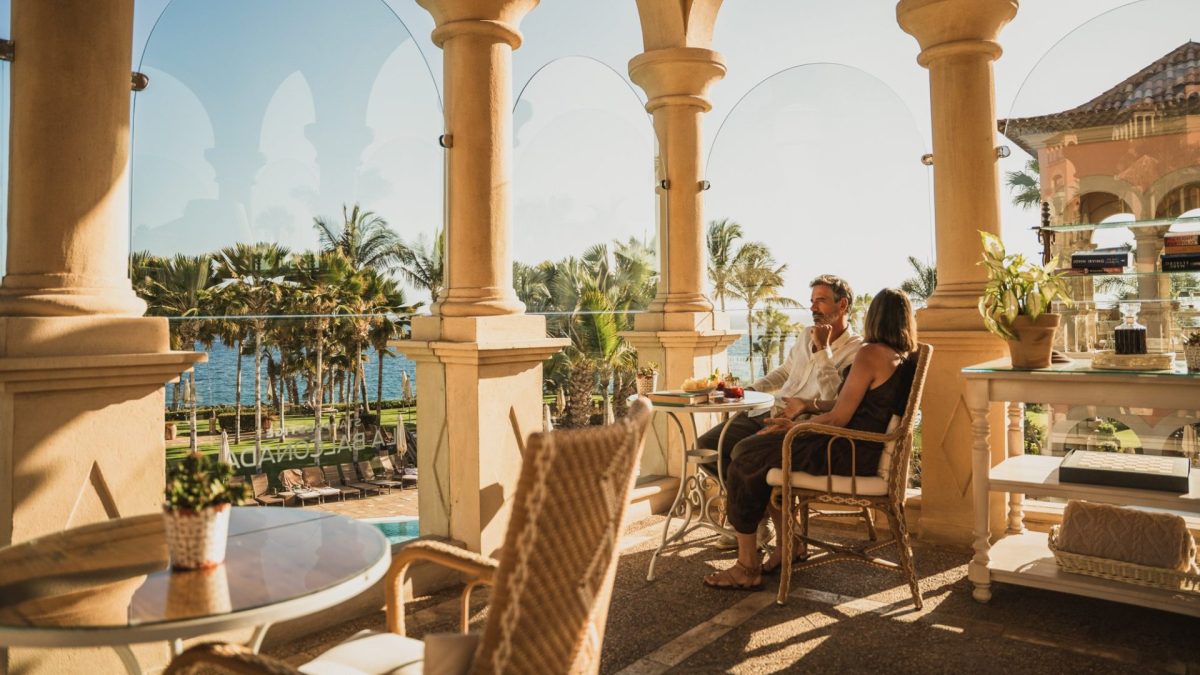
As night falls, the sky is streaked with orange and magenta. Along the coastline, lights begin to twinkle as the strip of Costa Adeje comes to life. Palm and dragon trees sway gently in a balmy, jasmine-scented breeze as the waves lap gently on pristine Playa El Duque below. Somehow, I never thought Tenerife would look like this. My early experiences of the Canary Islands were package holidays, plastic menus, holiday reps exhorting visitors to step inside for two-for-one cocktails, Irish bars, full Englishes, 90s Europop – cheap and cheerful for the hordes of tourists descending on the islands in search of some all-important winter sun. If you’d asked me what Canarian cuisine was, I’d have been stumped – burgers and beers? Fast forward 20 years and I’m now a dedicated travel snob – and Tenerife was not high on my destination wishlist. But checking into JOIA El Mirador, I realise how wrong I’ve been. The stone-flagged lobby is dark and tranquil, a haven from the sun beating down outside, and the Mediterranean-North African influenced buildings and pools are surrounded by tropical gardens. As I check in, and my bags are whisked away, I am greeted with a glass of cava and chocolate truffles. I have a feeling I won’t be going hungry during my time here. Food is mostly why I’m here – the hotel has a partnership with acclaimed chef José Pizarro and is hosting a special dinner combining his signature Spanish dishes with the best Canarian local ingredients.After a quick tour of my Tuscan-style suite, I head to the bar to meet the man himself. I ask him why Tenerife appeals to a chef who grew up in rural Extremadura on the Spanish mainland. Teracotta-hued features in JOIA El Mirador help to create a haven from the bustling beachfront (Photo: Manuel Yllera) “I am here to learn, just like you,” José tells me with a smile. It’s hard to imagine there’s much to teach the UK’s “Godfather of Spanish cuisine”, who opened his first restaurant in London 15 years ago. But, I soon discover, Tenerife offers a cornucopia of ingredients that may not be on every table in continental Spain, thanks to its volcanic soil, microclimates and history as a key Atlantic trading route between Europe, Africa and the Americas. Next year, the island’s capital, Santa Cruz de Tenerife, will be Spain’s Capital of Gastronomy. Vines on the clifftop at Finca El Ancón on Tenerife’s north coast (Photo: La Sonrisa de Beatriz) Nowhere is this more apparent than at Finca el Ancón in Tenerife’s rainy north, where we board golf buggies to tour the 20 hectares of this very unusual farm clinging to a cliffside. Here, we see a wild collection of bananas, coffee, avocados, papaya and guava. As we climb higher, we see glimpses of the black sand of El Ancón beach far below, and round a corner to encounter a sweeping hill of vines – the farm produces high-end volcanic wines in partnership with local winery Camino Los Laureles using native grapes including Malvasia Aromatica and Listán Negro. José’s eyes light up as he examines the fruit growing on the trailside (“are these red bananas?”) and enters into animated conversation with Rafael de León, the executive chef at JOIA, who is preparing a farm-to-fork lunch here today. “Are you getting some inspiration for your meal?” I ask José. He laughs: “This is why I never print my menus until the very last minute.” A farm-to-fork lunch created from the produce grown steps away at Finca El Ancón (Photo: Siobhan Norton) Back at the hotel after a not-so-hard morning on the farm, I’m braced for another Spanish tradition – the scramble for sunbeds. Not here, a staff member informs me as he asks me to pick my preferred spot by the pool and brings the sun lounger to me. The service may be five-star, but it is far from stuffy. It’s clearly a hit with other guests, who welcome waiters like old friends. “Well, they are,” one couple tells me. “This is our eighth visit,” one couple tells me. “We come here every winter.” They’re not the only returnees. Of Tenerife’s seven million annual visitors, more than two million are Britons, generating €3.7bn in annual revenue for the island. Tourism accounts for more than a third of GDP, but the island is not immune to the anti-tourism sentiment sweeping across Spain and is trying to transition away from mass market tourism to a more upmarket offering. El Duque beach at Costa Adeje, Tenerife (Photo: Balate Dorin/iStockphoto) I may be a creature of habit, and no stranger to a resort hotel, but I like to stretch my legs beyond a lukewarm buffet to sample a destination’s local flavours. However, JOIA’s restaurants include a buffet with local cheeses, inventive salads and pan-seared-to-order scallops delivered to my table. The next day, I visit family-owned Quesería Montesdeoca on the flanks of Mount Teide overlooking the sea. The marketing manager, Adriana Petkov, guides us through the award-winning goat and sheep cheeses, interrupted only briefly by her young son, who runs in to steal a sample. My favourite is the delicate smoked goat cheese, but it’s hard to not be drawn to the gorgeous fuschia- and purple-stained versions, their rinds respectively macerated in prickly pear and red wine. A selection of the award-winning cheeses available to sample and purchase at Quesería Montesdeoca It is kidding season and some new arrivals are struggling to stand on their wobbly legs while I have been busy in the tasting room. I am handed a minutes-old newborn, who bleats and complains before settling in for a snuggle. I fretted that the mum might mind, but Adriana laughs: “Goats are terrible mothers. Look, she’s wandered off already for a snack.” Siobhan meets the latest arrival at Queseria Montesdeoca And then, it is time for dinner. After a greeting from José, we are seated on the patio of El Cenador, JOIA El Mirador’s fine dining restaurant. An octopus salad with watercress and tomatoes is tangy and flavourful, followed by mains of stone bass with corn and coriander, and pork shoulder with mojo picón, a spicy Canarian sauce, and banana, the perfect marriage of Continental Spanish and Canarian cuisine. José Pizarro greets guests ahead of his special dinner in partnership with Iberostar and JOIA El Mirador Most memorable are the appetisers – Iberian jamón and banana croquetas and a Canarian chorizo Scotch egg, a Pizarro speciality. A crème caramel with fig and almond follows, with a bonus Basque cheesecake, which feels like José’s “just because” moment. Scotch egg with a twist – made with Canarian chorizo – is one of the memorable dishes at the José Pizarro X Iberostar dinner event Before I leave, I take a Blue Jack Sail boat from Puerto Colón for a tour of the coastline. I am surprised when the boat turns heads out to sea. Eventually, we pull to a halt, and I see why – a pod of pilot whales is frolicking nearby, and curiously make their way closer to the boat. They dip and weave in the water so close that I can make out their velvety texture. They move on – perhaps it’s dinner time for them too – and it’s time to head back to shore. It’s another memorable encounter on an island that has surprised me from start to finish – and I suspect I’ll be making my own repeat visits. Travel Essentials How to get thereTenerife South is served by flights from a wide range of UK airports. Where to stayJOIA El Mirador is an adults-only resort in Tenerife with suites from £299 B&B. The next José Pizarro x Iberostar event will take place from 10-11 April 2027, iberostar.com Where to visitFinca El Ancon, fincaelancon.comQuesería Montesdeoca, quesosmontesdeoca.comBlue Jack Sail offers two-hour boat trips from Puerto Colón on Costa Adejefor around £50pp, bluejacksail.com More informationhellocanaryislands.com/tenerife
I’m a travel snob but Tenerife’s food scene blew me away
Full Article
Original Source
Read the full article at Inews →KhanList aggregates and links to publicly available news content. We do not host full articles from third-party sources. Always verify important information with original sources.