
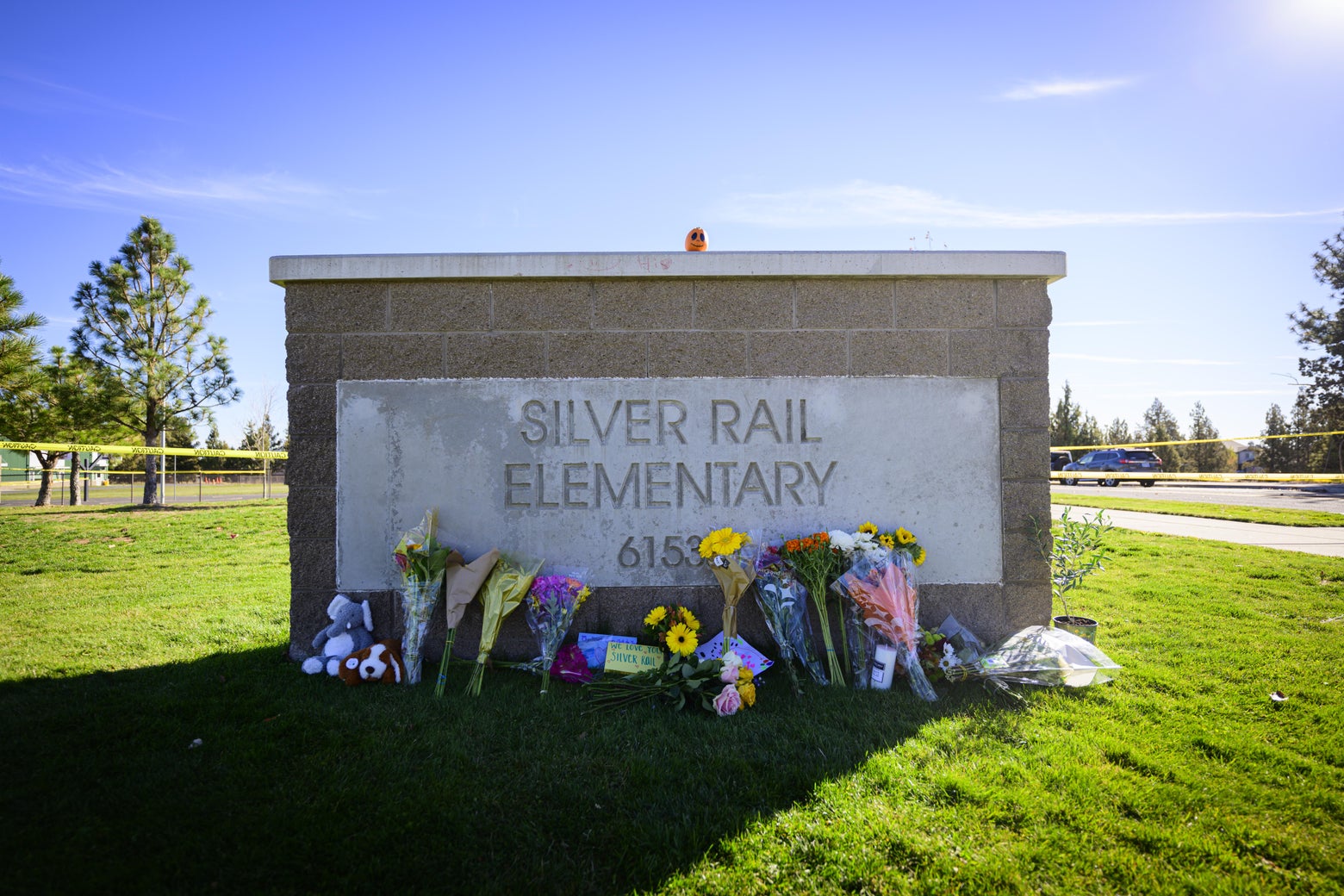
Life It didn’t seem like a mass shooting could happen here. But of course it could. Mathieu Lewis-Rolland/Getty Images Sign up for the Slatest to get the most insightful analysis, criticism, and advice out there, delivered to your inbox daily. On Thursday, I walked out of my usual noon exercise class in Bend, Oregon and immediately realized something was wrong. The sound of sirens was everywhere, and there was a crackle of tension in the air. As I tried to turn my car onto a main road to go home, I realized traffic had stopped entirely to make way for police cars—first a few, then a dozen. I checked my phone for any alerts, but nothing came up. I kept driving. Then I got a text from my husband, who is a nurse. He’d received a notification: All hands alert at the hospital. Mass casualty event. “There’s an active shooter at a school,” he wrote to me. My stomach rolled. “Where?” I wrote back. We have two children, ages 4 and 6.5, one in pre-K, one in first grade I gritted my teeth as I waited for his response. “Silver Rail Elementary School,” he said. I felt like I might throw up. I also felt grateful that my kids were safe, several miles away. I felt panicked, too. I began to mentally clock anyone I knew whose kids attended Silver Rail. It’s not far from our house. We opted to send our oldest to a Montessori charter program last year. But if we hadn’t made that choice, he could have been at that exact elementary school, on this exact day, less than a quarter mile from where I’d been exercising. Here, I think, it’s important to pause to paint a picture of where we live: Bend is a small mountain town set in idyllic Central Oregon. It’s home mostly to young families and retirees, and just 20 minutes from the most gorgeous hiking, skiing and mountain biking trails you can imagine. We experience so little crime here that much of our city funding goes instead to landscaped roundabouts and million-dollar libraries. This is the kind of town where you can leave your wallet on the table in a coffee shop while you pee, unworried; where on weekends, at every brewery you’ll find a herd of parents watching a herd of kids; where people are so friendly that when you arrive as a transplants, as we did several years ago, you may feel genuinely confused by their motives. The population is also, on the whole, quite wealthy. In other words, Bend is a place where it often feels that your safety is guaranteed, that America’s many problems do not apply. And now, against all odds—and despite best laid security plans by the school system—we were suddenly added to a long list of other towns and cities in the United States: residents of Bend were victims of a mass shooting. At an elementary school. I got home and took a work call, one eye on a client and the other clocking the texts that had started to roll in with new information. It would come in bits and pieces: 16-year-old shooter.Shot through a locked door.3 children dead.One child being air-lifted.One teacher injured.One teacher dead.Shooter killed. Babies shooting babies, I thought. This is a tale as old as time, I thought. But it doesn’t feel old when it’s happening to you. My husband left his clinic early that day to pick up our children while I paced at home, unable to focus. When my kids walked through the door, I sat down on the floor and started to cry. I hugged each one of them for a long time. My husband and I then had to explain what had happened, why mom and dad were crying. The conversation was devastating and also, somehow, mundane. After all, they already have active shooter drills at school. Many of their friends have bulletproof backpacks. This is an American child’s norm. My children weren’t upset. Instead, they were curious. Their questions—But why did a 16-year-old have a bad guy gun? What is a bullet? Where did the bullets hit those kids?—felt unanswerable, but we did our best. It felt impossible to give them, or ourselves, reassurances. But we reminded them, over and over, that they were safe in our home. But are we safe?, I thought. By then, the media had caught up with more information. I couldn’t pull myself away from my phone. When I learned that the first victim was a kindergartener who had only been in school for a month, I walked into my bedroom and scream-sobbed into a pillow so my own kids wouldn’t hear me. Later, my husband told me about the father of two who’d had to kill the 16-year-old shooter to save those elementary school students; I’ve never seen my husband cry so hard in his life. He shook from adrenaline for hours after. That man isn’t going to be okay, he kept saying. I would have done it too, but I’m not sure I could live with it. We felt helpless and drained. We eventually went to bed. The next morning, I woke up numb, exhausted, hungry but not able to eat, unable to get out of bed or respond to the many dozens of texts from friends checking that my kids were alive, that we were safe. Yes, we are alive, I wanted to shout. But we are not well. For years, I’ve heard about shootings like this happening in the news, able to press them out of my system in a day or so. At this point, I think millennial mothers are trained to tap into the collective horror, and then disassociate from it. But I never really thought this could happen so close to home, especially in my sweet town, Bend. Oh, what a delusion. We had previously lived in a rough part of Seattle; I knew what it felt like to worry about bumps in the night, and walking alone after 8 P.M. I’m naive, perhaps, that it had taken me this long to feel unsafe again. Now, I can’t stop thinking that our safety in this case was a fluke, a stroke of luck. If we hadn’t picked a charter school, I thought. If the shooter had chosen another elementary school. If we’d moved into a different house in a closer neighborhood… it could have been us. And that is what I hope you hear, as I write this to you: Mass shootings can happen to any of us. Gun violence is now the number one cause of death of our children. If we buy into the fact that we can’t change anything, then the story I’m telling will keep replaying. And when it happens, yet again, it happens to all of us. Because a society that can’t protect their children is broken. A society that doesn’t prioritize their children certainly won’t prioritize the elderly, the ill, the fragile. My rage—as a mother, as a woman—has me dancing with this question now: What will we do about this? The answer I’ve landed on for the moment: We can let our hearts break enough that they become more open to a new way of operating. We can willingly feel this sorrow in service of change. So feel with me. Living in the wake of a mass tragedy—of the senseless deaths of little children — feels like aimlessly picking up your own children’s toys from the floor with a knot in your throat, like a ghost in your own skin, hollowed out. It feels like forgetting any criticisms you were going to give your kids about TV time or eating their whole dinner because—well, they’re alive. It looks like not being able to peel yourself away from your phone, in awe of all the helpers and devastated by the heartbreak, both nauseated and hooked. It feels like numbness, slow tears, and a struggle to care for yourself while you still must care for your kids. You never imagined you’d be receiving the kinds of texts you are receiving right now. It looks like a desire to be with people but a bone-deep exhaustion that makes it impossible to leave your house, all while you wait for police to release the names of the families who’ve lost their hearts. It feels like fire, hot in your belly. It feels like the knowledge that you could and would burn the whole world down to guarantee your children’s safety. It looks like taking a walk and feeling amazed that the birds are still out there, flying as they always do. It looks like tracing the shape of your daughter’s 4-year-old hand while you watch Is It Cake? with her, committing her tiny knuckles to memory, like realizing you were lucky this time, but realizing that she could be next. It looks like meeting the eyes of strangers on your walk to get the mail and seeing your own stricken face reflected back to you. It feels like knowing you will go back to your normal life eventually and wondering if this fact makes things better or worse. You realize the families of the victims will not be able to move on, like you will. It looks like the kind of understanding you can’t put back in a box, ever. My family was lucky . But we are not okay. Family Guns Parenting
I’m a Mom in Bend, Oregon. I Was at a Workout Class on Thursday. Then I Heard the Sirens.
Full Article
Original Source
Read the full article at Slate →KhanList aggregates and links to publicly available news content. We do not host full articles from third-party sources. Always verify important information with original sources.