
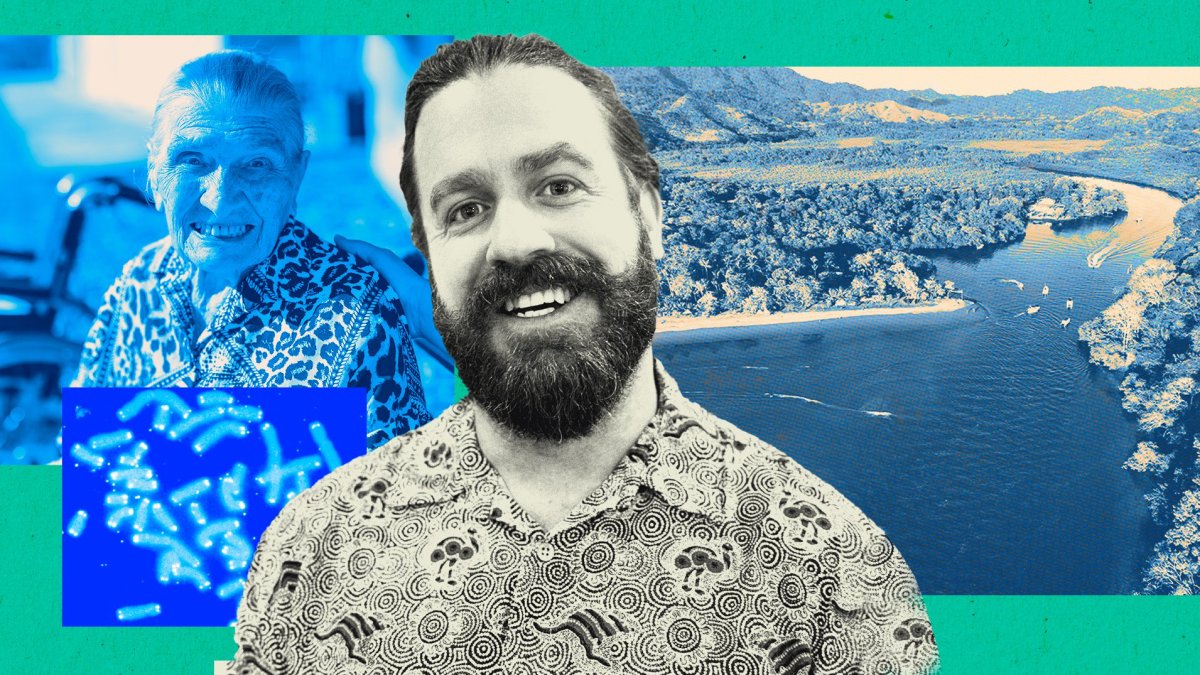
Around 200 BC, the first Chinese emperor, Qin Shi Huang was persuaded to give an alchemist called Xu Fu a stash of money, 60 ships and 6,000 virgin girls and boys to go searching in the Eastern Sea for an immortality elixir. After making various excuses, including encounters with a giant sea monster, the alchemist sailed over the horizon in his fleet, never to be seen again. This was the first recorded longevity grift, and anti-ageing research has followed a similar pattern ever since, says Dr Saul Newman, a demographer at the University of Oxford. Gullible people, desperate to live forever, or at least for longer, have handed over their money and their trust to people who just don’t deserve it, says Newman, who has just written a book critiquing anti-ageing research called Morbid: Debunking modern longevity science. “What these people are trying to take away, apart from your money, is this impending fear that you are going to die,” he says. “We are all going to die, so it’s a massive market.” Anti-ageing products range from supplements and blood tests to unapproved and sometimes dangerous medical procedures. “It leads to this avalanche of scams,” says Newman. “A mix of scientific-sounding futuristic stuff and complete nonsense. But people are desperate for this to be real.” Here are four areas of anti-ageing research that Newman says are plagued by bad science. Tips from supercentenarians A widespread belief among scientists is that we can learn more about ageing and how to delay it by studying the oldest old – centenarians, and “supercentenarians” – those who reach the age of 110 or more.Their genes and lifestyles are catalogued by researchers, with the findings turned into tips on diet and healthy living. The Guinness World Records fetes those with the title of world’s oldest man or woman, or oldest in a certain country. Unfortunately, most of the individuals who claim to have reached these great ages are probably mistaken, if not deliberately misleading people, says Newman. Most of them don’t have birth certificates or any other solid confirmation of their age. Indeed, birth certificates were rare in most countries until relatively recently. A common motivation for deception is that someone starts claiming an old age pension before they are entitled to it, and have to continue the pretence ever after, claiming to be 100 when they are really 90, and so on. Even supposedly authoritative research databases have turned out to have suspicious features, suggesting many of the entries are incorrect. Take the US Gerontology Research Group, which tracks supercentenarians and certifies Guinness World Records. When Newman investigated these records, people’s birthdates were too often suspiciously round numbers. People who make up a birthdate have a tendency to pick the first day of the month or a multiple of five. The GRG “badly failed this test”, says Newman in his book. Newman also analysed people on the International Database for Longevity, and found that in developed countries, the best predictor of people claiming to have reached extreme age was that they lived in deprived regions with high immigration from countries with poor record keeping. In the UK, for instance, more people aged 105 and older came from London’s Tower Hamlets than all the richer regions of England combined. Not only does this suggest a source of error, but it also contradicts everything we know about the strong correlation between low income and shorter lives. “Tower Hamlets was the single worst place in all of England for old-age poverty, had the highest crime rate, and strikingly had the fewest 90-plus-year-olds out of 317 English districts,” says Newman. Yet according to the database, it was somehow among the top in the world for people reaching 105. Blue Zones Looking beyond individuals, some researchers claim that certain places have environments and cultures that foster living to extreme old age. This is usually attributed to the locals living traditional lifestyles: eating a whole-food, mainly plant-based diet, staying physically active late in life, and with strong social networks. There were initially supposed to be five such Blue Zones – the Greek island of Ikaria, a cluster of villages in Sardinia, Italy, the Nicoya Peninsula in Costa Rica, the subtropical island of Okinawa in Japan, and the special case of Loma Linda a Californian city with high numbers of Seventh-day Adventists, a religion that frowns on alcohol, smoking and meat. Newman has several beefs with the concept of Blue Zones. Firstly, he says the premise took off as a journalistic and commercial endeavour from National Geographic, quickly spawning a series of cook books and self-help guides. Then the Blue Zone trademark was bought by a business called ShareCare that sells licences to local authorities so they can be “Blue Zone certified” for promoting active lifestyles and healthy eating. Newman says the advice to build cycle lanes and encourage healthy eating should be “strikingly obvious to any public health official with a quarter of a brain”. A spokesperson for the company said: “Sharecare’s content and programs are scientifically validated and undergo regular medical review.” But more importantly the entire concept of Blue Zones is flawed, because there is no good data supporting the longevity of their inhabitants, nor that they eat healthier diets than anywhere else in those countries, says Newman. People in Okinawa, for instance, have long eaten more pork than elsewhere in Japan, since the Second World War US administration popularised consumption of Spam. Neither Sardinia, Greece, nor Costa Rica have a traditionally plant-based diet. In 2023, Singapore was declared a sixth Blue Zone. But the country’s Health Minister admitted in his acceptance speech: “We have the opposite attributes of the other five Blue Zones. We eat food that is rich in sugar, salt and a lot of our food is deep fried; we are not endowed with a vast expanse of nature that encourages outdoor activities; the pace of life is fast and stressful and many families keep to ourselves.” A spokesperson for Dan Buettner, who led the work on Blue Zones, said Singapore’s longevity “did not arise from longstanding lifestyle habits. Instead, Singapore engineered these better habits through policy, infrastructure, and programs … making it a Blue Zones 2.0.” They also said Newman’s work been disproven and debunked in the peer-reviewed scientific record by independent researchers. Telomeres the Nobel-winning secret to ageing Telomeres are often cited as one of the underlying cause of ageing: they are stretches of DNA on the ends of chromosomes, the bundles of our genetic material present in nearly every cell in the body. Telomeres act like a protective cap on the ends of chromosomes, often compared to the short bits of plastic on the ends of shoelaces. Each time a cell duplicates itself, it loses a bit of its telomeres on every chromosome. When telomeres get too short, after about 60 divisions, the daughter cells can no longer divide, the theory goes. The telomere theory of ageing was all the rage in the 2000s and 2010s, earning its discoverers a Nobel Prize in 2009, and with more than one thousand scientific papers a year about it being published every year. Excitingly, the researchers found an enzyme which could naturally re-extend telomeres. If we could find a way to safely activate it, we would have the secret to living longer. But later research revealed the picture was really more complex. For one thing, cells can already switch on the enzyme when they need to – and that is why, in our bodies, many tissues have cells that have divided far more times than 60. Telomere shortening is now seen more as a side-effect of ageing, reflecting more fundamental processes, whatever those are. “After 15,000 papers worth of hype and billions and billions of dollars spent, you would expect to have some pause where people said: ‘Why did this not work?’,” said Newman. “But people just moved on to the next hype.” Professor Elizabeth Blackburn, one of the Nobel winners, did not answer The i Paper‘s questions, but cited a 2015 paper of hers that said: “Recent advances in the understanding of human disease processes have clarified the roles of telomere biology. Recent findings highlight both causal and potentiating roles for telomere attrition in human diseases.” Young blood Bryan Johnson, a US tech millionaire-turned-anti-ageing pioneer, has helped popularise the idea people can delay ageing with transfusions of blood from someone much younger than themselves. Luckily Johnson has a willing donor in the form of his teenage son. Others have had such transfusions from a US company that harvested it from teenagers at a Texan high school. The company claimed the technique showed anti-ageing effects in rats. But this was just early-stage research. There are small but recognised risks from blood transfusions, ranging from allergic reactions to heart and lung damage. These risks are considered to be worth it in a patient with medical need for a blood transfusion, but not for someone hoping to delay ageing, based on bad science, says Newman. Johnson eventually stopped getting the blood transfusions, saying he didn’t notice any benefits. And the US Food and Drug Administration has warned against the practice, saying “There is no proven clinical benefit of the infusion of plasma from young donors in the prevention of conditions such as aging or memory loss.” Newman says there is a gaping hole in the logic behind young blood: millions of blood transfusions are given every year around the world for medical reasons. Most recipients are over the age of 65, while the average donor is in their 30s. “In none of these instances of young blood injections has anyone been noticed to age backward,” says Newman. “If they did, we would beset by Benjamin Button haemophiliacs and sickle-cell-anaemic Draculas. There’s just no hope that it was ever going to work. “Not much has changed in the last 2,230 years. We still buy the herbs. We still buy that the secret lies far away in an exotic place. We still give our money to Xu Fu and watch him sail away. The alternative is jogging, so what else are we to do?”
I’m a longevity expert. These four anti-ageing myths are junk science
Full Article
Original Source
Read the full article at Inews →KhanList aggregates and links to publicly available news content. We do not host full articles from third-party sources. Always verify important information with original sources.