
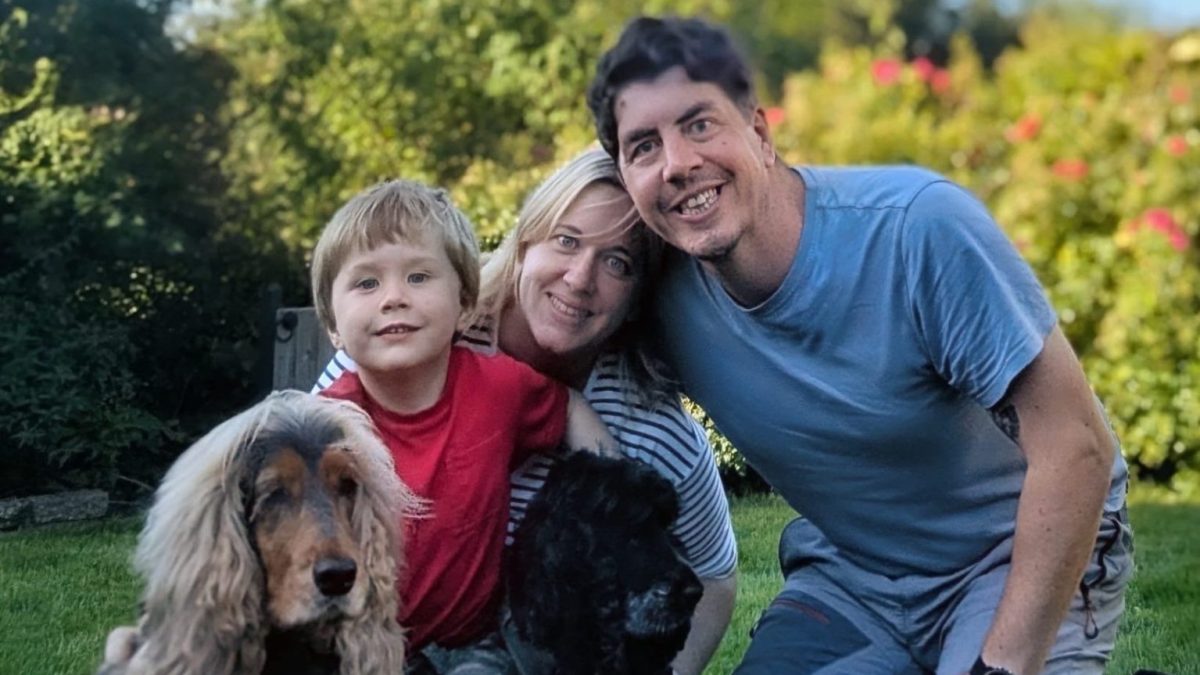
Doctors are notoriously bad at being patients. But when Huw McCandless, a GP, started feeling not himself seven years ago, he did decide to get himself checked out. “As a doctor I’d been very busy over Christmas, I was tired,” says Huw. In the months before, he adds: “I’d been having weird symptoms, like an unusual song I didn’t recognise in my ears. I’d fallen while I was out running. Doctors are [usually] very poor at going to see a doctor but I did.” Huw, who is married with a three-year-old son and lives in Disley, Greater Manchester, was referred to a consultant neurologist, who put it down to a possible heart complaint. But then, on Boxing Day, while driving his wife, Laura, his mother and dog to a local reservoir walk, he blacked out and his mother had to grab the wheel. “The last thing I remember is going round a roundabout, then waking up in an ambulance.” Shorts He was sent for a CT scan, and at the age of just 32, was told he had a large, fast growing brain tumour. Within a fortnight it was diagnosed as an incurable glioblastoma, grade three or four. Doctors said the fall he’d had while running had likely been a seizure. “It was a shock. I was with Laura, my mum, auntie and uncle. When the doctor left we were silent. I felt very low.” The tumour was, he says, the size of a small pineapple. “It was so big it was pushing my brain to one side on the scan. Over the next days and weeks I cried a lot. I thought I don’t have long left.” Glioblastoma – some of which, like Huw’s, were reclassified by the World Health Organisation in 2021 as IDH-mutated astrocytoma – affects 3,200 British adults each year. Only a third survive beyond a year, although Huw’s tumour-type can offer slightly longer. This cancer caused the early deaths of The Wanted singer Tom Parker, aged 32 (the same age Huw was diagnosed), Shopaholic author Sophie Kinsella and 23-year-old Laura Nuttall, the young brain cancer campaigner and friend of comedian Peter Kay. But Huw, a Leeds United fan, and keen runner and sportsman, is determined to beat the odds. “My 40th birthday is on 8 April,” says Huw, who has continued working in the NHS since diagnosis. “I don’t want to be that person who died under 40. I want to have as long as possible with Jacob, Laura and my family.” After diagnosis, Huw had a seven-hour surgery and six weeks’ radiotherapy. A scan three months in showed the tumour was stable with no sign of growth. “That appointment gave me hope. They always said its going to come back but the news got better each time and scans moved to six-monthly.” He returned to full-time work and Jacob was born. “We’d started talking about becoming parents. I knew Laura would be an incredible mum and I didn’t know how much longer I’d have.” Then, in January 2025, Huw had a seizure while playing padel with his brother. He experienced auras too, and, in May that year, while playing with Jacob at home, his GP called with scan results, explaining the tumour had grown back. “I had got back to normal life, I had Jacob, two dogs, we were financially stable, then the bomb hit.” He had his second craniotomy in June 2025, then chemotherapy but it couldn’t stem the cancer. “They knew at some time it would stop working,” he says of the treatment. Tests have now confirmed the tumour is grade four – meaning his remaining time is limited. Huw has just had this third bout of surgery this September – all three of his operations have been performed with him awake. “When you’re awake and several people are in your brain, it’s very strange. Your head is fixed, you’re constantly thirsty but they can only give you a drop of water. You’re being asked questions constantly, simple ones to check you can connect ideas and words, to asses for damage. It feels like an exam and endurance test,” he says. Huw has just had this third bout of surgery this September Chronically low investment in brain tumour research means Huw has run out of treatment options in the UK. Supported by Laura and mum Jackie, his loved ones are among families lobbying the Prime Minister to invest more, while also fundraising for treatment abroad. “In 30 years, when Jacob reaches the age I was when I was diagnosed, I want to see massive changes to treatment in the UK that add much longer to lives,” he says. Huw is now waiting on a personalised immunotherapy vaccine, in Germany, costing well over £100,000, that is unavailable in the UK but has been shown to prolong life in brain tumour patients. He could begin treatment, involving a monthly injection tailored to his cancer cells, early next year. In May, he ran a half marathon to raise funds for his immunotherapy, completing it in an hour and 54 minutes (“a bit slow for me,” he says) while his family have raised over £15,000 for Brain Tumour Research and The Christie Cancer Charity (the specialist hospital where he is treated). He says: “The only way I can access immunotherapy is through fundraising – we don’t have the money as a family. “For the last 18 years, I’ve helped tens of thousands of NHS patients, doing everything I possibly can. For that, I feel the government and NHS should invest that same level of support in me.” Brain cancer investment currently sits at less than 2 per cent of the UK’s £141m National Institute for Health and Care Research cancer spend. “It’s disproportionately low compared with other cancers. There has been little change in treatment in 20 years,” explains Huw. This lower spend is attributed to the formula that weighs up cost versus lives brought back through treatment but, says Huw: “Human life isn’t a spreadsheet exercise.” Day to day, Huw’s tumour affects his speech and short-term memory. “Sometimes the connection between brain and speech means words don’t come out or delay. I struggle to remember footballers’ names or song lyrics – yet I can recall every single medical thing I need for work.” His efforts now are on raising money for treatment, and Jacob’s future. “When I’m gone my income will be gone too. I’m focused on making a plan for Jacob and enjoying as much of life as I can.” Friends are walking a marathon to support his fundraiser, which he’s named Huw’s Your Daddy, and a private medical company he works for is doubling donations up to £10,000. “After I’ve gone, I want Laura and Jacob to be looked after. In the long term, I want a huge step up in treatment.” What does his son know about his father’s future? “Jacob knows that I’ve got a problem with my head and that he has to be careful because it hurts. He doesn’t have a full understanding. “Being his father for as long as possible motivates me. That and enjoying and loving as many opportunities as possible. For what I’ve done as a dad, husband, friend and doctor, I feel I deserve that.” Huw is fundraising at gofundme.com/f/huws-your-daddy.
I’m a GP who was diagnosed with cancer at 32 – what I wish I’d known at the start
Full Article
Original Source
Read the full article at Inews →KhanList aggregates and links to publicly available news content. We do not host full articles from third-party sources. Always verify important information with original sources.