
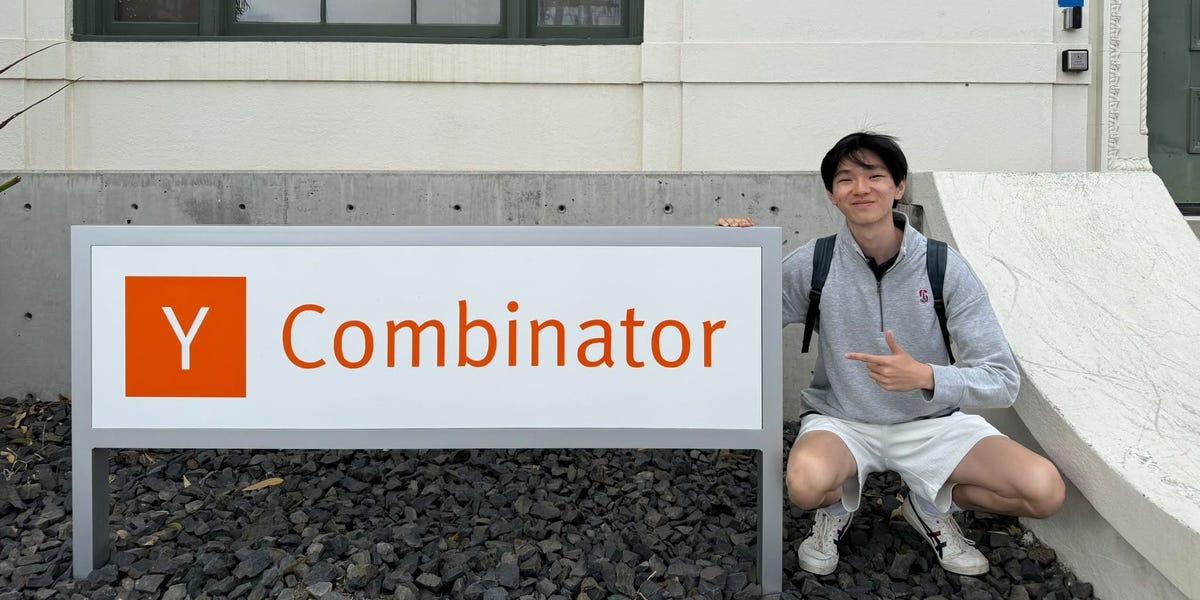
At 22, Anderson Chen is building a Y Combinator-backed AI startup in an industry where he says competitors are often decades older. Anderson Chen This as-told-to essay is based on a conversation with Anderson Chen, 22, the Taiwanese founder and CEO of San Francisco-based Operon Solutions, an industrial AI startup backed by Y Combinator. It has been edited for length and clarity.I'm taking my second gap year from Nanyang Technological University in Singapore, where I study chemical engineering and business. Now I'm planning not to return to college.During my first gap year, I started Operon, an industrial AI startup. We automate tasks that used to be run by human operators and specialists in heavy industries, including manufacturing, oil and gas, and construction.I initially thought I'd go back to school. But Operon grew exponentially toward the end of my first gap year, so I decided to take another year off.During that year, I realized that even if you graduate, it doesn't mean you'll figure things out.I was quite scared of dropping out, to be honest. Having a bachelor's degree is the Asian standard.My parents were also initially concerned because they thought I was doing badly at school. But my gap-year expenses were covered by a fellowship, so it was no risk for me.Now my parents are okay with my plans. They're like, "Okay, go for it."I think AI is changing the value of a college degreeAnother reason I'm planning not to return to college is that AI is moving so fast. OpenAI recently solved a version of the Navier–Stokes problem in fluid dynamics. I remember in my sophomore year, my professor in fluid dynamics told me it was unsolvable.I realized that if you know how to use AI effectively, you might even be able to outperform your own professor.I saw an opportunity to bring AI into heavy industriesI started Operon after doing internships at manufacturing companies and connecting with manufacturers and founders in Taiwan.I saw engineers throwing engineering PDFs into ChatGPT and asking it to understand them and write engineering documentation.But frontier AI models couldn't understand those documents because they had never been trained on that confidential data. That was the moment I knew I had to start this company.In manufacturing, humans follow very rigorous standard operating procedures. But the data in heavy industries is too hard for AI to understand. It's too messy.So we're structuring everything together, building a context layer for them, and allowing these agentic workflows to actually happen.In May, we received funding from Y Combinator as part of a $700,000 pre-seed round that also included other investors. We closed the round in about three days.We have about 20 clients. Some of our projects are proofs of concept, while others are already full contracts. Anderson Chen's startup, Operon, works with heavy industries to automate tasks traditionally performed by human operators and specialists. Anderson Chen I put almost all my savings into my AI startupBefore we raised funds, I put almost all my personal savings into Operon. It was around $80,000. I'm not paying myself a salary, although we're paying our employees.I made the money from businesses I started before Operon. When I was 14, I was selling sneakers and doing Amazon dropshipping.While I was in college, I built a tutoring agency connecting Malaysian students with parents of children attending international schools in Singapore. I did marketing for the tutors and hired a bunch of them.Being young in an old-economy industry has its advantagesOur team has five people, all under 30. The oldest is 26, and the youngest is 16.I think there's skepticism because we're working in heavy industries, and the founders of our competitors are all in their 40s and 50s.But that's the best thing I could ever ask for.Skepticism brings exposure, and people will naturally be intrigued. They'll be thinking, "Oh my God, how are you able to break into this space? I have to check it out." Read next Business Insider tells the innovative stories you want to know Business Insider tells the innovative stories you want to know Business Insider tells the innovative stories you want to know Business Insider tells the innovative stories you want to know Huileng Tan is a senior reporter based in Singapore, covering markets, the global economy, commodities, and investing. Her reporting focuses on how shifts in money, demographics, technology, and policy are reshaping businesses, wealth, and everyday life around the world.Since joining Business Insider, she has covered everything from commodity booms and investor trends to China's economy, the AI trade, and the forces driving global markets.Before joining Business Insider, she reported for CNBC, Dow Jones, ICIS, and The Wall Street Journal.Reach her at htan@businessinsider.com. Careers Startup
I'm 22 and I bet $80,000 of my savings on an industrial AI startup. Now I'm dropping out of college to go all-in.
Full Article
Original Source
Read the full article at Businessinsider →KhanList aggregates and links to publicly available news content. We do not host full articles from third-party sources. Always verify important information with original sources.