
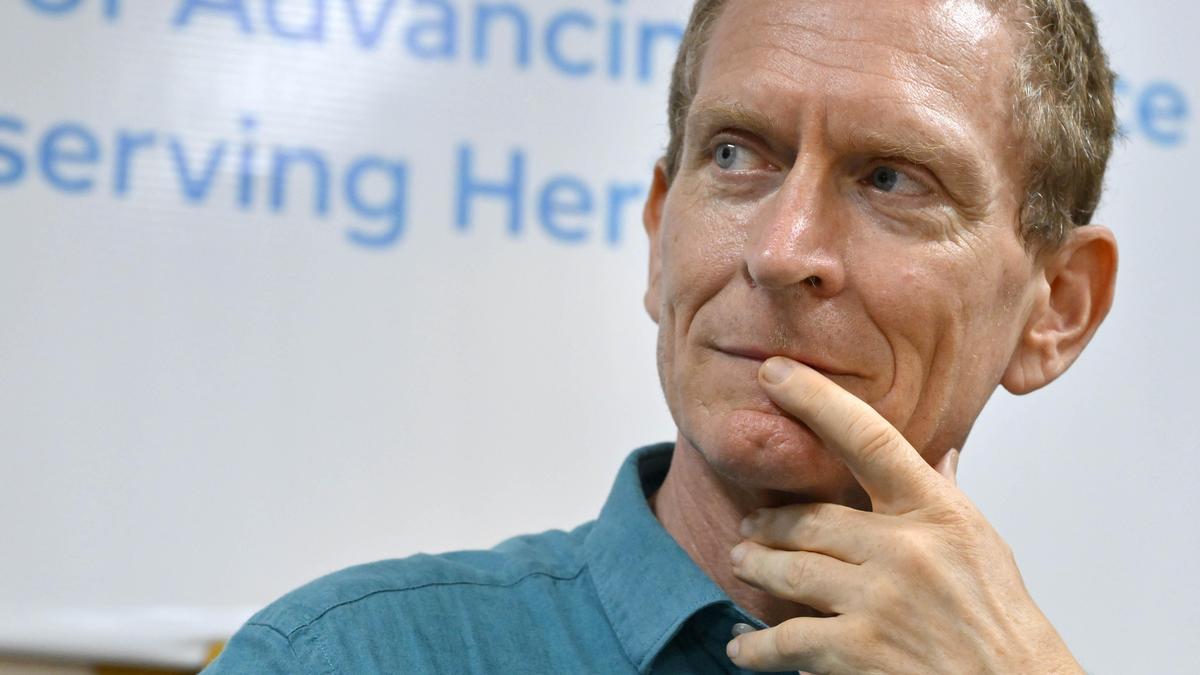
Renaud Colson, Director of French Institute of Pondicherry, during an interview with The Hindu in Puducherry. | Photo Credit: KUMAR SS The French Institute of Pondicherry (IFP) is organising several programmes as part of the week-long celebrations being held to mark its 70th anniversary from October 22 to 28 under the theme ‘70 Years of Shared Knowledge’.Featuring an exhibition, a book launch, a documentary screening and public discussions, the celebrations highlight its research across Indology, ecology, social sciences and geomatics. On the occasion, the institute’s Director Renaud Colson reflects on its research legacy and its priorities for the future. As IFP marks its 70th anniversary, what do you see as its most significant contribution to understanding the region and its people? To identify one single contribution, it all started with a profound investigation of the Shaiva Agamas and Shaivism, because this was something of great interest to the founder of the Institute Jean Filliozat. This investigation has continued until today. “We have an Indology Department, which is working on palm leaf manuscripts, which are a part of a collection acknowledged by UNESCO, and we have very strong collaboration with Indian institutions. We also have an ecology department with long-lasting research on South Indian forests.” How has the institute’s relationship with Puducherry and Tamil Nadu evolved over the years? The relationship that the directors and the French institution have with the local institutions has always been very good. But no history has been written on the subject. And one challenge of IFP at this point would be to find a historian ready to work on the post-colonial relationship between France and India, and France and Tamil Nadu. Through the history of the institutions, it would be very interesting. For the most part, the relations are very good, and we benefit from the support of the Puducherry government. For example, for the 70th anniversary, our strong connection with the Puducherry government made it possible to host thousands of students to tell them about this history and maybe inspire scientific careers and promote French collaborations. IFP works across Indology, ecology, social sciences and geomatics. How do these disciplines come together to address a common research question? Each department has its own research agenda, but we also have strong interdisciplinary research projects. For example, we work on the evolution of biodiversity and the energy transition in India, and there we can have a mix of social sciences, ecology and the geomatics department. Over these 70 years, IFP gathered very important scientific collections. The Institute also has a photo collection, which is very important. We now have a strong collaboration with international and Indian police departments, because IFP is part of a network of institutions, which is fighting trafficking of antiquities. Very recently, we had the restitution of a dancing Shiva idol from the Smithsonian Museum in Washington to the Indian government, and this was done thanks to the competency of the staff working at the photo collection. What pressing environmental or social questions do Tamil Nadu and Puducherry deserve greater research attention today? We are witnessing a double-digit growth in Tamil Nadu, which is obviously good news for South India and for India in general. This economic growth can be a driver of diminishing inequalities, and it brings wealth and welfare to the people. But at the same time, the ecological challenges are very much in front of us. And when you look at climate change, this could lead in the future, not only in India but worldwide to a real catastrophe. And of course, science and academics are here to help policymakers anticipate what’s coming. What do you see as the biggest challenge in preserving the text records and research collections entrusted to the institute? We have developed a very strong expertise in terms of preservation, and in the last few years we modernised the photo collection and the palm leaf collection as well, maintaining them in a very protected environment. The challenge for us at this point of history is very much to try to protect, save and maintain what we have got in order to construct the future with our younger generation. What are the institute’s main priorities for the next decade, and what would you like its relationship with the public to look like by then? The priorities at the moment are built around the preservation of our collections and the creation of interdisciplinary programmes, both within the institute and outside with Indian institutions. This collaborative and interdisciplinary projects are very much focused on the environment in an Indian context. IFP as such is an open institution, so the public is always welcome. In this time of social media, where access to information is changing very fast, the idea is probably to maintain some and give access to high-quality scientific information, in order to make sure that news and poor quality information are not occupying the whole space. I think the IFP is doing the same kind of work that The Hindu is doing. Published - October 23, 2026 12:22 am IST
‘IFP’s priorities at the moment are built around preservation of our collections’
Full Article
Original Source
Read the full article at Thehindu →KhanList aggregates and links to publicly available news content. We do not host full articles from third-party sources. Always verify important information with original sources.