
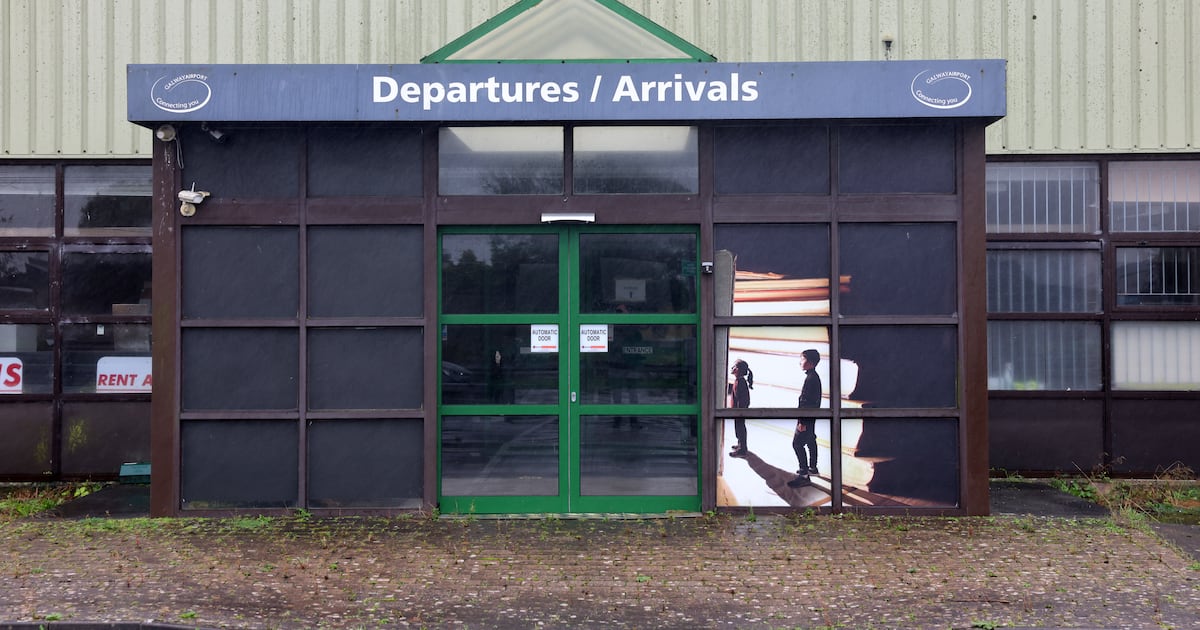
Fifteen years after Ireland’s economic crash led to the demise of commercial flights at Galway Airport, local businesspeople and aviation advocates are campaigning to save its runway and air travel infrastructure. Joint owners Galway City Council and Galway County Council are contemplating selling the valuable 118-acre site at Carnmore, which has huge potential due to its proximity to the M6 east-west and M17/18 north-south motorways, just 8km outside Galway city. The Galway Aviation and Innovation Advocacy (GAIA) group is, however, adamant that the airport’s strategic assets – its runway and two hangars – should be protected in any sale to safeguard the region’s economic future and emergency medical capabilities. “Galway Airport should be viewed as an investment in the future rather than a legacy of the past,” said the group’s chairperson, former senator Fidelma Healy Eames. READ MORE“Once a runway is removed and aviation capability is lost, it is exceptionally difficult and costly, if not impossible, to recreate.” The airport dates to the 1970s, when German industrialist Ernst Steiner developed an airstrip opposite his factory that supplied materials to the capacitator industry. It was later acquired by Galway Chamber of Commerce, whose investment attracted commercial flights, mostly to Dublin and London. It proved popular for time-poor business executives in a pre-motorway time when getting to Dublin Airport involved lengthy road journeys with bottlenecks at Kinnegad and Enfield. In its Celtic Tiger heyday in 2007, Galway Airport handled a record 309,000 passengers to 16 European destinations. Four years later, it succumbed to the turbulence of the economic crash. Galway Airport dates to the 1970s, when German industrialist Ernst Steiner developed an airstrip opposite his factory that supplied materials to the capacitator industry. Photograph: Dara Mac Dónaill/The Irish Times Galway Airport's runway stretches off into the distance. Photograph: Dara Mac Dónaill/The Irish Times The control tower at Galway Airport. Photograph: Dara Mac Dónaill/The Irish Times The airport was delivered a double blow in 2011 when the Department of Transport withdrew public service obligation (PSO) funding on Aer Arann’s Dublin-Galway service, and a value-for-money review of regional airports recommended its closure on economic grounds. The then minister for transport Noel Dempsey, his successor Leo Varadkar, and department officials argued the need for the airport was negated by improved rail and road networks, and also by proximity to Shannon and Knock airports, with larger runways that could handle larger aircraft. Galway was a “sacrificial lamb”, according to Dr Eamonn O’Donoghue of GAIA group. “A critical, reflex decision was made 15 years ago in a specific group of circumstances that are not relevant now,” he insisted. Galway Chamber offloaded the site to the two local authorities for €1.1 million in 2013. They piloted a park-and-ride facility there later that year, but it did not work out without a bus lane to the city. It fared better in 2020 as a temporary HSE drive-through Covid-19 testing centre. Danú Media, with Údarás na Gaeltachta and the Western Development Commission, was granted planning permission in 2021 for a multimillion-euro TV and film studio at the airport. That did not proceed, however, after temporary planning permission granted for the development limited its operation to five years. Last year, both councils invited expressions of interest (EOI) from prospective purchasers of the airport site. [ County council to investigate buying out city’s stake in former Galway Airport siteOpens in new window ]Galway Ladies Gaelic Football Association announced earlier this year that it wanted to build a “centre of excellence” there, but it did not make a submission before the EOI deadline. Separately, Atlantic Flight Training Academy offered to lease the site for use as a commercial flight training centre. This option – not part of the EOI process – would keep the asset in public ownership. Eighteen months after EOIs were invited from organisations interested in buying the site, the councils last week confirmed that none of the six proposals met the criteria to progress the future development of the site. The councils said they have now decided to “examine the establishment of an appropriate delivery entity to lead and co-ordinate the future development of the site”. Meanwhile, support for the advocacy group’s cause gathers pace. Representing more than 500 businesses, Galway Chamber said the region was well-served by Shannon and Ireland West airports, but it wanted a feasibility study to establish Galway Airport’s opportunities. “We believe it is important that the site’s full potential is understood before decisions are made about its future,” said outgoing chamber president Cait Noone. Management at the five-star Ashford Castle sees potential for growth in VIP tourism through Galway Airport. Managing director Niall Rochford said the luxury destination’s “growing cohort of high-net-worth international guests” expect “direct, discreet and personalised travel access”. Fire tenders on the tarmac at Galway Airport. Photograph: Dara Mac Dónaill/The Irish Times Disused interior of Galway Airport building. Photograph: Dara Mac Dónaill/The Irish Times Hangars at the airport. Photograph: Dara Mac Dónaill/The Irish Times “Direct aviation connectivity to Galway would significantly enhance our ability to attract and retain high-value visitors, reduce surface transfer times, and elevate the overall visitor experience,” Rochford said in a letter to the group, which emphasised the potential “substantial economic multiplier effect” on tourism. Elsewhere, former minister for defence Michael Smith highlighted the airport’s national security potential. He said transatlantic subsea fibre-optic and digital cables off the west coast were “vulnerable to sabotage or direct attack by malign actors”, and the airport was a “major asset” that could serve as a national security and surveillance hub for “monitoring and patrolling our maritime domain”. A spokesperson for the Department of Defence, however, said: “No consideration has been given by the Department of Defence to the purchase of the former Galway Airport site.” [ Galway Airport could become film industry hub, study saysOpens in new window ]O’Donoghue, a GAIA member and consultant ophthalmologist, emphasised the facility’s potential aeromedical benefits. Close to the region’s only model 4 – or highest acute public – hospital, University Hospital Galway, it could “help save many lives” by reducing response times if used as a base for helicopter emergency medical services, he said. It could also support air ambulances, urgent medical supplies, organ transport and emergency response during floods, fire and major incidents, O’Donoghue pointed out. Jarlath Conneely, former managing director of Aer Arann Islands, which operates daily flights between the three Aran Islands and the small Aerfort na Minna airport in Connemara, insisted GAIA was not seeking a return to scheduled commercial flights in the short or medium term. Ian Fennel, chairperson, Galway Flying Club. Photograph: Tom Honan/The Irish Times Fidelma Healy Eames, chair of Galway Aviation and Innovation Advocacy group, at home in Galway. Photograph: Dara Mac Dónaill/The Irish Times He said removing the runway would be like the modern equivalent of closing the Clifden-Galway railway in the 20th century. “We can have the best of both worlds. Keep aviation and develop the site for business,” he said. Healy Eames, who served on the board of the airport when she was a county councillor, pointed to Station F in Paris – a train station turned innovation centre with more than 1,000 start-up companies – as an example of what Galway Airport could become. “Before any irreversible decision is taken, every opportunity should be explored to preserve the runway, retain aviation zoning, invite expressions of interest from aviation operators and position Galway Airport as a centre for aviation, innovation, education and emergency services,” she said. Throughout the airport’s history, Galway Flying Club has been a constant. Last month, 50 aircraft from flying clubs across the country attended a charity fly-in at Galway Airport to celebrate the local club’s 80th year. [ Derelict Galway Airport site should be used for ‘regional stadium’Opens in new window ]Founded in 1946, Ireland’s oldest flying club is a voluntary, not-for-profit organisation with more than 100 members, seven flying instructors and two single-engine, four-seater Cessna 172s. A now disused pedestrian pathway on the airport tarmac. Photograph: Dara Mac Dónaill/The Irish Times Stained signage directing long-gone traffic. Photograph: Dara Mac Dónaill/The Irish Times Disabled parking bays outside the main building. Photograph: Dara Mac Dónaill/The Irish Times Could a change in direction alter the airport's future for good? Photograph: Dara Mac Dónaill/The Irish Times Since 2013, it has operated from the airport by lease agreement, renewed annually by vote of elected members of both local authorities. Chairperson Ian Fennell said if the airport is sold, the club “would work with any organisation with a view to maintaining our presence on site”. Fennell conceded the club would be “in difficulty” if the runway was dismantled by prospective buyers, as “there is no ready alternative available to us for what we do”. Elsewhere, Peter McKenna, chief executive of Aer Arann Islands, said Galway Airport is a “significant infrastructural asset for the region”. [ Galway Airport decision too hasty, says city councillorOpens in new window ]“We are on the cusp of a revolution in private air travel ... The ambition should not be to compete with Shannon or Knock but rather be a next-generation airport for smaller, sustainable aircraft. “If it’s lost it will be lost forever, just like the railways in the last century,” McKenna said.
‘If it’s lost it will be lost forever’: What future for Galway Airport?
Full Article
Original Source
Read the full article at Irishtimes →KhanList aggregates and links to publicly available news content. We do not host full articles from third-party sources. Always verify important information with original sources.