
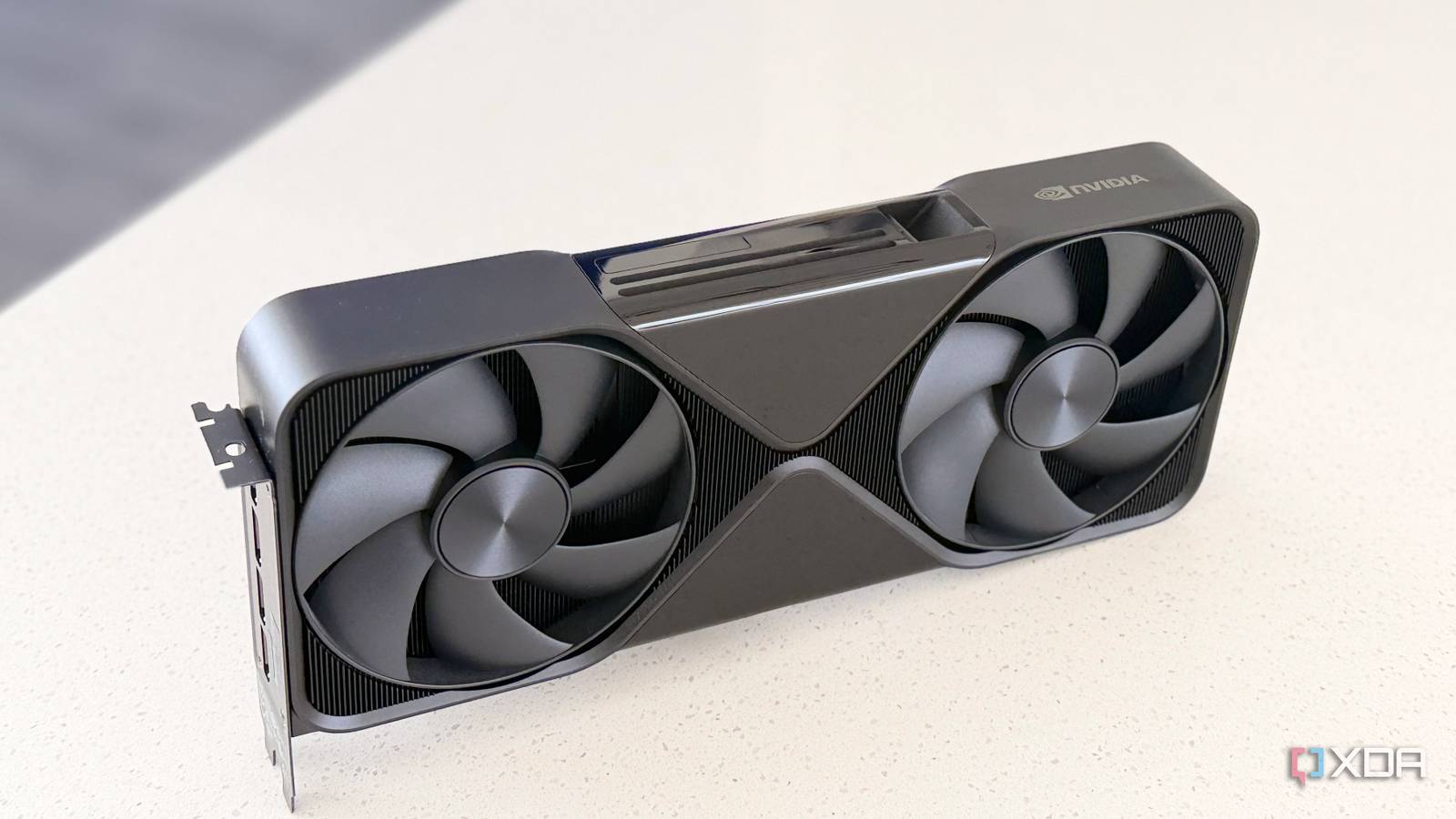
Published Oct 5, 2026, 12:00 PM EDT Hamlin has been in the tech field for over nine years. Since 2017, his work has appeared on MakeUseOf, Android Police, OSXDaily, Beebom, and more. He served as the Senior Editor at Valnet's MakeUseOf for over two years before joining XDA. He uses a high-end gaming rig for desktop use and a MacBook for traveling, but dislikes some of the quirks of macOS. You're more likely to catch him at the gym or on a flight than anywhere else. If I'm judging purely by aesthetics, I'd pick Nvidia's Founders Edition GPUs every single time. Their sleek and minimalist all-metal design is something aftermarket variants just can't seem to match. And even when they do, they end up looking bulkier because of their massive heatsinks and triple-fan coolers. The only exception is when they're liquid-cooled, but that's only because the radiator is separate from the GPU. Still, I've never even considered an FE card since I started building PCs in 2012. My first ever GPU was the MSI GTX 680 Twin Frozr III, and I opted for the Asus Strix variant when I upgraded to the GTX 1070 years later. Even when I built my current PC with the RTX 3090, I paid a premium for the Asus Strix model. And now, I use a Colorful Neptune RTX 4090, which is a liquid-cooled card. So despite exclusively using Nvidia GPUs and seeming like a "fanboy" at this point, I've always ended up with an aftermarket card. Why? Because aesthetics don't matter to me nearly as much once the card is inside the case and I'm gaming. It all comes down to cooling Temperatures come first, and it's not even close Nvidia has come a long way from the good old days of blower-style coolers, switching to two fans with the RTX 20-series and now using liquid metal in the RTX 5090. So, I'll admit Founders Edition cards are more competitive with air-cooled aftermarket models than they've ever been. The thing is, the FE's cooling design is supposed to be efficient, not necessarily deliver the lowest temperatures possible. The RTX 5090 is a perfect example. Nvidia could've gone with a 3-slot design and brought temperatures down further, but it decided to fit a 575W GPU into a 2-slot design instead. There's no doubt that's an impressive feat, but if you compare its temperatures to almost any air-cooled aftermarket RTX 5090 with a massive heatsink and three fans, you'll see it falls short by a few degrees. And that's despite it using liquid metal. The gap gets even bigger when you start looking at liquid-cooled cards. I've seen countless benchmarks of the beefier 3-slot RTX 4090 FE, and its temperatures are usually in the 70s. My Neptune RTX 4090, in comparison, averaged around 60C under load when it was new. Sure, the FE's temperatures aren't concerning by any means, but I want as much headroom as possible down the line since I live in a hot country. Then there's everything Nvidia doesn't give you Dual BIOS, extra ports, and sometimes even fan headers Even though better cooling alone is enough to convince me to go aftermarket, that's not the only thing you get for the premium over the FE. Many higher-end aftermarket GPUs come with a dual-BIOS switch that lets you jump between Performance and Quiet modes. I vividly remember my ROG Strix RTX 3090 having one, even though I never used it. My Neptune RTX 4090 is a different story, though, since the Turbo BIOS bumps its power limit from 450W to 550W. And it doesn't end there; I can crank up the power target in MSI Afterburner to push the ceiling all the way to 630W, and liquid cooling gives me plenty of thermal headroom to take advantage of it. Then, you'll find an extra port or two on some models. My Strix RTX 3090 had two HDMI 2.1 ports instead of just one like the FE. And if I recall correctly, the AORUS MASTER variant had three HDMI ports. Of course, this doesn't change the fact that you can only run four monitors simultaneously, but some of us still like having that flexibility without needing an adapter. Some ROG Strix and Astral variants even have two PWM fan headers, which you can use to connect your case fans directly to the GPU and have them respond to its temperature. The FE still has the value advantage But that's assuming you can actually find one Looks aren't the only thing going for Nvidia's Founders Edition cards, though. The MSRP that Nvidia announces for each new GPU is what you'll pay for the FE, whereas higher-end aftermarket models can easily cost a few hundred dollars more. For instance, my Neptune RTX 4090 cost $2,000 when I got it, even though the FE was available for $1,599. That's a $400 premium for the exact same GPU underneath, so I get why most people would rather get the better-looking FE and spend that money on a faster CPU or something else. The problem is actually finding an FE, or any aftermarket card at MSRP these days, thanks to how ridiculous GPU pricing has become. FE cards can be impossible to find in stock even when aftermarket variants are readily available. That leaves you with models that cost significantly more. I checked RTX 5080 prices on Newegg as I wrote this article, and every model costs north of $1,600, significantly more than the $999 MSRP Nvidia set for the FE, which is currently sold out. But even back in 2022, when things weren't nearly as bad, I remember the RTX 4090 FE selling out almost immediately. So, it's not like you have a choice unless you get really lucky. If I'm already spending thousands, what's a few hundred more? This is the mindset I have when I buy a premium aftermarket card. It's like buying an iPhone and spending another $200 for more storage because, at that point, I'm already spending so much that I'd rather get exactly what I want than save a little and deal with buyer's remorse. In the long run, that $400 premium I paid gets me better cooling and overclocking headroom, and the peace of mind that comes with them, all of which I value far more than aesthetics. And it's not like the uglier card is ugly to begin with; it just doesn't look as good as the FE.
I'd never buy Nvidia's Founders Edition GPU, even though it looks better than every aftermarket card
Full Article
Original Source
Read the full article at Xda-developers →KhanList aggregates and links to publicly available news content. We do not host full articles from third-party sources. Always verify important information with original sources.