
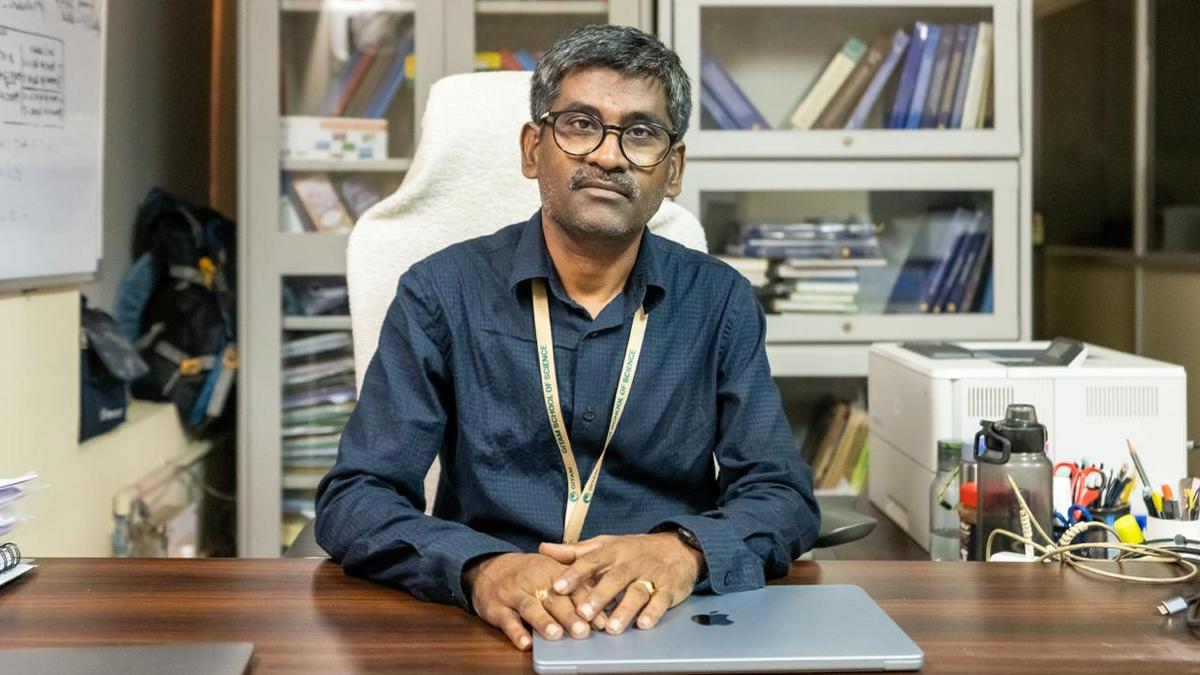
Rama Rao Malla, professor in the Department of Life Sciences, GITAM School of Science, in the cancer research laboratory he set up at the university in Visakhapatnam. He leads an ICMR-funded project to develop a blood test for early detection of triple-negative breast cancer. | Photo Credit: Paul Nicodemus Rama Rao Malla, the son of a farmer from Anakapalli, went on to earn a B.Ed., an M.Sc. and a Ph.D. in biochemistry from Andhra University. During Breast Cancer Awareness Month, Prof. Malla, of the Department of Life Sciences at the Gandhi Institute of Technology and Management (GITAM) (Deemed to be University), is leading research to develop a blood test for one of the most aggressive forms of breast cancer.The first graduate in his family, Prof. Malla has been a teacher for more than three decades. He joined GITAM early in his career in 2001 and, after completing postdoctoral work at the University of Illinois College of Medicine, returned to set up the university’s cancer research laboratory in 2011. He has guided 14 doctoral scholars and completed several projects on breast cancer, with four more under way, he says. Rama Rao Malla, professor in the Department of Life Sciences, GITAM School of Science, with research scholars at the university’s cancer research laboratory in Visakhapatnam. | Photo Credit: Paul Nicodemus His current research focuses on triple-negative breast cancer (TNBC), which lacks the receptors for oestrogen, progesterone and human epidermal growth factor receptor 2 (HER2), the targets of certain cancer therapies. Patients are treated mainly with chemotherapy, to which many develop resistance. TNBC accounts for 10% to 15% of breast cancers, he says, and is increasingly being diagnosed in women in their mid-30s and 40s. Mammography may miss small tumours, particularly in younger women. “If we can identify this cancer at an early stage, we can successfully eliminate the tumours by surgery,” he says.The project, titled “Exploring Serum Exosomal microRNAs as Minimally-Invasive Biomarkers for Early Diagnosis of Triple-Negative Breast Cancer”, has been sanctioned under the Indian Council of Medical Research (ICMR)’s “Follow-on Nischayak Anveshan” Extramural Grants programme, with Prof. Malla as the principal investigator. He says the project has an outlay of more than ₹2 crore over three years.The study will examine exosomes, nanosized vesicles released by cells, including tumour cells. Their microRNA content can reflect that of the cells from which they originate. The researchers will compare serum samples from patients with early-stage TNBC, provided by the Mahatma Gandhi Cancer Hospital & Research Institute (MGCHRI) and the GITAM Institute of Medical Sciences and Research (GIMSR), with samples from healthy women. Sequencing and digital polymerase chain reaction (PCR) will be used to identify candidate microRNAs, and a machine-learning model will be trained to distinguish patients with early-stage TNBC from healthy individuals. The ultimate objective is to develop a kit-based test.“We hope we can achieve something after three years that will be useful for society,” he says.The co-investigators are P. Kiranmayi, P. Vasudevaraju, A. Krishna Chaitanya and M. Srivenkatesh of the GITAM School of Science; K. Viswa Kalyan of GIMSR; and V. Muralikrishna of MGCHRI.The World Health Organization advises that any abnormal breast lump should be examined by a health professional, even if it is painless. Published - October 23, 2026 04:22 pm IST
ICMR-funded GITAM project aims at blood test for early detection of triple-negative breast cancer
Full Article
Original Source
Read the full article at Thehindu →KhanList aggregates and links to publicly available news content. We do not host full articles from third-party sources. Always verify important information with original sources.