
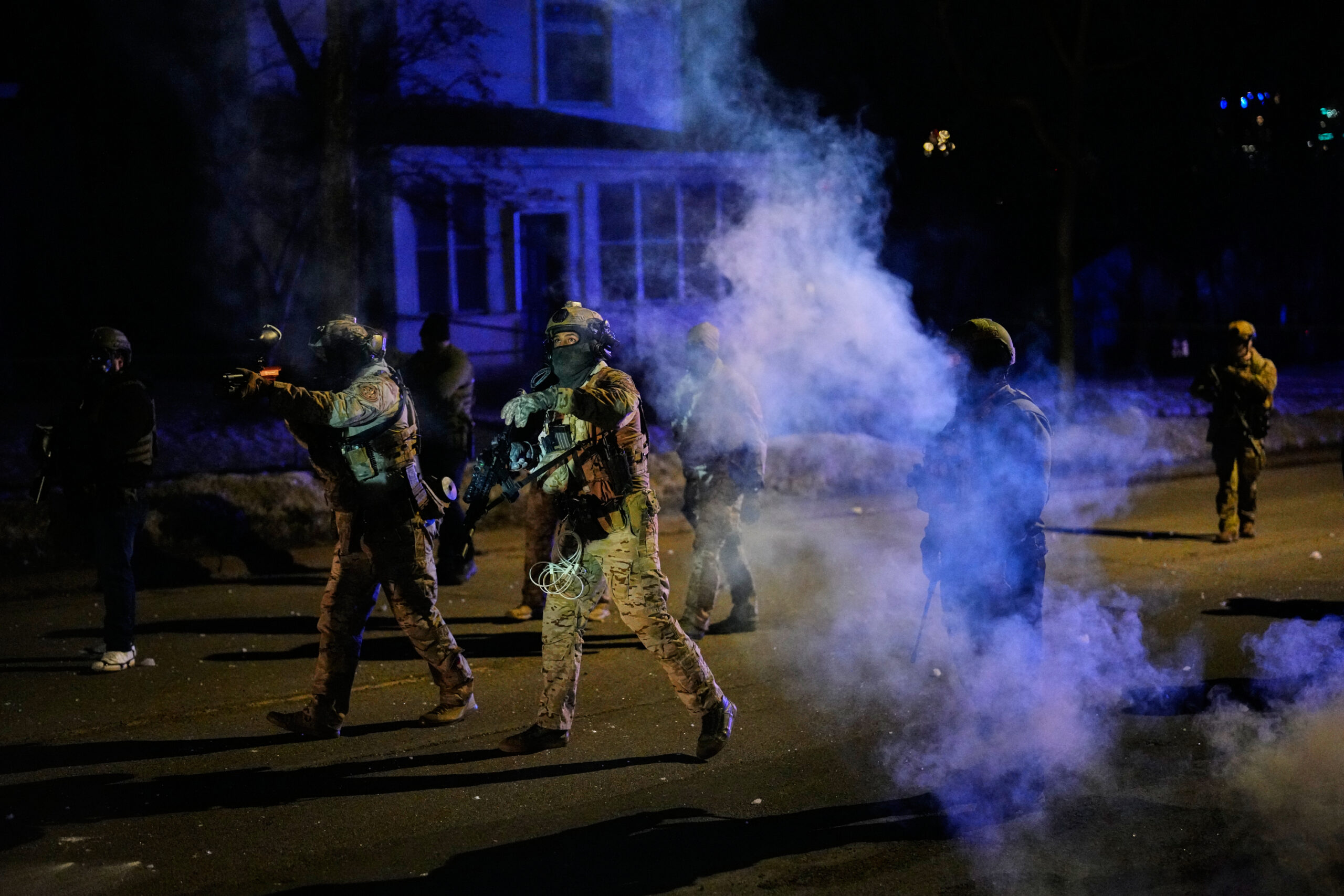
The agent broke down in tears when talking about the toll of Operation Metro Surge and what he experienced during his brief deployment.MINNEAPOLIS (CN) — Taking the stand in a rare hearing Tuesday, a U.S. Immigration and Customs Enforcement officer defended a roadway incident in Minneapolis where state prosecutors claim he pointed a gun at motorists while driving on a Minneapolis highway.The agent, Gregory Morgan Jr., is likely one of the first federal agents to face criminal prosecution by state authorities for actions taken on the job.U.S. District Judge Nancy Brasel presided over the roughly eight-hour evidentiary hearing, and the Donald Trump appointee is weighing whether Morgan’s case belongs in federal or state court, depending on whether he acted within the scope of his federal duties.Morgan, who was abruptly called up to the Twin Cities from Washington, D.C., said he did not want to join the surge because he was unfamiliar with the area and had heard reports of animosity toward immigration officers.“I’m not used to that, I’ve never seen something like that in policing,” he said.The agent broke down in tears while testifying about feeling unsafe and overwhelmed during Operation Metro Surge, describing the atmosphere as a “riot” where he faced relentless harassment, racial slurs and threats of death.Through a shaky voice, Morgan described the toll his brief deployment took on him and his family.“I’ve never experienced something like this before,” he said. “I had to take my daughter out of school… because I did the job I’m supposed to do.”Morgan’s second-degree assault charges stem from a Feb. 5 incident during the surge, when state prosecutors say he illegally drove an unmarked SUV on a Minneapolis freeway shoulder before pointing a firearm at the occupants of a white Cadillac that repeatedly swerved to block him.Prosecutors say the occupants did not know Morgan was a federal agent, and he should face state prosecution as the actions are unrelated to immigration enforcement.Morgan — clarifying he was unaware he was on the shoulder given his unfamiliarity with the area — said the move was a necessary, split-second reaction to a perceived threat while executing a “tactical withdrawal” to base, denying he pointed the gun directly at the driver, maintaining it was held downward as he yelled, “police, back off.”Minnesota countered that, because of the height difference between an SUV and the Cadillac, a weapon pointed down could still be perceived by the driver as aimed directly at them.State prosecutors zeroed in on federal use-of-force policies, pressing Morgan on other ways he could have handled the situation, such as slowing down or driving more safely — noting his driving is what might have caused the Cadillac to intervene.“I didn’t know what that vehicle was, I didn’t know who that person was,” Morgan said in response. “A lot of things are happening so fast, and you’re in law enforcement, you have to look out for your safety."Having just left a tense residential scene where agents were “boxed-in” by protesters and believing he was being followed, Morgan testified his state of mind was on high alert for an ambush when the Cadillac swerved, and he acted out of concern for the safety of others on the road.The vehicle’s occupants were initially slated to testify at last week’s hearing, but Brasel dismissed them after their attorney said they intended to invoke their Fifth Amendment right against self-incrimination. The judge said she may later determine whether their testimony was needed.ICE training officer John Parodi, who trained Morgan, testified that displaying or pointing a firearm is not a “use of force,” and standard police restrictions, like not pointing firearms at motorists, do not apply to ICE.“There is no tit-for-tat matching force; there is no policy that limits or forces the agent to react to a specific defined force or specific defined response,” Parodi said. “Our officers have the ability to judge and deploy a reasonable level of force.”Under cross-examination, Minnesota offered department policy stating officers may use force only when no safe alternatives exist — exhaustively questioning Parodi on what constitutes force, if a firearm is a lethal weapon and how officers are trained.Parodi, who noted he is under a Touhy demand, often said he could not comment on agency protocols or insights into training beyond general concepts, though his shifting testimony drew sharp criticism from Brasel.“This witness is all over the place in terms of what he answers and what he doesn’t,” Brasel said. “I can’t discern any line. I’m really close to just disregarding his entire testimony.”Morgan’s law enforcement partner, Myles Codner, provided testimony supporting Morgan’s actions last week.Morgan’s case will be a key test of how courts determine jurisdiction in state prosecutions of federal agents for crimes tied to their official duties. Minnesota’s felony charges against Morgan and another ICE agent in a separate case are likely the first instance of charges against on-duty officers.Subscribe to our free newslettersOur weekly newsletter Closing Arguments offers the latest about ongoing trials, major litigation and rulings in courthouses around the U.S. and the world, while the monthly Under the Lights dishes the legal dirt from Hollywood, sports, Big Tech and the arts.Additional Reads
ICE agent testifies in Minnesota assault case as judge weighs jurisdiction
Full Article
Original Source
Read the full article at Courthousenews →KhanList aggregates and links to publicly available news content. We do not host full articles from third-party sources. Always verify important information with original sources.