
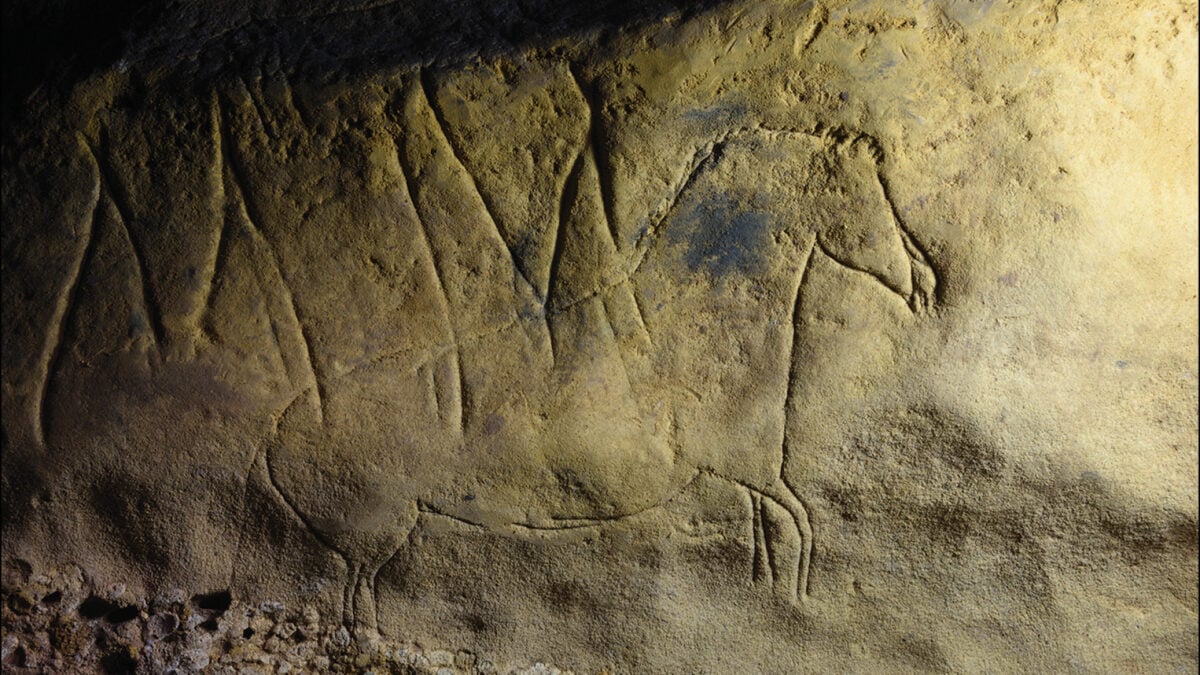
The Cova de la Font Major in Catalonia has long been a popular attraction for tourists, scientists, and looters. The cave is known for its marvelous views and scientific value, though the general consensus was that the walls were too soft for prehistoric artists to sketch their creations. It turns out we just weren’t looking hard enough. In 2019, Josep Maria Vergès discovered a series of vertical lines on the cave walls of the Cova de la Font Major, which turned out to be part of a large art assemblage from prehistoric times. When Vergès and his colleague Míriam Salas-Altès formally investigated the engravings, they identified 280 motifs on the cave’s walls and ceilings, including 55 animal figures representing horses, deer, or bovids, 40 parallel lines, and other geometric shapes. Dating the engravings has been trickier, but the team has narrowed the age of the engravings to at least 19,000 years old; they date to the Upper Paleolithic, during the last glacial period. Vergès and Salas-Altès, both archaeologists at the Catalan Institute of Human Palaeoecology and Social Evolution, shared their findings in a paper published today in Antiquity. “At the moment of discovery, I [Vergès] experienced a mixture of excitement at encountering something both unexpected and extraordinary and profound disbelief,” the team recalled in a joint comment to Gizmodo. “It seemed inconceivable that none of the many visitors who had traversed the gallery […] had ever noticed the presence of these prehistoric engravings.” The sign of the tourists To be fair, the team wasn’t necessarily looking for the drawings, either. Vergès was overseeing excavations at the cave when one researcher told him about a group of tourists in wetsuits. These merry tourists, reportedly taking part in an “adventure route,” emerged from an opening leading to a small side cave that Vergès decided to check out. Vergès photographs the engravings in Cova de la Font Major. Credit: Míriam Salas Altès / IPHES-CERCA “Upon entering, I saw that the walls were covered with names and dates engraved by people who had passed through the gallery since 1957,” he recalled. Then, he took off his helmet and shone his headlamp on the graffiti to take a closer look. And that’s when he noticed the older lines. And another one. Then some more. The small cave was an entire gallery of Paleolithic art, he realized. Art finally comes to light “Stylistically, there was no doubt that the engravings were prehistoric,” the pair explained. But to be extra sure, they carefully analyzed the physical traits of the engravings, comparing their chemical composition to check they weren’t modern forgeries. Once they were certain the engravings were authentically prehistoric, they referenced other well-dated art assemblages to gauge their age based on technical, stylistic, and thematic features. They also performed radiocarbon dating to collect more information about the timing of human occupation at the site. The bear engraving found at the cave, with tracing to denote the anatomical details of the drawing. Credit: Josep Maria Vergès (photograph), Míriam Salas Altès (tracing) / IPHES-CERCA Several characteristics make the Cova de la Font Major assemblage stand out from the rest. For one, again, it’s just a really big assemblage. Fewer than 10% of rock art in the region has more than 20 drawings of animals, and 75% has no more than 5, the team explained. And these animal drawings are rather good. For instance, there’s a bear—unusual in Paleolithic art—drawn with its ears facing the front and mouth slightly agape. Right under your nose? The researchers suspect there were rather realistic reasons for why the engravings went unnoticed for so long. First, the drawings are much less visible under frontal lighting, which is exactly how guides and visitors will typically see the walls using their headlamps. The modern graffiti also pops out more to the casual observer. People may have noticed the more obvious markings, like the horse, but didn’t really stop to make the connection. Salas-Altès documents and studies the engravings inside the cave. Credit: Josep Maria Vergès / IPHES-CERCA “In fact, it is a question of how the brain filters and structures visual information,” the team explained. To put this in perspective, one of the most experienced guides reportedly told the team that she’d been to the gallery hundreds of times, and yet she’d never noticed the horse. “Yet once it had been brought to her attention, it became impossible to overlook,” they added. “From then on, it was the first thing she noticed whenever she entered the gallery.” Buried and hidden The gallery, for better or worse, isn’t open to the public due to the walls being too fragile. But now that this is on people’s minds, we might soon discover even more “lost” Paleolithic art. The team’s goal is to further refine the dating of the assemblage, but there are some entrances in the cave blocked by sediment deposits. These could lead to even more hidden galleries, since the latest discovery was also sealed by sediments until 1853. Researchers take a close look at the cave wall engravings. Credit: Josep Maria Vergès / IPHES-CERCA “Contrary to what was previously thought, north-eastern Iberia holds first-rate Palaeolithic rock art sites,” the team said. “The Mediterranean art of western Europe is now enriched by a new body of rock art, which allows us to characterize in greater depth a Mediterranean graphic tradition with an identity of its own, distinct from that of the Franco-Cantabrian region.”
Ice Age Artists Left 280 Engravings in This Spanish Cave. Visitors Walked Right Past Them
Full Article
Original Source
Read the full article at Gizmodo →KhanList aggregates and links to publicly available news content. We do not host full articles from third-party sources. Always verify important information with original sources.