
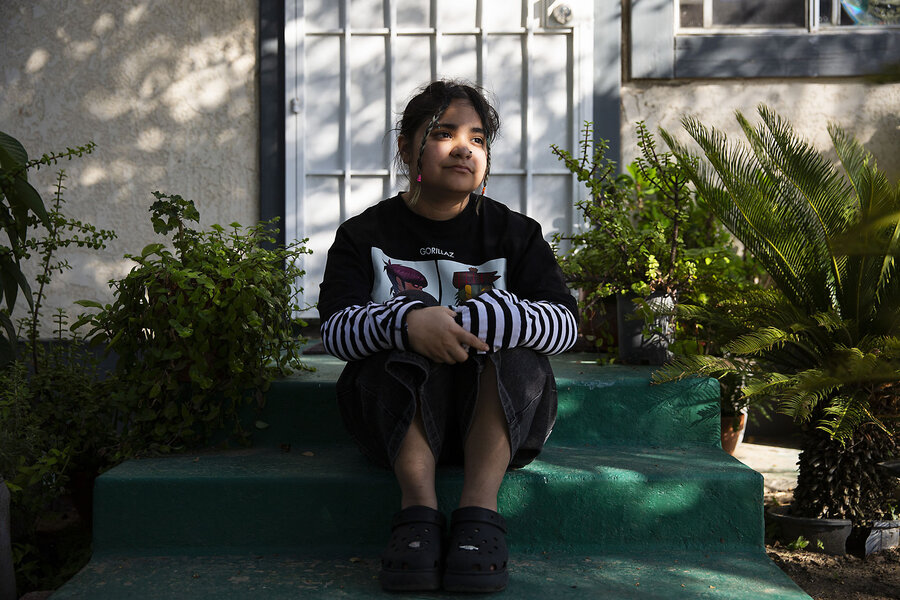
Wasco, Calif. | Nov. 01, 2026, 5:05 a.m. ET | 6 min read Before federal immigration agents surged in California last year, Marisol Perez wasn’t interested in politics. But when the Trump administration’s immigration dragnet swept the state – in some cases, detaining people with legal status and even U.S. citizens – she paid attention.Ms. Perez, a teenager, watched the flood of social media images and videos of masked federal agents handcuffing and taking away people who frequently looked like her or her relatives, she says.Then, a few weeks ago, Immigration and Customs Enforcement officials descended on her town of Wasco, a farming community of about 26,000 people. Local police say they are aware of at least two immigration enforcement incidents in the community, though they have not confirmed how many people were detained. Now, just months after her 18th birthday, Ms. Perez is eager to vote in direct response to what she’s seeing in her community.Here, in California’s competitive 22nd Congressional District, the most heavily Latino district in the state, there is concern over recent immigration enforcement. In some cases, canvassers encounter people who will not answer the door because they fear who might be knocking. But in places like Wasco, there are signs that the Trump administration’s immigration crackdown could also motivate voters.“I need to vote for the people who can’t vote,” Ms. Perez says.A political shiftIn Wasco, one of several farming communities in the San Joaquin Valley, locals describe a sudden spike in immigration enforcement in the weeks leading up to the election. It has triggered protests and accusations that the Trump administration is trying to scare Latino voters. It was an anti-immigrant push that helped turn California blue more than two decades ago. In 1994, a ballot initiative passed that would have barred unauthorized immigrants from public services and forced state employees to report those suspected of not having legal status. Though the courts blocked its implementation, an increase in naturalization and a shift among Latino voters toward the Democratic Party followed.Nationally, there has been pushback to President Donald Trump’s immigration crackdown, an issue that helped return him to the White House two years ago. A Fox News poll in September found 53% of registered voters say the administration’s immigration enforcement has gone too far. Polling also indicates that Mr. Trump has lost significant support among Latinos who backed him in 2024, though a majority of those voters continue to approve of his performance.Today, California’s 22nd District – one of several redrawn last year to give Democrats an edge in response to gerrymandering in Republican-controlled states – is hotly contested. Republican Rep. David Valadao is seeking reelection against Democrat Randy Villegas. It is one of several races that could allow Democrats to retake control of the House. Mr. Valadao’s district was redrawn to now include parts of the large inland city of Fresno, bringing more Democratic voters into Mr. Valadao’s district. Jenna Schoenefeld/StaffFlor Olvera canvasses for Democratic candidates in Wasco, California, Oct. 27, 2026. Flor Olvera, who has spent weeks canvassing for Democratic-leaning candidates in her hometown of Wasco, says fear is palpable in her community. But she says the federal immigration surge in town – where 87% of the population is Latino – is actually moving many voters she’s spoken with to take action.“Some people may feel hesitant to vote because they fear they may be racially profiled on their way to the polls,” she says. “But more than anything, I’m actually seeing more momentum to vote.”“Operation Safe California”Mr. Villegas, the son of Mexican immigrants, has accused the Trump administration of suppressing Latino voters and condemned the federal immigration sweeps. Jae C. Hong/APRepublican Rep. David Valadao, who represents California's 22nd Congressional District, listens as House Speaker Mike Johnson delivers remarks during a campaign event in Bakersfield, California, Sept. 30, 2026. His opponent, Mr. Valadao, whose family migrated from Portugal, has expressed concern about fear among immigrant farmworkers and reiterated his support for a pathway to legal status for longtime residents. But he also said in a statement posted on his U.S. House website that he’s been in contact with federal officials regarding the recent immigration enforcement, and they’ve said that “these operations are focused on individuals with active warrants and known criminal histories.”That might – or might not – be the case. The Washington Examiner, a conservative news outlet in D.C., reported that unnamed sources familiar with the plan said they intended to arrest people they encountered in California without legal status, including those without a criminal record, as part of a 45-day push called “Operation Safe California,” which began in October.In an unsigned statement to the Monitor, the Department of Homeland Security declined to “disclose or discuss law enforcement operations.”“Every day, DHS enforces the laws of the nation across the country, including in California,” the statement said.Federal immigration agents have spent weeks scouring the Central Valley, immigrant rights organizers say, noting warrantless arrests and the targeting of farm laborers on their way to work.Ms. Perez, who lives with noncitizen family members, says she’s also trying to persuade her classmates at the local college to vote for Mr. Villegas – meaning against Mr. Valadao, who has supported the Trump administration’s increased ICE funding. “It’s just not right,” she says.Nuanced views, support for tighter bordersThe newly redrawn 22nd Congressional District covers portions of Kings, Kern, Fresno, Madera, and Tulare counties. It is now more Democratic-leaning than it was when Mr. Valadao last won.The district’s Latino electorate is predominantly young, working-class, and migratory – a demographic that historically tracks lower in voter turnout, according to several studies. This has created challenges for Democratic candidates.Also, Latino conservatives hold unique, nuanced views on immigration, according to extensive polling by the Pew Research Center and the UCLA Latino Policy & Politics Institute.Data shows the majority of Latino Republicans favor increased border security. More than 30% of Hispanic Republicans also support increasing deportations of people who are in the country illegally as a policy priority, according to a 2022 Pew survey. ReutersThe Mesa Verde ICE Processing Facility in Bakersfield, California, Feb. 12, 2020. The facility is privately operated by GEO Group, a for-profit prison and detention contractor. Marco Florez, a board member of the Central Valley Young Republicans who was born and raised in Exeter in Tulare County, says he supports the recent ICE enforcement.“For me, being a Latino doesn’t mean I support open borders,” Mr. Florez says. “Security comes first.”Mr. Florez says he understands mistakes may have been made by ICE agents, who have arrested and detained people who are in the U.S. legally. “Sometimes, people are wrongfully arrested. I don’t deny that fact,” he says.But those mistakes, he says, are eventually sorted out, and people are released.“I don’t think this is going to strain the Latino vote by any means,” he said of the ICE actions.MotivationElizabeth Chur, who is canvassing for Mr. Villegas in the 22nd District, says that “especially, young people are motivated in a way that I have not seen before in previous election cycles.”Ms. Chur, a San Francisco resident, has canvassed in Wasco and surrounding areas since 2018.A grassroots voter-engagement trainer and author of the guidebook “The Joy of Talking Politics with Strangers: How to Save Democracy, One Conversation at a Time,” Ms. Chur says U.S. citizen voters who live in mixed-status households are particularly motivated by recent ICE arrests in their communities. Jenna Schoenefeld/StaffA canvasser for the grassroots group Faith in the Valley places a leaflet through a chain-link fence outside a residence in Arvin, California, Oct. 26, 2026. Information regarding rights or voting is often left behind this way rather than knocking on the doors of people who might be afraid to answer because of stepped-up immigration enforcement actions. That’s the case for Gabriel, who just turned 18 and lives in Lamont.Gabriel, who did not give his last name because his mother lacks U.S. residency, says he not only plans to vote but is actively encouraging others to do the same. On a recent evening, Gabriel hit the streets of the Kern County farming community of Arvin to distribute leaflets. One was in both English and Spanish.“I want to do my part for my community,” says Gabriel, who works for Faith in the Valley, a faith-based, grassroots community group in California’s Central Valley that advocates racial, economic, and environmental justice.He says it can be scary to walk the streets near dusk because of recent ICE activity, but he puts that feeling aside.“The fear is there. I don’t think it will ever go away,” he says. “But I don’t stop just because of that fear.” Deepen your worldviewwith Monitor Highlights.Politics with respectGet political stories with respectful analysis.There‘s a world of new ideas in everyBooks newsletter.There‘s more to life, enrich yours withCulture & Learning weekly.Follow humanity‘s discoveries withScience & Nature stories in your inbox.Gain a spiritual perspectivefrom the stories in your inbox.Want to understand the deeper impact of critical events? Learn the Monitor‘s insight.Already a subscriber? Log in to hide ads. Normally, Gabriel would knock on doors and ask people to vote. But because of recent ICE actions in town, some are too afraid to come to the door.So, he leaves information on their front stoops or on a chain-link fence. The leaflet explains people’s rights and includes a long list of tips for “when you vote” and “if immigration agents come.” ALREADY A SUBSCRIBER? LoginReal news can be honest, hopeful, credible, constructive.The Christian Science Monitor was founded in 1908 to lift the standard of journalism and uplift humanity. We aim to “speak the truth in love.” Our goal is not to tell you what to think, but to give you the essential knowledge and understanding to come to your own intelligent conclusions. Join us in this mission by subscribing.
ICE activity motivates voters in competitive California congressional race
Full Article
Original Source
Read the full article at Csmonitor →KhanList aggregates and links to publicly available news content. We do not host full articles from third-party sources. Always verify important information with original sources.