
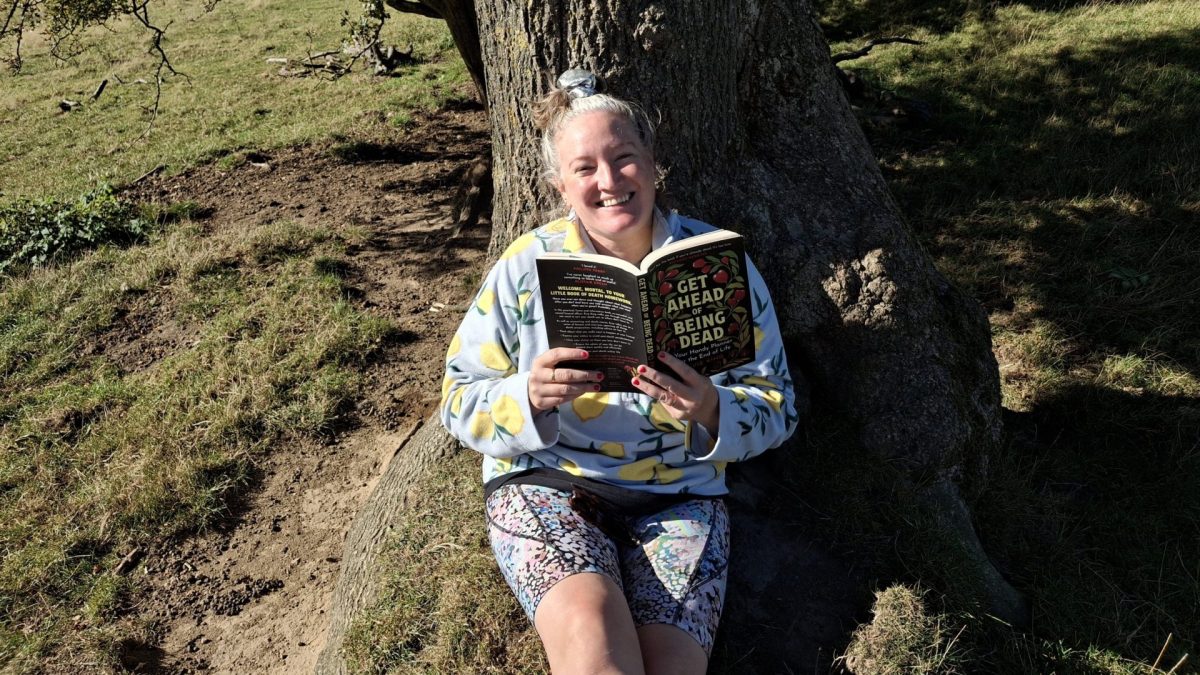
What do you want to happen to your body when you die? Have you given it any thought or does the subject fill you with fear and disgust? If you’re not sure, perhaps you might find inspiration in the plan shared by writer and performer, James Rowland. After his cremation, he’d like his ashes to be separated “into little party bags” and shared with his loved ones “who can do whatever they want with them”. As far as post-mortem planning goes, it’s certainly original and gets a big laugh from the watching audience. Rowland’s one-hour theatrical performance James Rowland Dies at the End is just one in a series of thought-provoking and entertaining offerings at The Sondering, a new microfestival in the Lake District that explores death, dying and grief in new and old ways. Described as “part-festival, part-retreat and part-shared experiment”, the event, which takes place over a weekend in September, does this through music, workshops, conversation, nature, contemporary arts and death literacy expertise – and it’s undoubtedly one of the most inspirational and surprising weekends I’ll have this year. Shorts “Weird”, “bleak” and “morbid” were just some of the responses I had to the news that I was heading to a death festival. But – like many of us – death has made a series of unwelcome appearances in my life. Some were expected, such as a grandparent who died of old age. One was sudden: a close friend who died at the unforgivably young age of 25, while a second friend died after a cancer diagnosis at 40. The death of a parent is often a seismic moment in a person’s life and despite suffering from ill-health, the death of my mother just over a year ago was a deep and unexpected shock. And a bombshell cancer diagnosis at the age of 39 also left me in the unpleasant position of having to confront my mortality. All these things are both unique to me and remarkably commonplace. Death is the grand unifier – the one thing every one of us has in common, and the thing none of us can escape. But despite this, it’s a subject that people are, understandably, reluctant to think about. My journey with changing my perspective on death was also informed by reading several books on the subject, including You Are Not Alone by Cariad Lloyd. In it, Lloyd, a comedian and actress, talks about how Britain’s approach to death is still stuck in the Victorian era and how “fear and social awkwardness drive us to seek to contain grief, tidy it up, run away [from it] – as if tears were petrol and we’re all holding matches”. Instead, she implores us to “free ourselves from the stigma of behaving ‘inappropriately’”. The Minden sisters, Sophia (left) and Cam (right), founded the festival (Photo: Sheenah Alcock) And she’s far from alone. There exists a growing ecosystem of people in fields as diverse as theatre to end-of-life care, funeral directors to musicians who are all working towards increased literacy when it comes to the end of life in an effort to make what is often a difficult time less scary. In their commitment to this vision, sisters Cam and Soph Minden – the founders and brains behind The Sondering – invited a group of such people to the festival to share their expertise, engage and encourage others to think about what is still deemed a macabre subject by too many. Their question: “Can exploring mortality creatively, consciously and communally bring us closer to life – and each other?” is one for attendees to consider. And there’s plenty on offer to help us get to grips with it, from the practical to matters spiritual. In the former, I find Evie King’s “Get Ahead of Being Dead” workshop (also the name of her essential book on the same subject) – eye-opening, informative and hilarious (she’s also a comedian). As a council worker with years of experience organising funerals, she encourages us all to plan what happens after we die, quipping that death is “90 per cent admin”. From listing practical matters, such as bank details and subscriptions, to advanced care plans and deciding which songs we want at our funeral, creating a live document is “the biggest act of love and care you can do for your people – it will make their life easier”, she says. “It also stops people arguing,” she adds. I leave feeling weirdly inspired and ready to have this conversation with my loved ones. The Sondering festival attracted engaged and thoughtful crowds (Photo: Rachael Loomes) Elsewhere, celebrant Lonán Jenkins invites us to consider what we could learn from Irish wake traditions. Such occasions, he says, are characterised by community togetherness, generosity, vigil, storytelling and toasting, plus a welcome dose of humour that is often absent from other cultural approaches to death. “Grieving is an inherent part of the Irish narrative,” states Jenkins, adding that a wake demands a real confrontation with death. Contemporary challenges, such as how to hold a wake without having a family home, or questioning how we grieve at work spark welcome discussions among the gathered crowd. It’s appropriate that Jenkins’s session is followed by a performance from musician and sound facilitator Laurel Morgan whose drone and voice piece is inspired by the Celtic keening tradition. Common in Gaelic communities, keening is a loud and long wailing or crying sound often made by women to mourn someone’s death. Surrounded by candles, Morgan warns us that the performance “might go a bit feral”. I don’t find this to be the case, however, and there’s a reverential hush as her wordless lament that is part-sound art, part-vocal improvisation washes through the room. With its cycles and sensory comforts, nature has long been a source of comfort for the bereaved, so it makes absolute sense that it forms an integral part of the festival, which takes place amid the dramatic fells of Cumbria. Wild swimming, “death yoga nidra” and fireside storytelling are all part of the itinerary, but it’s the Rydal Cave vocal ritual that speaks to me. Led by a professor from the Royal College of Music, me and around 75 other people take a steady walk up and over fields past Rydal Water to arrive at Rydal Cave – a 19th-century cavern, about 30ft high, with a shallow lake. We’re guided by volunteers wielding fire torches across stepping stones and slowly gather in a circle in the darkness of the cave. Several facilitators make a series of sounds and simple refrains that we all repeat back. The echo of our collective voices reverberates throughout the space and bounces back to us in an otherworldly exercise that makes the hairs on the back of my neck stand up. After about 25 minutes, we slowly emerge. Everyone seems more peaceful, which is no surprise; the benefits of communal singing are well documented, coupled with the effects of doing so in such a special place. It is something I wish I could do every weekend. The experience in Rydal Cave made everyone more peaceful A deep feeling of connection with other people is the common thread that runs throughout my entire weekend. Keeping numbers low is intentional and there are no nasty surprises – all my fellow attendees know what the festival is about. And because it’s so small, it’s easy to keep bumping into the same faces. The surprisingly honest and open conversations I have with strangers and overhear are astonishing – it all feels a long way away from the “real world”. It stands to reason that anyone voluntarily choosing to go to a “death festival”, must have a reasonably open mind about life, a suspicion that seems to be reinforced with every new conversation and friend I make. And the delicate subject matter means that everyone seems to treat those around us with generosity and kindness; it feels positively utopian. Saturday night is for “release” – a time to shake off all the big feelings of the day. I’m genuinely sad to miss out on Emöshpit – an opportunity to shout, scream, dance and sweat it out on the dancefloor, but it clashes with the Rydal Cave ritual. A busy itinerary means competing demands – it’s impossible to do everything and rushing from event to event feels antithetical to the entire experience. Thankfully, the dynamism, drums, brass and vocals courtesy of performers Ladies of Midnight Blue provide the prime opportunity to jump around, followed by DJ Madam West, whose bass and beats motivate us to move, fuelled by shots of sambuca. The next morning, I awake in my tent to the sounds of sheep bleating, the wind in the trees and the trickle of the nearby River Rothay. Throughout the previous day, the team at Woven Farewell – an award-winning eco-coffin company specialising in willow-woven biodegradable coffins – have been making a coffin for a Coffin Route ritual that’s set to take place later that day. This “pilgrimage” consists of a three-mile walk to St Oswald’s church in Grasmere followed by an ethereal musical performance ahead of the coffin’s return. Across the weekend, attendees are welcome to help Woven Farewell’s Abi weave the coffin or place offerings of loss or love – a note or a small natural item, such as a flower – into the coffin. It’s then decorated with flowers and buried in an emotional closing ceremony on the Sunday. Coffin weaving with Woven Farewell Coffins While there’s plenty of laughter and pleasure over the weekend, it’s natural that big emotions arise. As well as a trained welfare team to chat to, there are also plenty of places to take a moment, plus as much free tea as you can consume. And the tears do come. The first time it happens, I’m triggered by listening to The Flaming Lips’ deeply emotive song “Do You Realise??” at the start of James Rowland’s show. It’s a song I have to switch off when it comes on the radio but here, there’s nowhere to hide. I try hard to fight it, but the tears start to run down my face. I feel exposed and embarrassed; is it too soon to cry? But by the end of the 60 minutes, I know I’m far from alone. It happens again during a session held by the Incorrigible Crones the following day – three women who facilitate a death cafe. A death cafe is simply a gathering of people – usually strangers – who come together to take openly about death and dying. The conversation is a positive and lively one, with attendees discussing who exactly a funeral is for: do we insist upon our final wishes being followed to the letter or consider the emotional logistics such desires may impose on our loved ones? It’s far from a bleak chat, but I do feel my emotions rising up and step away for a private moment. It feels like a lot of emotions have been building without the space to release them, so I take the time to have a really good cry, followed by some big, deep breaths, before rejoining the group. No one’s weird about it because we’ve all been there. And that’s what makes the weekend such a special one: everyone around is likely to have had some familiarity with death. It’s something none of us can escape, but I’ve found out the hard way that those with no direct experience of this (yet) often err on the side of avoidance or staying silent after someone dies. For this reason alone – our ability to care for those around us – it’s in all our interests to become better at talking and thinking about death. “What will you do with your one wild and precious life?” This line from Mary Oliver’s famous poem “The Summer Day” has been memeified within an inch of its life, but it’s something I see written down at the festival that swims around my brain all weekend. I leave having made new connections, learned new things, thought differently about life and death, been challenged, laughed and cried. Rather than dwelling on death, the last few days have provided me with a stark reminder that none of us are here forever and that squeezing the most out of life is not something we should postpone. This healthy reality check prompts me to consider where I’m currently at in life, what needs to change and how I might be able to make that happen. Life is finite – and at this special festival, surrounded by strangers, I’m confronted by a deep, deep desire to live.
I went to a death festival – it was the most surprising weekend I’ve had all year
Full Article
Original Source
Read the full article at Inews →KhanList aggregates and links to publicly available news content. We do not host full articles from third-party sources. Always verify important information with original sources.