
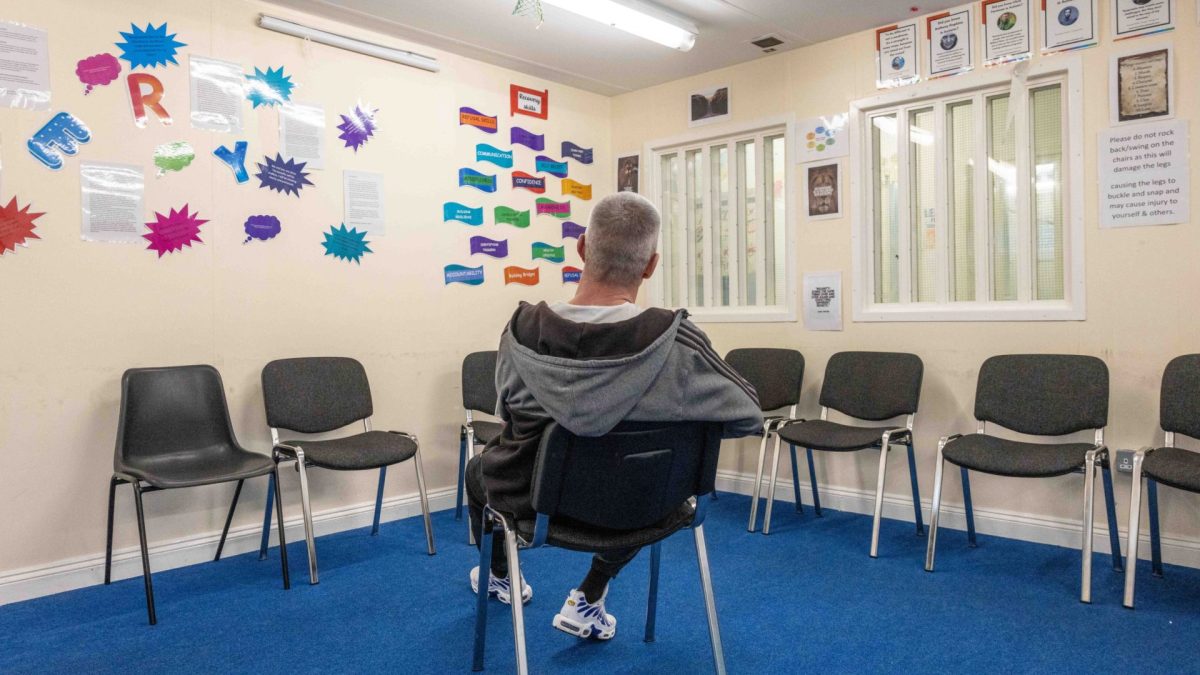
By the time Scott* stabbed someone in a drunken rage, he had been struggling with alcoholism for a decade. His last two years were the worst. “I was waking up in the morning, shaking,” he says. Scott would start drinking immediately to stop the shakes, as early as 5am. As soon as his local shop opened, he’d buy more cans and bottles, “then I’d be drinking all the way through the day.” He was “stuck in a rut.” I ask how he ended up in prison. “I was drunk at the time. I’ve picked the knife up and I’ve stabbed somebody.” It was “not just once,” he admits. He was convicted of attempted murder. Sentenced to 18 years, did he wonder how he would survive jail in the depths of addiction? “My head was all over, aye.” But in fact, says Scott, “If I hadn’t went to prison, I would have been dead.” He knows he deserved to be punished for his crime. But he also credits the staff, his fellow inmates, the classes and the culture of a special unit here at HMP Northumberland for rescuing him. It’s an Incentivised Substance-Free Living wing (ISFL), where offenders are offered more time out of their cells if they commit to treatment and frequent testing. They can also benefit from more gym sessions, priority family days, cooking facilities and music lessons. “People that come on here want to stay off drink and drugs,” says Scott, who is three years into his term. He spent two of those in the ISFL, which went so well that he’s now a mentor and wears a red band on his arm to show he’s a “trusted prisoner”. He has moved onto a higher-grade wing where his cell door is left unlocked at night and he can cook his own food. There are 88 ISFLs in England and Wales. Now the Government is investing in 12 more, and the system badly needs them to work for all our benefit. Prisons are not just full of addicts; they are also rife with drugs. That worsens reoffending rates, resulting in more people becoming victims of crime and more lives being wasted in jail, costing more taxpayers’ money. Ministers cite research showing that prisoners on effectively run ISFLs are roughly 30 per cent less likely to be involved in violence, self-harm or disorder. But are these units working as well as they should? Not everyone is so sure. Tall fences and barbed wire surround HMP Northumberland (Photo: Andy Commins/North News for The i Paper) Two thirds of inmates have drink and drug issues HMP Northumberland, located in the countryside about 20 miles north of Newcastle upon Tyne, is one of the largest prisons in the country. A walk around its perimeter fence is 4.5 miles long, enclosing 800 acres. It is a Category C men’s training and resettlement facility run by the French company Sodexo. Its security is ranked “medium”, though it doesn’t feel very middling while I am being led through gates in three fences that are 5m high and topped with barbed wire, plus several thick metal doors, to reach the ISFL. Altogether, the prison holds more than 1,300 offenders. Of those, about two-thirds have drink and drug issues. The public might imagine these people feed their habit to rebel and have fun, but often that’s not the case, says Joanne Mavin, the jail’s lead manager of drug strategy. Many will have begun using substances during traumatic childhoods that left mental scars. “Some people want to use substances just to manage their emotions in prison and they will often do that behind the doors,” says Mavin. “They’re not necessarily getting high and running around a landing, causing problems.” But drugs do increase aggression, violence and self-harm, especially when prisoners are struggling to pay off debts to dealers. Stepping inside the ISFL, which has 40 cells, I’m greeted by inmates in a boisterous mood. Dressed in vests, tracksuits and pyjamas, with plenty of tattoos on display, some are playing pool or table tennis. Others play chess or simply sit and chat. These men are isolated from the rest of the prison to cut them off from temptations and suppliers. Gemma Bruce, left, and Joanne Mavin, right, work on the ISFL wing (Photo: Andy Commins/North News for The i Paper) ‘We’re not going to be able to keep this man alive’ I’m led into a group therapy room where prisoners will sit in circles to discuss experiences, dangers and ways of coping. The walls are covered in posters providing facts about symptoms and harms, hammered home by graphic photos. One section is dedicated to heroin, with a picture showing an addict’s forearm dotted with swollen abscesses from injections. There’s also that unforgettably tragic image of Rachel Whitear, a 21-year-old student who was found in her Exmouth bedsit in 2000, three days after she was killed by an overdose. Her family released the photo of her dead body, kneeling and curled over with a syringe still in her darkened hands, to warn schoolchildren of the risks. Across the room, another wall about crack cocaine displays dental pictures of users left with holes in the tops of their mouths, known as palate perforation. Gemma Bruce, a manager of the Drug and Alcohol Recovery Team (Dart), says it’s “really rewarding” to see people change here. She gives the example of a man who left this month under the Government’s controversial early release scheme. “There was a time where I thought: we’re not going to be able to keep this man alive,” she says. He was often the subject of code-blue calls when people collapse or have breathing difficulties and was sometimes found on the floor of his cell. “There was never a point where he was sober enough to be able to do anything meaningful with him in terms of drug recovery,” says Bruce. “Then he came here… He was like a new man. You could have a conversation with him. He gained weight. He went from being very unkempt to being quite well dressed.” She is honest that it “can be rare”, however. “There probably are more times where you see people come back.” Like at all prisons, her team’s job is made harder by the drugs being smuggled inside. Inmates play chess inside the ISFL wing (Photo: Andy Commins/North News for The i Paper) Drug-smuggling drones Bertie the red Labrador has just finished his rounds. He’s one of four sniffer dogs at HMP Northumberland and has the “passive” role of smelling people. Meanwhile, “active” spaniels are let off their leads to go hunting for drugs in cells, vehicles or mail packages. Bertie has had one “indication” today, says his handler, Matt*. This involves him freezing next to where he thinks a substance has been hidden, such as a trouser pocket. “There’s a lot of ingenious ways in which stuff comes in,” says Matt. He remembers a radio where a hole had been drilled into it, filled with drugs, then covered with a safety sticker. “We’ve even had cases where they’d unpicked towels and secreted drugs along the bottom.” His spaniel, Oscar, was busiest during Covid when many parcels were being sent in. “We estimated that he probably stopped in the region of £2m worth.” Spice – a man-made drug that mimics the effects of cannabis but is more powerful, harmful and unpredictable – is the most common drug in prisons and highly profitable for gangs who can smuggle it inside, says Mavin. “The markup is huge… Organised crime is always going to want a part of that.” These days, the biggest threats come from drones. Mavin has never seen one, as they tend to fly in at night, but the arrival of just one can cause chaos. As well as spice, they can bring in mobile phones and chargers which are quickly sold. Security teams are “feeling the pressure” from this, she says. Scott admits he is lucky that it’s harder to access alcohol in prison than spice, making his particular addiction less vulnerable. But do any drugs get into the ISFL? “Little bits can get on, but it gets stopped,” he says. The presence of drugs isn’t the only problem in prisons, however. Sniffer dogs are used to detect drugs at HMP Northumberland, which has a special wing to treat addicts (Photo: Andy Commins/North News for The i Paper) ‘This prison is in crisis’ When I enter the ISFL, a few inmates smile and exchange banter with the staff, but one shouts that things are “diabolical” here. “This prison’s in crisis!” I ask Scott what he meant. “He’s not getting his gym because it’s short-staffed,” he explains, saying that many inmates become “frustrated” if they can’t exercise. This highlights an issue that also concerns the Chief Inspector of Prisons, Charlie Taylor. In his annual report this summer, he complained that training and education have been “brutally cut” since his appointment in 2020, with attendance often “appalling”. As a result, prisoners are locked in their cells for longer. “Frustration, boredom and despair are driving the demand for drugs,” Taylor warned. Nor was he impressed with many ISFLs. “Apart from a handful of exceptions,” he wrote, these units are “rarely effective in supporting the recovery of the many addicts in jail.” Taylor continued: “In some cases, ISFL wings are overrun by drugs and others are populated by organised crime gang members who opt to live apart from the chaos they have created elsewhere in the prison.” Joining me at HMP Northumberland is the Justice Secretary, Alex Norris. Isn’t he concerned, I ask, about investing in these facilities when the chief inspector is worried they don’t work? Norris admits “there are cynical individuals who will seek to manipulate and exploit those opportunities”. But he insists: “When these wings are done well, then they can be transformative.” He says the Ministry of Justice will learn from the inspector’s findings. If ISFLs are too large, for example, this risks overflowing prisons, filling them with inmates who are not committed to going clean. But what about prison funding generally? Is the good done inside effective ISFLs undone by cuts elsewhere? Norris accepts there are dangers when “individuals don’t have things to do, structures to their day, things to build towards the future”. But it’s hard to deliver services when jails “are completely full to the brim,” he says. “We inherited a situation with fewer than 100 prison places left. If your estate is running that hot, then it’s a problem.” He argues that by spending £2.3bn to create 14,000 more prison places by 2031, this will help the system become more “rehabilitative and productive”. It should also mean the early release scheme can be ended, eventually. Yet staff here remain worried about what happens to prisoners when they’re let out, early or not. Justice Secretary Alex Norris answers questions from The i Paper reporter Rob Hastings (Photo: Andy Commins/North News for The i Paper) Early release ‘makes us uncomfortable’ Asked what she’d like to tell the Justice Secretary, Jenny Hayes, deputy head of Spectrum Community Health CIC, which treats prisoners at Northumberland, does not hold back. “It makes us feel uncomfortable at times that you’re releasing people, particularly on the early release scheme, homeless,” she says. She is left wondering: “Are they going to end up in a situation where they’re surrounded by people who are using substances?” Probation officers – who help offenders reintegrate into society to reduce reoffending – have similar concerns and are balloting on strike action. This is partly over pay, but they also argue that early release has overstretched them, potentially endangering the public. Norris acknowledges that probation has been “a forgotten service” and knows it is “crucial” in keeping people safe. “I want to reduce workload for staff so they can do their jobs really well.” He argues that an investment of £700m over three years will aid recruitment and provide labour-saving technology. Scott is many years away from release, but asked if he thinks more ISFLs would be a good thing, be couldn’t be clearer. “Definitely,” he replies. “It saved us.” *Names changed for security or avoiding victim distress @robhastings.bsky.social
I went inside a prison giving inmates music and cooking classes to stay off drugs
Full Article
Original Source
Read the full article at Inews →KhanList aggregates and links to publicly available news content. We do not host full articles from third-party sources. Always verify important information with original sources.