
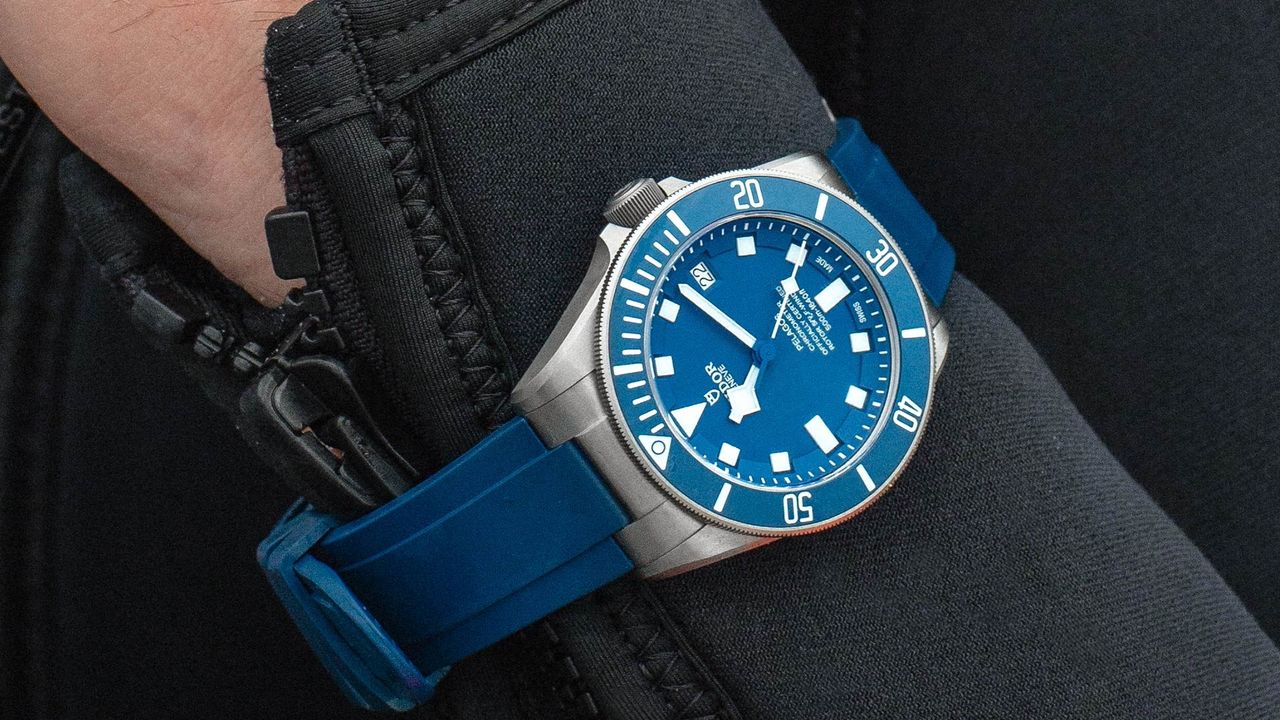
The trick? Try not to watch the clock.Tudor“When I dive deep, I think about nothing. Nothing.” So says Morgan Bourc’his, a French-born world-champion freediver. I was in Marseilles on the Côte d’Azur to learn the basics of freediving, a sport for which timing is both essential and something that must be ignored.Though Bourc’his can hold his breath for well over seven minutes, I, a mere mortal, cannot. Perhaps with a bit of training, I thought, I could extend my time to a respectable few minutes? Certainly it helps that Tudor—Bourc’his’s principal sponsor and the underwriter of this French excursion—had equipped each of us journalists with a heavy-duty, highly waterproof Pelagos 42-mm dive watch.Alas, it turns out that one isn’t meant to think much about time when underwater. Unlike SCUBA diving, in which one tracks bottom and decompression time through the use of a dive computer or watch, freediving doesn’t actually have much to do with time, at least not during the actual dive. When you’re pulling yourself downward from a rope attached to a buoy at the surface, it’s best to have a clear mind free of distraction. If one is competitive—as world champion Bourc’his was during his career—then the numbers that really matter are those of depth.Morgan Bourc’his with his unique Pelagos Ultra Even so, Bourc’his is zen-like when using his Pelagos to time our practice sessions, which consist of lying facedown, hands on the edge of a pool at a villa situated along the Marseilles coast, as he times progressively longer intervals. Beginning with just 15 or 30 seconds, we end with a “personal record” interval, in which I achieve something like 2:25. Satisfied with this progress, I wonder what it’ll be like trying it in the ocean, with waves, weather…and maybe sharks.Of course, time—and timing—does play an important role in freediving. But not the way you’d expect. “When you are in this state of mind of slowing down, time seems to be very long,” explains Bourc’his. “You are completely linked to the present moment, and nothing passes through your brain. You say, ‘Okay, I think I probably dived for two minutes and 30 seconds. But no—it was four minutes. You forget [time] completely. You check after the dive for the information.” The idea of slowing down time—and slowing down oneself—looms large in the practice of freediving.The push-pull between the consciousness of time and the dissociation from it pervades Bourc’his’s freediving practice as well as his life. Still, he keeps his original blue-dialed variant Pelagos around for even his most audacious attempts. During a freedive in the frigid waters off the coast of Norway, he found himself staring facedown at a pod of some 20 humpback whales as they passed silently beneath him. “It was like a train—a never-ending train passing by me,” he says. “I was alone with my wetsuit and wearing my Pelagos, and that’s probably one of the most iconic and amazing memories I have.”Bourc’his training us in the safe haven of the pool The author practicing freediving with his Pelagos Most people, of course, will never test a Pelagos the way that Bourc’his tests his, but it’s good to know that it could come along if you suddenly decided to pursue a career as a three-time world-champion freediver. Launched at Baselworld in 2012, the Pelagos was conceived from the ground up as a flagship, highly technical timepiece made for serious divers. It came in titanium, measured a large 42 mm in diameter, carried a depth rating of 500 meters, and featured a spring-loaded self-adjusting clasp on its matching bracelet.Over the years, the Pelagos has evolved, shedding its earlier ETA movements in favor of in-house calibers and adding both smaller and larger sizes to the collection. The relatively new Pelagos Ultra, which debuted at Watches and Wonders 2025, measures 43 mm (also in titanium) and features a whopping 1,000 meters of water resistance, plus a helium escape valve (HEV). For Bourc’his, it has particular appeal. “The Ultra is probably my favorite one today,” he says, noting that only small changes in diameter and thickness yielded double the water resistance. In fact, Tudor presented him with a one-of-one example, engraved on the caseback with an image of him suspended in the water during his final World Championship dive.As a freediver, Bourc’his also has a unique relationship to time, which makes him an especially interesting partner for a watch brand. He is the tour guide into freediving for journalists, retailers, and collectors in Tudor’s orbit, teaching them that, ultimately, mastering the sport means letting go. “Today, performance means for everybody to be faster, to be higher,” he says. “And here, if you want to perform, you have to slow down. You have to do a lot of things with softness and slowness. This is the paradox of the activity.”Out in the open ocean, just off the coast of Marseilles, Bourc’his is a calming force. With the blue Pelagos strapped to my wrist, I enter the warm water, secure in the knowledge that this talisman has brought me good luck thus far—but trying, all the same, to forget about time. After several middling practice attempts, I realize that if I’m going to hit the modest goal of five meters I’ve set for myself—the height of a tall single-story building—I’m going to have to descend feet-first, rather than headfirst. This involves wrapping the aforementioned line around my fins and pulling myself hand-over-fist downward, stopping at each pull to equalize my eardrums—a practice I’m used to from scuba diving. “Why did you stop?” he questions me after I turn around and head for the surface after just a few meters during a practice run. “You held your breath in the pool for over two minutes. You have plenty of time. Breath is not the issue.”He’s right, of course. But holding one’s breath while floating in a calm pool and out in the open ocean are two completely different worlds. After two days of practice, however, I get the hang of it, descending deeper and deeper each time I try. Finally, on my last attempt—during which I’ve been tasked with removing a card from the bottom of the buoy and taking it back to the surface—I spend two minutes breathing calmly, then descend, Pelagos on my wrist. Though the pressure builds in my left ear, I remain calm, equalize, and feel the bottom of the rope hit my fins. I grab the card, rip it free from its rubber band, and swim quickly for the surface.While Bourc’his’s competitive career is behind him, he still spends an inordinate amount of time freediving. Unlike with scuba, the beauty of freediving is that it can be done with barely any equipment. A diver like Bourc’his can effectively disappear into the environment. A mechanical watch is one of the few tether points to the topside world of technology and objective measurement for a freediver like him.Really, Tudor’s role in freediving (and its partnership with Bourc’his in particular) is almost more of a totem—a signifier of the man-made environment to which the diver belongs. Disconnected from urgent reminders of missed meetings, pending RFPs, and an overflowing inbox, you’re consumed by the ocean, free to experience nature as a child might. Then, finally—when you’re ready—a glance down at your wrist reminds you of the surface, and you swim homeward.“Freediving is a nice school about the knowledge of yourself in this sport—in daily life also,” says Bourc’his. “Slowing down is not just ‘I do nothing.’ You know? It’s a way to organize your life.”Oren Hartov is a GQ contributor covering all things horological. He’s written extensively about celebrity watch culture, waxed poetic about the GMT complication, and railed against case sizes larger than 40mm. A graduate of the Berklee College of Music and a military veteran, he can be found playing the guitar, ... Read More
I Went Freediving With a $6,000 Tudor Watch on My Wrist
Full Article
Original Source
Read the full article at Gq →KhanList aggregates and links to publicly available news content. We do not host full articles from third-party sources. Always verify important information with original sources.