
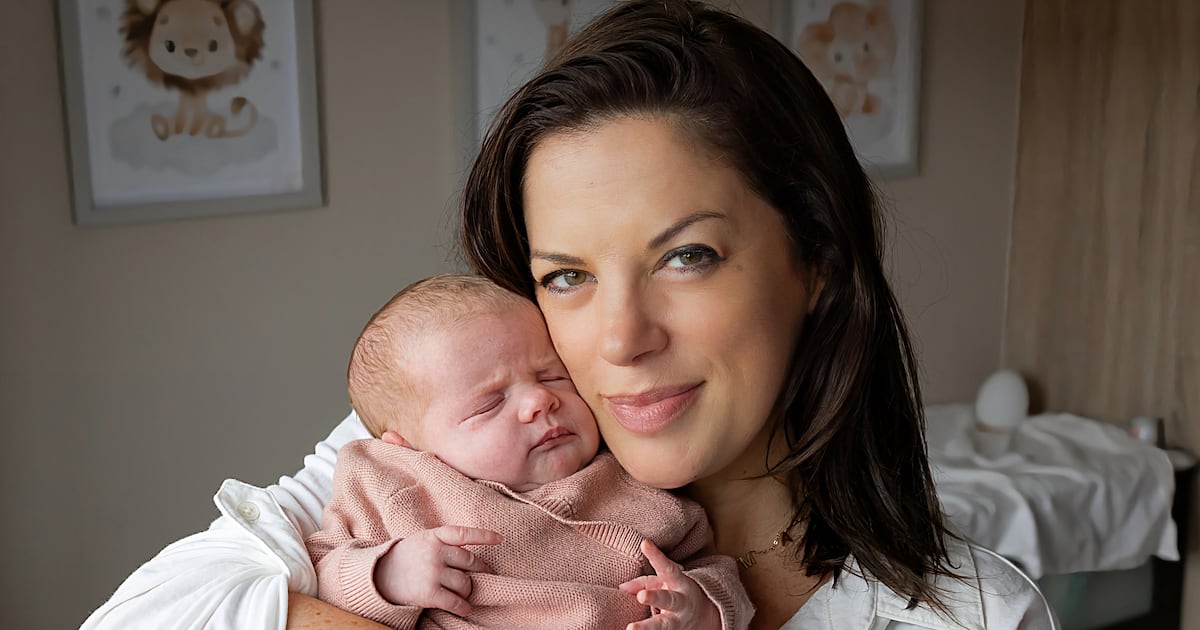
In the 1970s, the average age for a woman in Ireland to have their first baby was between 24 and 25 years of age. Today, the average age for a first-time mother is 32.And there are also many women who don’t have children until much later in life. Figures show that, in 2023, almost 5,000 women had their first baby when they were aged 40 or older. This could be due to a variety of reasons – career, lifestyle, fertility, not being with the right partner, or simply not feeling that the time was right until then.Ariana Dunne came late to motherhood as she gave birth to her daughter in October 2025, when she was 43. She says older mothers are “10 a penny” now so she doesn’t see anything strange about it.“I think it’s all fairly normal, and although it seems like it’s a really modern thing, I’ve met so many people who have said that their mom had them when she was in her late 40s – although they were usually not their first baby,” she says.READ MORE“My grandmother had her last child at 42 and my mother had her twins at 38, so although I was 43 having my first baby, I thought I would be over the hill, but I saw lots of women my age at my appointments – there was even one woman doing antenatal classes with me who was 48, so it all seems quite normal. Also, I wasn’t given any special guidelines or anything, I was just treated the same as anyone else.“The pregnancy was great – I was very fortunate that I didn’t have any sickness at all. I chose to have an elective Caesarean, knowing she was going to be my one and only baby, and I also have a back injury from when I was younger. So I just wanted things to be as unchaotic as possible and thought that a section would be better than a spontaneous labour. “Also, I had a lot of friends and family members who had emergency Caesareans and I didn’t want that – so, thankfully for us, Raya’s birth was a really beautiful experience.”Dunne – who runs her own coaching business called Mindstream – says she waited until her 40s to have a baby as she wasn’t ready when she was younger and now she and her partner, Graham, feel that being older parents will keep them young“Now is the best time for me to have a child,” she says. “I know people say that it is more tiring for older mothers, but I think everyone is tired and has to deal with sleepless nights.Ariana Dunne with her husband, Graham, and baby daughter Raya Ariana Dunne gave birth to Raya when she was 43 via elective Caesarean “I’ve lived a great life so far, done a lot of travel, had great careers and had a lot of fun, so now is a good time for us to become parents and it will keep us young. Having a little baby will motivate us to be healthy and exercise and enjoy the love and joy our child will bring, keeping us young right through our 40s and 50s.“So far she seems to be a great baby – and we’re very lucky with her. She sleeps well and latched on straight away, the minute I came out of the recovery room, so I’ve been breastfeeding with no issues.“She is a very quiet baby and a joy to be around – so far, so good, she has been wonderful and we are so delighted with her.”Lisa McHugh gave birth to twins when she was 42. She says she delayed motherhood because she “had so much going on”, and by the time she decided that she wanted a baby it “wasn’t as easy” as she thought.“I remember, when I was in my 20s, my mother and grandmother would often hint about it being the best time to ‘settle down and have a baby’, but it was the farthest thing from my mind. I was in a steady relationship at the time, but we were busy travelling, working and socialising, so it wasn’t even a topic we ever discussed.I now know why people say you should have kids in your 20s because it is exhausting, particularly with twins— LisaMcHugh“Fortunately we didn’t have a baby then, as we went our separate ways a few years later when I met my now-husband at work and we really clicked. I knew I had found the right person that I wanted to spend my life with. But things were messy and it took a while for me to finish one relationship and start another. “By this point I was in my early 30s, and we needed time to get to know each other properly before we decided to settle down and get married.”[ Irish women share their stories of motherhood after 40: ‘I knew if I didn’t try, I would have regrets’Opens in new window ]The 45-year-old, who lives in Dublin but is originally from the UK, says it wasn’t until she was in her late 30s that she “really began to think about having a baby” and “there were quite a few complications” before she finally became pregnant.“We talked about having children when I was probably about 37,” she says. “My husband John is a bit older than me and was aware of the fact that we needed to make a decision sooner rather than later. But I continued to put it off for a while as I just didn’t feel ready. “Then, when I was 38, I realised that I needed to make a decision as I was heading for 40 – so I decided that would like to try for a baby as I was secure at work and we had our house sorted. But it wasn’t as easy as that.“I thought I would get pregnant easily, but unfortunately we tried for a year and nothing happened, so eventually we made the decision to go down the in vitro fertilisation (IVF) route. “This also wasn’t successful straight away and we actually had three attempts before I finally got pregnant, with twins. Needless to say, we were over the moon, but also somewhat anxious as it was a long road to get here and we were also worried that there may be complications with the pregnancy.”[ Motherhood after 40: Why are women having children at an older age, and why does it matter?Opens in new window ]She went on to have two healthy babies – but, according to the HSE, age can be problematic for some women with regard to fertility and also with complications during pregnancy and birth. “Women are born with all the eggs they are going to have – so as you get older, your eggs get older too,” says a spokesperson. “Women are most fertile in their early 20s, but this starts to reduce after 30 and even faster after 35. If you are 30, each month you try to get pregnant naturally, you will have about a one in five chance of getting pregnant. But when you reach 40, each month you try to get pregnant naturally, you will have less than a one in 20 chance of getting pregnant – and after 45, you are unlikely to get pregnant naturally.”The public healthcare executive warns that fertility treatments such as IVF do not work as well in women over 40, but staying healthy and fit helps to improve chances. However, it “does not completely cancel out the effect of age”, and older mothers are at greater risk of miscarriage, pre-eclampsia, gestational diabetes and having a baby with a chromosomal abnormality.McHugh feels very fortunate she has “two beautiful, healthy children”, and although she has found motherhood to be “amazing”, she also says it can be very hard work.“I love being a mother, but if I’m being completely honest I wish that I had done it sooner,” she says. “I now know why people say you should have kids in your 20s because it is exhausting, particularly with twins. My husband has a lot more energy and he takes on the lion’s share of the parenting and we also have an au pair, who is brilliant and I don’t know what I would do without her because the girls (now aged three) are so busy and always up to some sort of mischief. “But having said that, I wouldn’t swap this for the world and I would say to anyone who is worried about having babies when they are older, to just go for it, particularly if you have someone to help out, as they are the best thing that has ever happened to me and I can’t imagine my life without them.”
‘I was 43 having my first baby, but I saw lots of women my age at my appointments’
Full Article
Original Source
Read the full article at Irishtimes →KhanList aggregates and links to publicly available news content. We do not host full articles from third-party sources. Always verify important information with original sources.