
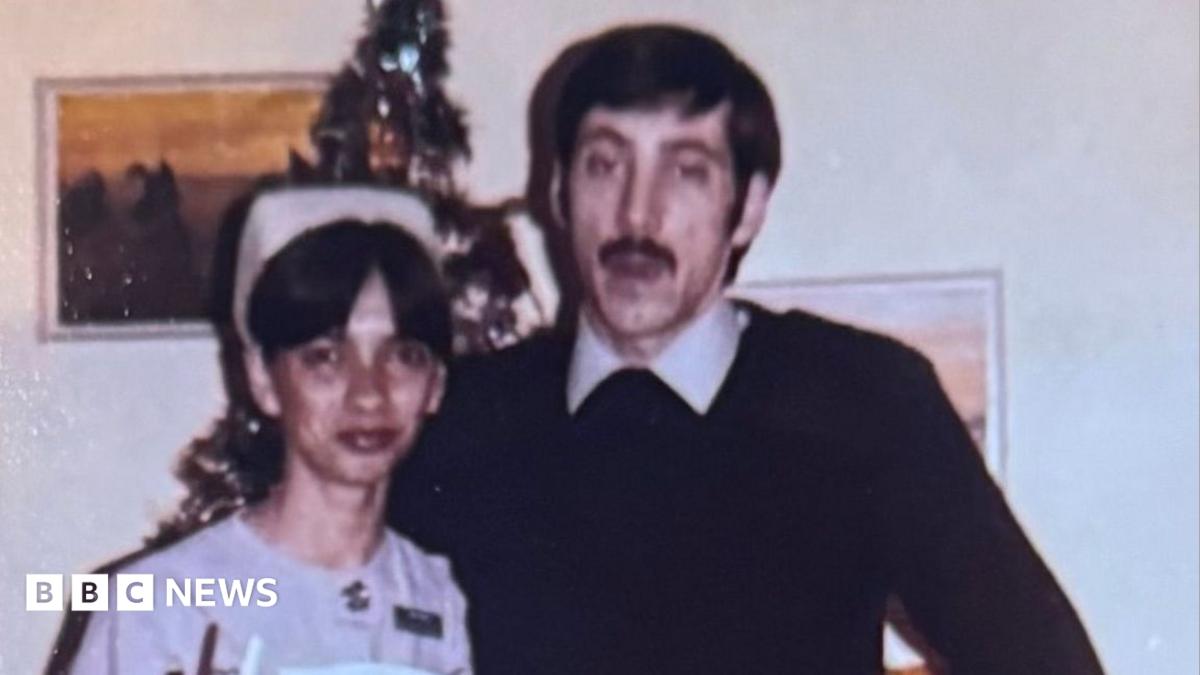
I want to know if toxic lagoon fire caused my husband's rare deadly cancerImage source, Jilska WilliamsImage caption, Firefighter Steve Williams, pictured here with his widow Jilska, died of a rare lung cancer 14 years after falling into a toxic lagoonBySteffan MessengerWales environment correspondent and Lucy BallingerBBC WalesIt was a sight which struck terror into the firefighters called to tackle it - a blazing chemical waste lagoon on fire, with barrels exploding into the air.Steve Williams, then in his 20s, was one of 60 firefighters sent to tackle the burning Llwyneinion lagoon in August 1980, which was sending thick black smoke over a nearby village.Steve slipped in and, although he was pulled out, his widow thinks what he swallowed may have cost him his life from a rare form of lung cancer aged 39. She said "someone should be held accountable".Wrexham council, which owns the site, said while it did not meet the legal definition of "contaminated land", it regularly inspected and monitored the area.Figure caption, It took 60 firefighters about 18 hours to bring the 1980 fire at Llwyneinion lagoon under controlA leading expert in fire chemistry and toxicity said it was difficult to establish a link between firefighters' exposure to chemicals and health issues later in life.Steve's widow Jilska Williams believes the father-of-two's terminal cancer could have stemmed from the chemicals at the fire at the former toxic waste dump near Wrexham in north Wales."It's a definite probability," said the 71-year-old. "They're firemen and they're always running into fires, so you don't know what the long-term effects are going to be - but actually falling into the lake and drinking that fluid, which is full of chemicals. He had a double-whammy, didn't he?"Steve's family are part of a group which came forward after the BBC documentary Buried with Michael Sheen highlighted Wales' toxic waste legacy.Image source, Jilska WilliamsImage caption, This is the last family photo of Jilska and Steve Williams, with their children David and Kelly, taken in June 1994, shortly before he was diagnosed with terminal lung cancerThey want surviving firefighters to be tested for deadly carcinogens they fear they were exposed to in the fire at the Llwyneinion lagoon.Eleven firefighters or their families have told a BBC investigation about concerns the fire could have had an impact on their health.They said there was an increased number of miscarriages suffered by partners of those who attended the fire in the year after - and also highlighted concerns about rates of cancers since.Steve followed his dad into the fire service in 1978 and his first posting was in Wrexham, where he was among the first responders to the lagoon fire.Buried with Michael SheenWhat is the truth lying beneath our feet? Michael Sheen uncovers claims of conspiracy, complicity and denial over alleged toxic 'forever chemical' contamination in south Wales.Jilska said he was checked at hospital after falling in, then given a tetanus injection before being sent home."What is a tetanus injection going to do for him?" said the retired nurse. "It was a disaster waiting to happen. A time bomb waiting to go off, as far as I'm concerned."The couple moved to Melbourne in Australia, then in 1994 Steve was diagnosed with stage four cancer – small cell carcinoma - and given weeks to live.He died three days after the couple's 17th wedding anniversary. Their children were aged six and 10.The Llwyneinion site was a dumping ground for chemicals suspected to have included cancer-causing polychlorinated biphenyls (PCBs) from chemical giant Monsanto. Sheen's Buried programme team found elevated levels of PCBs in soil samples taken in an area open to the public beyond the fenced-off lagoon, as well as at 13 other suspected dumpsites for the firm's toxic waste across the country.Image caption, Footage from a BBC news report in August 1980 shows the extent of the toxic waste dump fire at the Llwyneinion lagoonPCBs were once widely used in things like lipsticks and white goods - and were liked for being non-flammable and hard to break down.But today they are seen as the first "forever chemicals" which are building up in the environment, threatening wildlife and human health.The Llwyneinion lagoon was purchased by the then Clwyd County Council for just £1 in May 1980.Andy Moore spent the day bringing in foam to help firefighters smother the fire at the former dump - and saw Steve fall in.Andy, who was also stationed at Wrexham, said firefighters were not equipped to face the chemicals in the lagoon.Image source, Jilska WilliamsImage caption, Steve Williams, on the left, and Andy Moore, on the right, were stationed at Wrexham fire station"There was no request for chemical PPE, we were basically fighting that fire in our normal tunics, drips and helmets," said Andy, now 70."I was walking around that fire ground in a shirt and tie - I've always been concerned about what it could have done to me."I was diagnosed a year ago with skin cancer."Whether I can relate that back to this specific incident I don't know but there's too many coincidences - I talk to my colleagues and we've had a lot of our guys who have died young specifically of cancers."Image caption, The lagoon at Llwyneinion is one of 12 locations around Wales that were highlighted as historic toxic waste dumping grounds of concern in Michael Sheen's BBC documentary BuriedJim MacGrane was also a firefighter at Wrexham at that time and his wife suffered a miscarriage in the period after the fire."There were six wives that we can recall had miscarriages within 12 to 15 months of that incident," said Jim, now 71."It was highlighted by one of the guys on the station who said, 'that's not coincidence. There's something not right there'."Mark Jones and his father Ken both attended the fire and Ken later died of lymph and brain cancer in 2011.Image caption, Mark Jones and his father Ken were firefighters in Wrexham and attended the toxic waste dump fire at Llwyneinion Lake"Out of the 60 people that attended that fire a significant number had cancers or passed away with cancer," said Mark, now 68."I'd be keen to participate in some blood testing to see if there was any link because it's only recently we found out about the PCBs in the vicinity."We were fairly well looked after health-wise when we were in the service, we used to have an annual health check. Unfortunately once you've finished the service that doesn't continue."Professor Anna Stec, one of the UK's leading experts on fire chemistry and toxicity, warned it would be challenging to prove a firefighter's exposure to particular chemicals during their career had led to health issues later in life.Image caption, A group of former Wrexham firefighters who attended the Llwyneinion lagoon fire came forward to raise their concerns about the blaze"It's very difficult to link specific chemicals to health disorders and it requires a multi-disciplinary approach where we're looking at residents' exposure, their lifestyle, and so on," said the University of Leicester professor."With firefighters it's even harder," she added, as they can be exposed to "a cocktail of toxic substances" throughout their careers. But Stec said there should be more research into what happened at Llwyneinion."What we're learning from our Firefighters' Cancer and Disease Registry is that we see a pattern where there is a major fire incident - and a group of firefighters developing similar cancers. So it's definitely worth looking at."The Llwyneinion lagoon is still there, but fenced off, which has worried some of the firefighters."The actual lagoon is still there from what I can make out in the same state it was 46 years ago," said Stuart Jones. "The potential of that happening again is very clear."Image source, Jilska WilliamsImage caption, Steve Williams with his mum Phyllis, who visited from Rhyl while he was dying in Australia, and his two children Kelly and DavidThe BBC has been told the group of Llwyneinion firefighters are set to meet with representatives from the Fire Brigades' Union (FBU) later this week."We're taking this really seriously," said Gareth Tovey of the FBU.He said the union was consulting with scientists to "discuss what options we may have available to support" the retired firefighters in their search for answers.Tovey said he would write to Wales' fire and rescue services to ask about protections in place today for those called to attend an incident at sites linked to historical dumping of toxic waste.Eastman Chemical Company, which is responsible for Monsanto's legacy production in the UK, did not respond when asked to comment.Wrexham Council said while the site did not meet the legal definition of "contaminated land" under current legislation, there were regular inspections of the surrounding area and ongoing monitoring of streams and groundwater."The council is sorry to hear of the illnesses experienced by members of the fire service and their families," said a council spokesperson.Image source, BBC/Wall to WallImage caption, The lagoon at Llwyneinion is still there today but is surrounded by a fenceThe council said it took "its responsibilities for protecting public health and the environment extremely seriously" and had carried out "extensive investigations over many years" into the Llwyneinion lagoon.Wrexham council added that concerns about the health of firefighters who attended the fire were raised with their contaminated land officer twice.The first was in February 2004 by the fire officer in charge at Wrexham fire station and on another occasion by a fire officer, who was told to speak to the health authority.On the risk of another fire on the site, Wrexham council said that in 2006 advice was sought from the fire service about this, but they were told a number of "specific circumstances" would need to occur for this to happen.An emergency response plan has been drawn up, and it was revisited in 2017.North Wales Fire and Rescue Service said it was not in a position to comment on the fire in 1980.It added: "We recognise the importance of understanding the potential long-term health impacts associated with firefighting. Approaches to occupational health, wellbeing and health monitoring continue to be developed nationally as evidence, research and understanding across the sector evolve."The Welsh government announced in its draft budget on Tuesday that it would commit £2m to "kick-start a new approach to managing contaminated land"."We are developing a Wales-wide strategy to progressively restore post-industrial land," the government said in a statement."We also continue to press the UK government for funding to address the legacy of Wales's industrial past, including the remediation of contaminated land."Get in touchHave you been affected by issues raised in this story?More top stories
I want to know if toxic lagoon fire caused my husband's rare deadly cancer
Full Article
Original Source
Read the full article at Bbc →KhanList aggregates and links to publicly available news content. We do not host full articles from third-party sources. Always verify important information with original sources.