
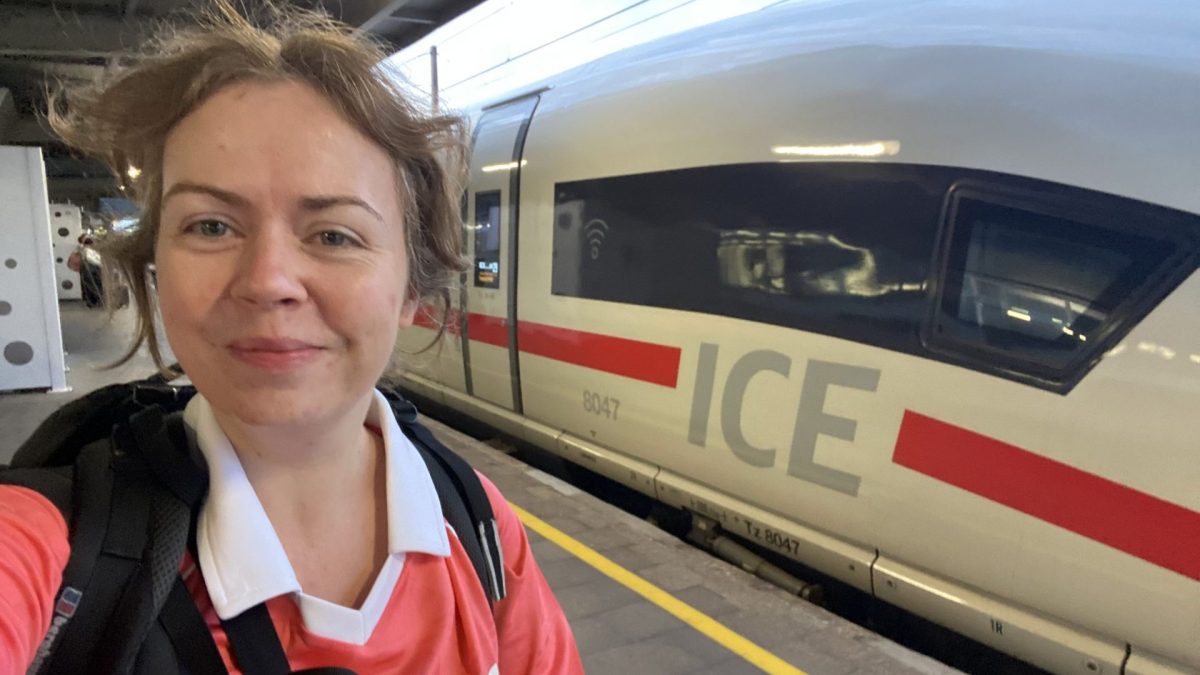
Despite being a full-time house-sitter who travels frequently, I avoid trains whenever possible. Too many delays, cancellations and eye-watering fares in the UK have taught me to take the coach instead. But with a few days to fill before a house-sit in Sweden, and fearing the long border control queues seen at some European airports earlier this summer, I decided to try Interrailing for the first time. Using Interrail’s seven-day Global Pass – which allows seven days of travel within a month – I planned stopovers in Brussels, Hamburg and Copenhagen before reaching Gothenburg. My Sheffield to London leg was also included – a real win when tickets to the capital can often be the most expensive part of any trip. At 38, I’ve made peace with the fact that I like a bit of comfort, so a first-class Interrail upgrade was just the ticket (priced at £436 vs £335 for standard class) to make the 11-train trip more bearable. Shorts My seat reservations (these are a compulsory supplement to the pass on some high-speed, international and tourist trains) came to roughly £116, the priciest being Eurostar’s £37.50 each way. However, the first-class pass meant I was entitled to Eurostar Plus, so I tucked into a light dinner of orzo chicken salad and sipped French rosé as we hurtled out of the country. In Brussels, I cooled off in air-conditioned chocolate shops before ordering a cone of hot chips slathered in tangy andalouse sauce at a popular friterie. Enjoying chips with andalouse sauce in Brussels (Photo: Emma Truscott) Outside La Bourse, the grand old Brussels Stock Exchange, a young violinist played to passers-by, her melody competing with the “oohs” and “aahs” of football fans in bars watching a World Cup match. The next day it was onward to Germany, and my train reservation was every solo traveller’s worst nightmare: a windowless window seat. Still, it wasn’t so bad. I spent the five-ish hours catching up on abandoned podcasts and watching curiously as passengers around me ordered everything from chicken tikka masala to a single bread roll from the onboard menu. It was raining when we pulled into Hamburg, but I’d ensured all my accommodation was never more than 15 minutes’ walk from a station. Keen to capture at least one memory of my short time in the city, I wandered over to Speicherstadt, the largest warehouse district in the world and a Unesco World Heritage Site, to snap a picture of the Wasserschloss (water castle) perched between the canals. Hamburg’s Wasserschloss (Photo: Westend61/Getty Images) Sightseeing box ticked, I decided to seek out some company. By using Hostelworld’s in-app chat feature, which helps guests to connect, I made plans to meet seven strangers for dinner.At pub-restaurant Frau Möller, I met fellow solo Interrailer Maeve Milliken from Northern Ireland. I tempted fate by telling her my journey had been smooth so far. “It’s the best thing I’ve ever done,” she told me over fried potatoes. “I’ve felt very empowered navigating all these countries on my own. I’m already thinking about where I can go next. Though I doubt my work will let me disappear for another two months.” The next morning, my train to Copenhagen was cancelled. I took the replacement bus and munched on a franzbrötchen (cinnamon pastry) next to an Italian woman with a Copenhagen guidebook open on her lap – at least I was on the right bus. We compared notes on our unexpected detour via Google Translate as we cruised along the graffiti-covered A1 through northern Germany. In the seaside village of Puttgarden, we boarded a Scandlines ferry to cross the Fehmarn Belt to the Danish town of Rødby. Emma on the ferry from Germany to Denmark Passengers snapping selfies on deck (of which I was one) squealed as their hats were almost lost to the wind, much to the amusement of those sipping coffee from sun loungers. Everyone seemed delighted to be out of their vehicles for the 45-minute crossing. Then it was back on the bus, tracing the yellow-green fields of southern Denmark. In the end, we were only 10 minutes behind schedule. In Copenhagen, I followed the sound of jazz to an outdoor festival, where couples of all ages twisted and turned to a four-man band in matching waistcoats. The next morning, I had time to wander through Christiania, Copenhagen’s self-governing community. “I’m consuming more water than ChatGPT,” sighed an art shop employee as her colleague slid her a cold drink. By the time of my high summer visit, Denmark had already logged six heatwave days in 2026, the highest since records began in 2011. After four days rattling across Europe, I boarded my final train to Gothenburg on the direct Øresundståg service, crossing the 16km Øresund Bridge that connects Denmark with Sweden. As we headed up Sweden’s west coast, I saw two swimmers bobbing in the shallows of the Kattegat Sea, who waved from the water as we passed. Emma in Christiania, Copenhagen On the other side of the train, vivid green farmland was broken by flashes of purple wildflowers and the occasional iron-red house. Downtown Gothenburg was humming with giddy teenagers as the Gothia Cup, the world’s largest youth football tournament, took over the city. I embraced football fever too, using my hosts’ season tickets to go to a match, where their team, GAIS, beat IF Elfsborg. When I needed a break from the buzz, I caught the ferry to Styrsö, a car-free island in Gothenburg’s southern archipelago, for a swim and a shrimp sandwich. Twelve days later, it was time to start my journey home. “Where are you going?” my taxi driver asked, on the way to Gothenburg Central at 4.30am. “London,” I replied sleepily, clutching a bag of Swedish snacks as I explained my route. This time I would be doing the entire journey in 36 hours, with just one overnight stop in Cologne.“Oh!” the driver said sharply, his eyes wide and eyebrows raised as he looked at me in the rear-view mirror. “So you go to one, two, three more countries,” he said, counting them off on his fingers. “That’s much nicer than flying.” I couldn’t help but agree. Interrail Global Pass starts at £249 for four days of second-class travel within one month. Seven days’ first-class travel costs £436.
I took a first-class Interrail trip from Sheffield to Sweden – and fell for trains
Full Article
Original Source
Read the full article at Inews →KhanList aggregates and links to publicly available news content. We do not host full articles from third-party sources. Always verify important information with original sources.